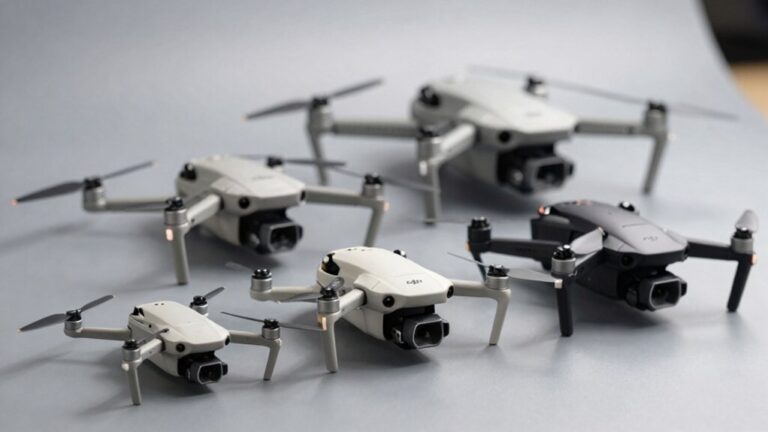
DJI’s intelligent flight batteries use lithium-polymer chemistry delivering 140-200+ Wh/kg across capacity tiers from 2400 mAh (micro drones) to 5880 mAh TB65 packs (enterprise use). You’ll see flight times ranging 20-46 minutes at nominal specs, though real-world conditions—wind, payload, temperature—reduce performance 20-40%. Each battery features multi-layered protection circuits, cell balancing, and auto-discharge safeguards. Your mission profile determines ideal selection: capacity affects endurance, discharge rates impact maneuverability, and proper storage at 40-60% charge extends lifespan beyond 200 cycles. The systems-level approach to battery management, charging infrastructure, and operational planning ahead reveals quantifiable performance gains.
Battery Chemistry and Technology in DJI Flight Systems
While consumer drones rely on various electrochemical systems, DJI’s flight platforms primarily utilize lithium-ion (Li-ion) and lithium polymer (LiPo) batteries as their main power sources. These power cells deliver exceptional energy density, ranging from 140-200+ Wh/kg by weight and 250-350+ Wh/L by volume, enabling extended flight times in compact form factors.
You’ll find Li-ion batteries dominating DJI’s consumer lineup due to their high battery efficiency and minimal self-discharge rates. Each cell operates at 3.7V nominal voltage, reaching 4.2V maximum. Advanced chemistries like LiNiMnCoO2 (NMC) in the Matrice 4D series provide enhanced stability and low-temperature performance, supporting operations between 5°C and 45°C. Professional-grade batteries incorporate intelligent self-heating systems that enable safe charging in cold environments, expanding operational flexibility for field missions.
These batteries eliminate memory effect, allowing charging at any discharge level while maintaining peak performance throughout their 400-cycle lifespan. To maximize longevity, store batteries at 40-60% charge when not in use for extended periods to prevent degradation. LiPo batteries feature a polymer electrolyte that makes them lighter and more flexible while reducing leakage risk compared to liquid electrolyte alternatives. Their high power-to-weight ratio makes them particularly suitable for racing drones and applications requiring rapid acceleration and bursts of power. Some advanced LiPo packs support rapid charging capabilities to 80% capacity in as little as 30 minutes, minimizing downtime between flights. DJI’s intelligent battery management systems monitor battery status in real-time, incorporating multiple safety protections against overcharging, over-discharging, and overheating while enabling fast charging capabilities.
Intelligent Flight Battery Variants and Capacity Options
DJI breaks down its battery portfolio into distinct form factors that match airframe mass, regulatory constraints, and mission profiles. You’ll find micro/mini series packs (2400–4680 mAh) engineered for sub-250 g drones, where every gram determines regulatory class. Standard consumer battery variants deliver 2500–5000 mAh in 3–4S configurations, balancing flight time against payload budgets for Air and Mavic families. Pro-tier TB/TB65 packs scale to 5880 mAh and 263.2 Wh, enabling hot-swap and paired operation in enterprise platforms. Capacity options directly govern endurance: low-tier (~2400–3100 mAh) yields 20–31 min, mid-tier (~3500–4700 mAh) supports 30–40+ min, and high-capacity consumer packs (~5000 mAh) achieve 40–46+ min under ideal conditions. Real-world performance drops 20–40% with wind, payload, and maneuvering. These batteries are favored for their high energy density, lightweight design, and ability to deliver extended flight times critical for drone performance. All DJI intelligent batteries require a charge temperature range of 5 ~ 40°C to ensure safe and efficient power replenishment.
Performance Metrics That Impact Flight Duration
Knowing which capacity pack fits your airframe tells only half the story—how that energy depletes under real-world load determines actual minutes aloft. Discharge profiles shift dramatically with flight regime: hover draws peak current in multirotors, while cruise at moderate speed optimizes energy per meter. Payload mass and wind force higher sustained discharge rates, reducing usable capacity at elevated C-rates. Temperature effects compound performance variability—cold cells lose 20–30% effective capacity and trigger early voltage sag, whereas hot packs accelerate aging and may activate thermal protection. Firmware imposes conservative SOC cutoffs (RTH at ~30%, critical at ~10%) that reserve margin but subtract from theoretical endurance. Controller parasitic loads and video-transmission power add continuous drain beyond propulsion. Higher altitude environments demand faster propeller rotation to compensate for thinner air density, significantly increasing power draw and reducing effective flight time compared to sea-level operation. Aggressive flying styles with rapid acceleration and complex maneuvers escalate battery drain beyond conservative flight patterns, forcing cells to sustain higher discharge rates that diminish available capacity. Battery chemistry selection plays a crucial role, as Li-ion batteries deliver higher energy density for extended flight missions compared to lighter LiPo alternatives designed for racing applications. The relationship between weight and energy consumption is nearly linear, meaning even small payload additions of 0.44 lbs (0.2 kg) can noticeably reduce flight duration as increased mass demands more thrust and higher propeller RPM. Proper storage conditions with consistent temperatures protect battery chemistry and prevent accelerated degradation between flight sessions. Batteries must be protected against short-circuiting and physical damage through proper packaging or protective sleeves whenever transported or stored. Track discharge current, ambient temperature, and cycle count to predict real flight duration accurately.
Smart Battery Features and Safety Management
Because lithium-based cells carry inherent risks when mismanaged, DJI integrates multi-layered protection circuits directly into each smart battery pack. These smart battery mechanisms include overcharge protection that halts charging at 100% capacity, preventing cell damage from excess voltage. Temperature detection enforces operational limits between 5°C and 40°C, refusing charging outside this range to avoid thermal runaway. You’ll benefit from balanced charging that automatically equalizes cell voltages, prolonging lifespan through systematic equalization. Overdischarge protection prevents excessive drain below safe thresholds, while auto-discharging drops charge below 65% after 10+ days of inactivity. The DJI GO 4 app displays all safety features in real-time, providing warning messages and status updates that enable you to monitor battery health and prevent degradation throughout your flight operations. When considering battery upgrades, ensure compatibility with your drone’s voltage requirements and physical dimensions to maintain safe operation. Proper storage at moderate temperatures with partial charge helps extend overall battery lifespan beyond standard performance. To maintain optimal battery performance, conduct a full charge and discharge cycle at least once every three months. Always use manufacturer-approved chargers to ensure safe and efficient charging that protects your battery investment. For added protection during the charging process, store batteries in fire-resistant LiPo charging bags to minimize risks associated with potential thermal events. Similar to Parrot’s approach with official smart batteries that provide specific flight times for their professional models, matching batteries to your specific drone model ensures optimal performance and safety.
Mission Planning: Balancing Weight, Endurance, and Payload
After safeguarding your battery through integrated protection systems, you’ll need to translate that healthy pack into actual mission capability—which depends on three tightly coupled variables: aircraft weight, flight endurance, and payload mass. Understanding weight trade offs is critical: DJI’s higher-capacity “Plus” batteries add 40–50 g yet deliver 30–50% more flight time on Mini-class platforms, demonstrating nonlinear scaling. Energy density (Wh/kg) determines endurance maximization—Li-ion cells at 100–200 Wh/kg outperform older chemistries considerably. Calculate usable payload as MTOW minus (airframe + battery + reserve), then validate through power models rather than manufacturer ratings. The Mini 4 Pro achieves up to 51 minutes of flight time with an optional battery while maintaining advanced omnidirectional obstacle sensing for extended mission operations. Every payload kilogram increases power draw substantially; sensors introduce both mass and aerodynamic drag. For range-critical operations, optimize cruise speed and select higher-Wh batteries to minimize swaps while respecting mass limits. Racing and performance applications may require high discharge rate LiPo batteries that can deliver up to 100C for aggressive maneuvers and rapid power demands. LiPo batteries are favored for their high power-to-weight ratio and efficiency, making them the top choice for modern drone applications across racing, FPV, and photography. Implementing proper thermal management prevents overheating during extended operations and helps maintain optimal battery performance throughout the mission. Monitor battery health regularly to recognize warning signs like reduced flight time, swelling, or rapid voltage drops that can compromise mission success and safety. Advanced semi-solid-state batteries can support 1C fast charging up to 150W without compromising safety, reducing charging time by 20% compared to conventional LiPo batteries.
Extending Battery Lifespan Through Proper Maintenance
Proper maintenance directly determines whether your DJI battery delivers 200 cycles or fails at 50—and the distinction hinges on five controllable factors: temperature management, state-of-charge discipline, cycling frequency, charging protocols, and physical care. Store batteries at 40–65% SOC in 22–28°C environments; full-charge battery storage accelerates capacity fade. Cool packs to ambient before charging—heat during charge cycles degrades chemistry. Rotate multiple batteries to distribute charge cycles evenly across inventory, and execute full discharge cycles quarterly to maintain cell activity. Use only manufacturer-approved chargers within specified temperature ranges. Inspect for swelling or deformation before each flight; retire damaged packs immediately. Never charge swollen, leaky, or damaged batteries, as compromised cells pose serious safety risks including overheating and potential fire hazards. Keep firmware updated across all batteries, ensuring >50% charge before updates. Examine battery connections regularly for corrosion or physical damage that could impede charging performance or create safety hazards. Store batteries away from metal objects like keys, coins, or screws to prevent short circuits that could damage the pack or create fire hazards. Proper charging practices can extend battery lifespan to 650–1000 cycles when combined with appropriate storage and temperature management protocols. These protocols extend cycle life predictably and prevent premature failure.
Charging Infrastructure and Field Operations Strategy
Field charging infrastructure determines operational tempo—infrastructure capacity bottlenecks limit sorties per day regardless of pilot skill or battery inventory. Charging hub selection must align with battery models: DJI multi-bay hubs (30–65W USB-C PD for Mini series, higher for enterprise platforms) enable simultaneous managed charging and firmware updates. Calculate daily energy demand by multiplying battery capacity per sortie by sortie count, then add 20% reserves for controllers. Power redundancy requires layered feeds: AC mains, vehicle inverter, and portable power stations (DJI Power 1000 provides 1024 Wh with fast SDC recharge). Deploy MPPT solar adapters where sunlight permits continuous top-up. Implement staggered charge cycles—rotate batteries through charge, cool-down, and standby states to maximize throughput without thermal throttling. Air Series charging hubs prioritize the highest power battery first, transferring power between batteries to optimize charging efficiency. For drone operations requiring precise flight control and stability, integrating high-performance MEMS IMUs like the GUIDE688B or GUIDE700 ensures optimal navigation during extended missions. For emergency field charging, you can charge batteries in-drone by connecting a USB-C charger directly to the aircraft with the battery powered off, monitoring LED indicators for charging progress. Always use manufacturer-recommended chargers or certified third-party alternatives to avoid damage and ensure safety during field operations. Maintain cold spares at 40–60% storage SOC for immediate swaps. Proper battery storage practices—keeping batteries charged between 40% and 65% in cool, dry places and cycling them every few months—help extend battery longevity and preserve capacity over the battery’s operational life.