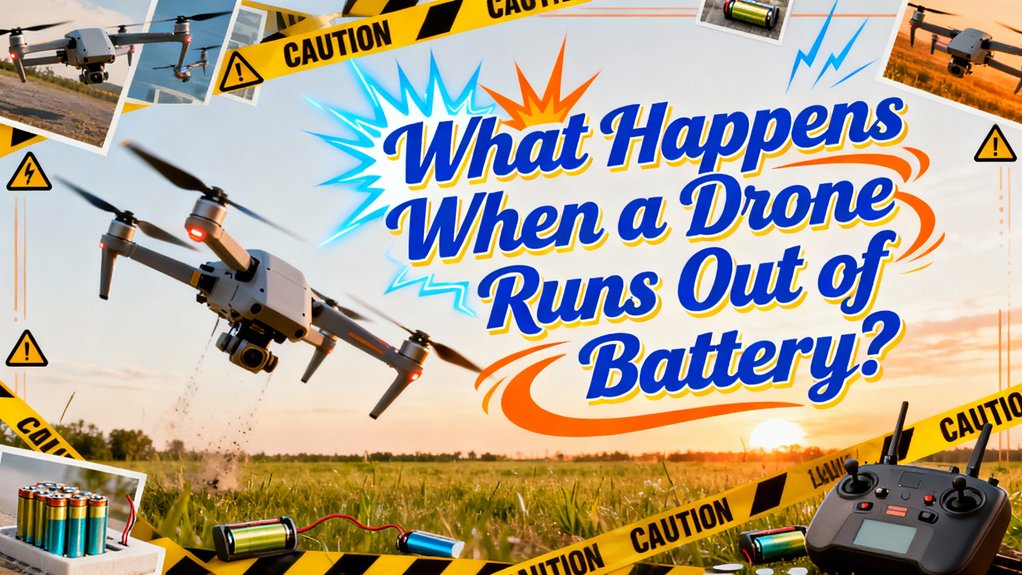
When your drone’s battery depletes, firmware-level failsafe protocols automatically override manual controls and initiate a forced landing sequence. The aircraft will attempt Return-To-Home at low-battery thresholds, then trigger Auto-Land at critical voltage levels—prioritizing descent over your commands regardless of terrain below. If power fails completely, you’ll face uncontrolled drift and potential free-fall at 32 ft/sec/sec, risking structural damage upon impact, battery cell rupture, data corruption, and complicated retrieval operations. Understanding proper battery management strategies can help you prevent these cascading failure scenarios.
Automatic Safe Landing Mode Activation
When battery voltage or state-of-charge crosses a critical threshold, most modern drone flight controllers forcibly activate an automatic landing sequence that supersedes manual pilot commands. This forced alteration bypasses your current flight mode—whether manual, GPS-hold, or autonomous mission—implementing firmware-level failsafe mechanisms that prioritize immediate descent over operational continuity. You’ll typically experience a two-tier response: low-battery warnings trigger Return-To-Home, while critical levels initiate Auto-Land regardless of distance from safe zones. The controller evaluates sensor reliability (GPS, barometer, altitude) before committing to operational protocols; if positioning data is degraded, Auto-Land executes in place rather than attempting navigation. Some platforms hold this failsafe state until you manually clear it, even after telemetry restoration, preventing premature resumption of normal flight authority. During the descent, the pilot should identify a clear spot for landing to avoid obstacles and ensure the drone touches down safely. Advanced systems incorporate smart battery management technology that monitors cell health and provides more accurate power estimates to prevent unexpected shutdowns. Smaller drones under 250 grams typically have shorter flight times due to reduced battery capacity, making battery monitoring especially critical for these lightweight models. Enterprise platforms like the DJI Mavic 4 Pro offer enhanced obstacle avoidance systems that work in tandem with low-battery protocols to navigate around hazards during emergency descents. Enterprise platforms like the DJI Matrice 300 RTK integrate sophisticated battery management with mission-planning software to calculate remaining flight time based on payload and environmental conditions. Modern drones with auto-return functionality ensure safe navigation back to the launch point when battery levels reach predetermined low thresholds.
Uncontrolled Descent and Free-Fall Dynamics
However, automatic landing protocols assume sufficient power reserves remain to execute controlled descent—a condition violated when battery depletion occurs faster than firmware anticipates. When motors lose thrust, you’ll experience immediate uncontrolled drift, especially at higher altitudes where wind gradients intensify. At 84 meters, your drone can drift 260 meters offshore despite calm surface conditions. Inertia effects compound the crisis: once free-fall begins at 32 ft/sec/sec, momentum overrides any throttle commands you attempt. Your aircraft remains upright initially but accelerates vertically as battery-starved motors fail to counteract gravity. Descent from 84 to 50 meters may restore partial control, but delayed action makes recovery impossible. Wind-driven deviation combined with gravitational acceleration creates an irreversible trajectory toward impact. Maintaining proper charging habits that avoid leaving batteries at full charge for extended periods can help prevent unexpected power failures during flight. Professional light show drones like the Lumenier ARORA address endurance challenges with 25-minute flight time capabilities and smart battery management systems to prevent mid-performance failures. Advanced drone mothership platforms can provide refueling and repair services to maintain operational readiness, but these systems require coordination and proximity that battery-depleted drones cannot achieve. Starting flights with depleted batteries significantly increases the likelihood of mid-air power failures, as drone performance degrades progressively throughout the discharge cycle. Implementing thermal management systems prevents overheating that can lead to sudden power loss and catastrophic battery failure during critical flight operations. Modern drones typically require users to access their phone’s Wi-Fi settings to establish a connection with the aircraft’s network before transmitting real-time telemetry data including battery status.
Impact Scenarios and Physical Damage
Upon impact, your drone’s structural integrity fails across multiple critical systems simultaneously. The collision crushes battery cells, creating punctures that trigger immediate safety hazards. Physical deformation causes internal shorts through manufacturing weak points, while connective debris contacts exposed terminals. You’ll notice outer pins like TXD and power connectors shear off rather than melt, preventing future charging attempts. Frayed insulation from impact allows positive-negative wire contact, escalating battery malfunction risks. The crash compresses cells beyond tolerance, initiating gas buildup and electrolyte breakdown. Damaged XT60 connectors enable dangerous lead contact. These failures compromise drone safety protocols, requiring immediate isolation in fireproof containment. Punctured cells become unstable time bombs, demanding emergency response rather than repair attempts. Impact-induced shorts necessitate professional disposal procedures. Battery chemistry type also influences the severity of crash damage, with LiPo batteries particularly vulnerable to rapid degradation after physical trauma. Extended periods without charging can cause LiPo batteries to reach a dead state, compounding damage from the initial crash. Crashes can also damage delicate sensor systems that require recalibration after any significant impact to restore proper flight stability and navigation accuracy. Inspecting battery connections for damage or corrosion becomes critical after any crash to determine if the battery can even interface with charging equipment. Damaged batteries should never be charged while inside the drone’s battery compartment, as this violates critical safety practices and increases fire risk. Using batteries not designed for your specific drone model can lead to improper fit and reduced efficiency, amplifying the risks during emergency situations or crashes.
Battery Cell Degradation and Voltage Collapse
As your drone battery ages through repeated charge-discharge cycles, chemical reactions within individual cells progressively degrade their ability to deliver rated voltage and capacity. Solid electrolyte interphase growth consumes lithium, while lithium plating during fast charging creates inactive deposits that raise internal resistance. This cell degradation manifests as capacity fade—typically reaching end-of-life at 80% nominal capacity—and pronounced voltage sag under high C-rate loads. When you demand maximum thrust, increased internal resistance produces severe IR drops that trigger ESC cutoffs or motor stalls, even when charge remains. Multi-cell packs amplify this risk: imbalanced cells force the weakest to reach cutoff first, causing abrupt voltage collapse that dictates pack-level failure. Near end-of-life, transient voltage dips during aggressive maneuvers can precipitate catastrophic loss of control. Temperature conditions significantly influence degradation rates, with capacity loss following an asymmetric V-shaped curve across the operating temperature range. Modern drones with omnidirectional obstacle avoidance systems can help prevent crashes during these critical low-battery moments by automatically detecting and avoiding obstacles even when voltage instability affects flight performance. Premium models like the Mavic 3 Pro feature multi-camera prosumer setups that offer enhanced situational awareness during compromised battery states. Enterprise surveillance models such as the DJI Matrice 4T leverage AI capabilities to optimize flight efficiency and predict battery depletion patterns during extended missions. Battery failures during nighttime operations present additional challenges, as pilots must maintain visual line of sight while monitoring battery levels and ensuring anti-collision lighting remains functional throughout the flight. To prevent premature degradation, always use a certified USB adapter rated at the appropriate voltage and amperage for your specific drone battery.
Electronic Component Failure Risks
Battery voltage collapse represents only one path to losing your drone mid-flight; electronic components themselves introduce independent failure modes that can ground or destroy an aircraft regardless of remaining charge. Electrostatic discharge (ESD) events deliver thousands of volts in nanosecond pulses, destroying microcontrollers, sensors, and communication ICs—either immediately or as latent defects. Inadequate TVS diode protection on USB and charging ports allows voltage spikes to propagate into flight controllers, causing semiconductor junction breakdown in power-management ICs. Component degradation accelerates when loose connectors produce sudden power interruptions or corroded pins raise contact resistance, generating arcing and heat. ESC MOSFETs overheat under excessive current draw, triggering thermal runaway. Cold solder joints crack under vibration, creating intermittent opens that precipitate motor failure. Firmware incompatibility between flight controllers and ESCs can disrupt motor timing algorithms, causing erratic thrust output or complete motor shutdown during critical flight phases. Military-grade loitering munitions like the Shahed-136 utilize commercial off-the-shelf components that demonstrate how standardized electronics enable mass production, though civilian drones face similar vulnerabilities when these components fail. Modern FPV systems rely on digital video transmission technologies that can also fail due to component degradation, causing pilots to lose visual feedback during flight. High-end models equipped with LiDAR obstacle avoidance depend on these sensors to navigate safely, yet component failure can disable collision prevention entirely during low-battery return-to-home sequences. Each failure mechanism compounds low-battery risks, transforming routine voltage sag into catastrophic system loss.
Search and Retrieval Complications
When your drone loses power in remote terrain, the complications multiply beyond simple equipment failure—retrieval operations demand pre-positioned battery readiness that most operators haven’t established. Search protocols require replacement batteries maintained at 3.8-3.85V per cell for immediate deployment, yet full charges degrade after 10 days. You’ll face a critical trade-off: batteries need one-hour preparation for callouts, while cold temperatures trigger mid-flight failures during recovery operations. Fire-resistant transport bags become mandatory when shuttling charged units between vehicles. Deep discharge below 2.5V per cell creates fire risks during retrieval, and swollen batteries demand immediate disposal. Recovery operations expose firmware detection failures and SOC calibration errors that prevent successful search missions when you’ve only performed partial charges. Batteries over 95% may have overcharge protection triggered and should be discharged below 90% before recharging for deployment missions. If your drone crashes on someone else’s property, you’ll need to retrieve it legally rather than risk trespassing, as property owners cannot legally shoot down drones under federal law—even when the equipment lands on their land. Professional operators conducting large-scale operations may require FAA approvals before launching recovery missions in certain airspace classifications. Vehicle-mounted inverters enable 30-45 minutes charging en route to the crash site, providing partial power restoration during transit to the recovery location.
Data Loss and Flight Log Corruption
Beyond the physical challenge of recovering a downed aircraft, battery depletion destroys the digital evidence you need to diagnose what went wrong. Mid-air voltage drops corrupt in-flight logs, while sudden power loss leaves flight records incomplete. You’ll face severe data recovery challenges when crashes damage SD cards or when improper extraction creates formatting errors. Telemetry corruption risks escalate during precipitous power failures—your flight controller can’t maintain log integrity when systems go offline unexpectedly. Swapping cards between drones compounds these issues through formatting mismatches. Environmental factors worsen the situation: temperature extremes degrade card contents, saltwater contact renders storage unrecoverable, and field operations without protective cases increase corruption probability. Cold temperatures particularly accelerate battery failure, as freezing conditions can reduce battery capacity and trigger premature shutdowns that compound data corruption risks. Most consumer drones provide only 20-40 minutes of flight per charge, meaning pilots must plan data backup windows carefully to avoid losing critical footage when power runs out unexpectedly. Professional operators conducting solar panel inspections rely on thermal imaging drones to detect anomalies, making flight log preservation essential for correlating visual defects with precise location data. Transferring data to the cloud immediately after each flight session prevents catastrophic loss when battery failures strike. Maintaining proper FAA drone registration ensures compliance while protecting your investment in flight equipment and data recovery systems. Enterprise platforms equipped with redundancy features offer failsafe protections that preserve critical flight data even during catastrophic power loss events. Human error remains the primary cause of lost footage data.
Long-Term Battery Capacity Reduction
Every flight you complete chips away at your battery’s maximum capacity through irreversible chemical degradation. Cycle wear accumulates with each charge-discharge sequence, causing electrode material stress and electrolyte breakdown that permanently reduces storage capability. You’ll notice capacity loss accelerating when you over-discharge below 3.7V, as severe voltage drops damage internal chemistry. Temperature extremes compound this degradation—cold conditions increase internal resistance while heat causes electrolyte evaporation and lithium plating. High discharge rates further stress battery components, shortening operational lifespan. Track your usage metrics and rotate multiple batteries to distribute cycle wear evenly. Overcharging creates heat spots and dendrite formation, while improper storage with moisture exposure accelerates corrosion. Real-world testing shows that batteries with over 31 charge cycles still provide reasonable flight time after extended use, though with noticeable performance degradation. LiFePO4 batteries demonstrate superior durability with exceptional cycle life often exceeding 2000 cycles, offering a more resilient option for operators seeking long-term reliability. Implement manufacturer-recommended charging protocols and maintain proper storage conditions to minimize long-term capacity reduction and preserve flight performance. When batteries become damaged through excessive degradation, they should never be shipped or transported, as damaged lithium batteries pose significant safety risks during handling. Repetitive charging cycles progressively degrade battery performance, making each subsequent charge-discharge sequence less efficient than the previous one. Budget-friendly models like the Holy Stone HS210 offer accessible entry points for new pilots learning battery management practices without major financial investment. To extend battery lifespan, store your batteries at 3.8V to 3.85V per cell when not in use rather than at full charge.
Preventive Strategies for Battery Management
Proper battery management requires structured protocols that address thermal conditions, charge states, and monitoring systems before degradation compromises flight safety. You’ll need to warm batteries to 20°C in cold weather and perform battery calibration before each flight to guarantee accurate voltage readings. Your monitoring systems should track real-time cell voltages, prompting landing at 3.5V-3.6V per cell to prevent over-discharge damage. Rotate at least three battery sets during extended operations, cycling them evenly to distribute usage pressure. Every 50 cycles or three months, discharge to 15% then fully charge to optimize lifecycle. Store batteries at 40-60% capacity (3.8V-3.85V per cell) in cool, dry conditions. Cell balancing through passive or active methods maintains uniform charge distribution across cells. During charging, monitor battery temperature and immediately stop if overheating occurs to prevent thermal runaway and potential fire hazards. Selecting batteries with appropriate C-ratings ensures your drone receives adequate burst power during demanding flight maneuvers while maintaining safe discharge rates. High-quality batteries from manufacturers like Tattu and Gens Ace offer enhanced thermal dissipation capabilities that reduce heat buildup during aggressive flight operations.