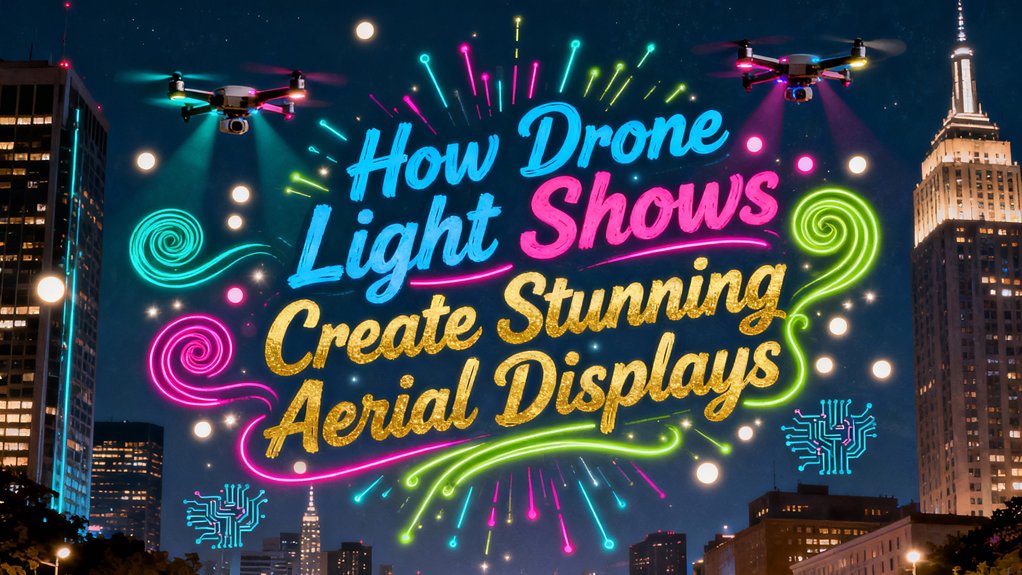
You’re orchestrating hundreds of autonomous drones executing synchronized movements through real-time GPS corrections and collision-avoidance algorithms. Each aircraft receives time-stamped mission packets from ground control, maintaining centimeter-level accuracy while LED timing synchronizes with choreographed flight paths. 3D animation software translates your artistic vision into volumetric scenes, encoding thousands of coordinate points with spatial data and RGB values. The result? A programmable canvas that transforms night skies into dynamic visual narratives. Uncover how these systems work together seamlessly.
The Evolution of Aerial Entertainment Technology
When Ars Electronica’s SPAXELS first coordinated ~20 illuminated drones over the Danube in 2012, they didn’t just create a spectacle—they proved that swarms could function as a dynamic artistic medium. You’re witnessing drones history unfold as laboratory research transformed into public performance through collaborations between art collectives and commercial agencies. Early shows relied on dozens of drones forming simple shapes, constrained by limited LED brightness and positional accuracy. By 2015, entertainment evolution accelerated dramatically. Intel’s “Drone 100” project and subsequent Olympic displays demonstrated coordination of 100+ drones, legitimizing commercial viability. Dedicated companies emerged offering integrated hardware, software, and operations services, with more than five companies now producing drones and software specifically designed for light show performances. Professional options like UVify IFO drones have become the industry standard for reliability and precision in large-scale shows. Advanced surveillance drone models such as the DJI Matrice 4T demonstrate how thermal imaging and extended range capabilities continue to push the boundaries of aerial technology across multiple applications. Simultaneously, technological advances—brighter LEDs, extended battery life, robust RTK positioning, and real-time collision avoidance—enabled increasingly complex aerial choreography. These capabilities have made possible the hybridization of drone displays with complementary effects like fireworks, lasers, fountains, or projections, all synchronized through timecode technology for unified multi-sensory experiences. Operators must also comply with FAA regulations and local ordinances when conducting these performances over populated areas. Each drone is programmed with precise flight paths and synchronized color changes to create the intricate patterns audiences see in the night sky. You’re observing how systematic innovation transformed experimental art into regulated commercial entertainment.
Understanding Drone Synchronization Systems
As hundreds of drones move in perfect synchronization—executing split-second maneuvers across expansive airspace—you’re relying on orchestrated systems that operate at multiple architectural levels. Centralized ground-control architectures dispatch time-stamped mission packets, while hybrid models blend ground authority with onboard autonomy for responsive local corrections.
Positioning systems leverage Real-Time Kinematic GNSS combined with sensor fusion—IMU, barometer, optical flow—ensuring centimeter-level accuracy even during satellite signal degradation. Dual-GNSS receivers and multi-constellation support maximize redundancy. RTK GPS systems mitigate urban GPS reliability issues by providing accurate positioning even in environments with signal obstruction. Each drone receives continuous position corrections through radio signal transmission from ground control stations to maintain precise flight paths. Advanced micro drones increasingly integrate obstacle avoidance systems like LiDAR to enhance safety during coordinated aerial maneuvers. Maintaining optical clarity during these complex maneuvers is equally critical, which is why many operators employ ND filters to control exposure and reduce glare that could interfere with visual tracking systems.
Communication protocols prioritize low-latency telemetry using compact, time-stamped packets across reserved channels. Mesh networking maintains connectivity when direct links fail. Preloaded mission scripts reduce dependence on continuous bandwidth. These protocols enable decentralized collaborative decision-making that allows drones to autonomously respond to dynamic conditions while maintaining formation integrity. For younger operators or educational demonstrations, simpler one-button takeoff systems provide foundational understanding of basic drone coordination principles.
Collision management integrates precomputed non-intersecting flight paths with temporal separation guarantees and real-time local avoidance algorithms, while health monitoring synchronizes fail-safe behaviors into the performance timeline.
The Art of 3D Animation and Programming
Translating synchronized drone movements into visual spectacle demands a sophisticated fusion of artistry and computational precision. You’ll start with 3D modeling software like Houdini or Blender, converting your conceptual designs into volumetric scenes. Your animation techniques translate drawn images into thousands of coordinate points representing individual drones. Each formation gets encoded with spatial data—X, Y, Z coordinates paired with RGB color values—formatted into binary files the drone swarm software interprets. You’re not simply animating; you’re orchestrating autonomous machines through real-time trajectories. The software automatically enforces speed limits and collision avoidance while maintaining your artistic vision. GPS and real-time positioning systems enable the precise placement necessary for complex three-dimensional formations in the sky. Professional drone show operations require RTK GPS systems to achieve the sub-meter accuracy needed for seamless aerial choreography, similar to the precision standards utilized in survey-grade 3D modeling applications. For truly immersive aerial displays, FPV drone models can be incorporated to capture the drone show from unique vantage points. Beyond aerial displays, drone technology serves critical functions in environmental monitoring and other essential applications across multiple industries. Similar to how camera resolution and low-light systems enhance underwater drone visibility in inspection work, high-precision optics and positioning enhance aerial drone show visibility. You’ll verify everything through 3D renderings before deployment, ensuring perfect alignment between your creative intent and the drones’ programmed flight paths.
Preparing Drones for Optimal Performance
Your programmed formations mean nothing without hardware that’ll execute them flawlessly. You’ll need to master battery management—swapping 2S 3000mAh LiPo cells between flights to maintain peak performance. Each battery configuration delivers 20C to 45C discharge rates, powering your drones’ motors and LED arrays simultaneously.
Hover time’s your operational window. You’re targeting 18 to 35 minutes per flight, so you’ll calculate battery capacity against formation complexity. Pre-show testing validates everything: verify LED modes—breath, flash, quick—and confirm RTK GPS positioning accuracy to 6cm tolerances. The 16.7 million color gradations available in your display system allow you to create visually stunning transitions between formations. Low-latency transmission systems like OcuSync 4 ensure your commands reach each drone without delay during synchronized sequences.
You’ll monitor power levels in real-time through ground control stations, adjusting speed and luminous output dynamically. Your 270g to 540g frames handle wind up to 20mph within your 500m altitude envelope. Consider drones with omnidirectional obstacle avoidance capabilities to ensure safety during complex choreographed sequences in populated areas. Always verify you have the correct charger compatibility for your specific battery model before each flight cycle. This preparation transforms theoretical choreography into aerial reality.
Real-Time Coordination and Execution
Once your drones launch, they’re executing a precisely choreographed timeline that you’ve embedded into each frame’s autonomous flight controller. Real-time execution relies on sub-centimeter positional accuracy via GNSS-RTK corrections and deterministic scheduling across your swarm. Each drone follows timestamped waypoints autonomously, minimizing dependency on continuous ground commands.
Your synchronized flight depends on edge computing running critical control loops locally while mesh networking enables peer-to-peer state sharing for cohesion. Onboard sensors continuously correct micro-deviations, maintaining visual choreography without breaking formation. Simultaneously, your ground-control station monitors telemetry and can transmit overrides if anomalies emerge. These advanced sensors work alongside artificial intelligence to enable real-time decision-making that keeps your swarm perfectly coordinated. Modern foldable drones with integrated camera systems like the DJI Mini 5 Pro demonstrate the compact sensing technology that can be adapted for swarm operations. Redundant RF channels with multi-band radios guarantee communications persist through partial link loss, while failsafe protocols trigger autonomous return-to-home if thresholds breach. The RQ-4 Global Hawk’s extended endurance capabilities demonstrate how modern UAVs achieve the sustained flight times necessary for complex aerial operations. Partitioning architecture isolates different software components across your control systems to enhance reliability and safety during execution. Be aware that drone operations are comprehensively banned in national parks under federal policy, so ensure your light show venue complies with all applicable regulations. For optimal nighttime visibility during your choreographed swarm performance, consider incorporating built-in LED lights to enhance each drone’s position in the formation while maintaining clear sightlines for ground observers. This layered autonomy transforms your vision into flawless aerial reality.
Creating Visual Effects and Formations
The choreography of drone light shows transforms static formations into living narratives through meticulous spatial design and real-time color manipulation. You’ll layer drone subgroups at varying altitudes to create aerial depth and parallax effects that suggest three-dimensional volume. Dynamic gradients emerge when you assign per-drone RGB values and strobing patterns across swarm clusters, producing flowing ribbons and morphing shapes through particle animation techniques. Your synchronized changes rely on easing curves and temporal offsets that eliminate abrupt visual jumps between formations. LED modulation—controlling brightness, beam angle, and color sequencing—enables complex visual effects beyond single-LED limitations. You’ll employ high-frame-rate time-sliced color mixing to render intricate shades and spatial illusions. This visual choreography demands precise timing: each drone receives discrete mission segments with exact start/end positions, ensuring your formations cohere into cohesive, legible imagery across vast viewing distances. Professional drone light show systems benefit from stabilization technology similar to that found in advanced camera gimbals to maintain precise positioning during complex aerial maneuvers. Modern drone light shows leverage omnidirectional obstacle avoidance systems to safely navigate crowded airspace while maintaining formation integrity. Leading companies like DJI have pioneered the drone technology and innovation necessary to support sophisticated swarm coordination and synchronized light display capabilities. These performances typically utilize large commercial drones capable of extended flight times and advanced sensor integration for coordinated swarm operations. Many drone light shows are free to watch despite the significant technical complexity and production costs involved. The 3D animation software you use to design these flight paths and choreography must undergo rigorous testing to ensure flawless execution and safety during performances.
Safety Protocols and Collision Avoidance
While choreographed light displays demand exquisite visual precision, the operational reality of coordinating dozens or hundreds of autonomous aircraft requires an equally rigorous safety infrastructure. You’ll implement multiple geofencing layers that create invisible barriers, preventing unauthorized flight paths and ensuring drones remain within designated airspace. Real-time collision detection systems track each aircraft’s position, instantly identifying interference or malfunctions. You establish strict sterile zones and buffer areas excluding spectators and vehicles, maintaining operations below 400 feet AGL over restricted-access regions. Your emergency protocols—including return-to-home functions, soft landings, manual override capabilities, and kill-switches—activate immediately if anomalies emerge. Authorization from civil aviation authorities must be obtained prior to drone show operations, typically requiring two to four weeks of advance planning and coordination. You coordinate no-fly zones around venues, avoiding manned aircraft interference. Advanced systems utilize sensor fusion techniques that integrate multiple detection modalities to monitor airspace and enhance situational awareness throughout the performance. These multi-rotor drones can be equipped with extended battery life systems to ensure sustained flight duration and precise coordination within the swarm formation. Lightweight drones with rechargeable Li-Ion batteries provide operators with reliable power sources for extended coordinated operations. This thorough safety architecture transforms autonomous drone swarms into predictable, controlled systems capable of delivering breathtaking aerial performances.
Sound Design and Musical Integration
As you choreograph hundreds of synchronized drones across the night sky, you’ll reveal that visual spectacle alone remains incomplete without sonic architecture that binds movement to emotion. You’ll establish your musical structure first, then program each drone’s trajectory and LED timing to match precise audio moments. Using software like Houdini or Blender, you’ll assign individual flight missions with color changes synchronized to key musical shifts. Your sunset harmonics emerge through ambient layers—combining low ominous drones with warm, peaceful tones that create emotional flexibility. You’ll apply compressors, dual delays, and modulation effects to enhance spatial depth. This technical integration guarantees your drones respond autonomously to crescendos, color changes, and fireworks, transforming synchronized flight into a multisensory experience. Modern drone systems like the DJI Matrice 600 Pro offer the industrial-grade reliability and extended flight times necessary for executing complex synchronized aerial choreography in large-scale productions. Flight control software enables precise drone path coordination to maintain synchronization throughout the entire performance. Reliable LiPo batteries provide the high power-to-weight ratio necessary to sustain the rapid maneuvers and LED operations required during coordinated light show sequences. Modern DJI drone models deliver the advanced stability and extended flight times essential for executing complex synchronized aerial choreography. For major events, budget considerations are essential, as large-scale productions with 500 or more drones often exceed $100,000 in total costs. Drone light show performances represent a growing segment of the commercial drone market, which is expanding at 20.8% annually as businesses recognize the profitability potential of specialized aerial entertainment services.
Customization Options for Events and Audiences
Once you’ve established your sonic foundation, you’ll transform your drone fleet into a canvas for event-specific narratives that resonate with your audience’s identity and occasion. You can customize designs through 16 million color possibilities, enabling precise brand integration and thematic alignment. Your storyboard timeline orchestrates images, effects, and shifts into synchronized flight paths that amplify audience engagement.
You’ll choose between stock visuals for budget-conscious selections or fully custom designs reflecting your event themes. Whether incorporating company logos, couple initials, or festival motifs, you control complexity levels. Pre-visualization videos grant approval before execution, ensuring your aerial narrative matches your vision exactly. For drone light shows, consider using sub-250g drone models that offer excellent flight stability and GPS positioning for reliable performance. This flexibility lets you create immersive experiences that genuinely connect with spectators, whether corporate stakeholders, wedding guests, or concert attendees. Typical show durations range from 3 to 12 minutes depending on your event needs and desired narrative depth.
The Future of Drone Light Shows
The drone light show industry’s trajectory points toward a convergence of artificial intelligence, massive swarm capabilities, and immersive technologies that’ll fundamentally reshape aerial entertainment. You’ll witness AI-driven choreography generating dynamic formations in real-time, while swarm intelligence enables thousands of drones to self-organize without central control. Machine learning algorithms’ll adapt shows based on crowd behavior and environmental conditions, maximizing audience engagement through personalized experiences.
Augmented reality integration transforms passive viewing into interactive spectacles, syncing drone formations with live DJ sets and hybrid displays combining lasers and projections. These AI and AR integration capabilities represent recognized growth areas within the industry. Advanced obstacle avoidance systems and autonomous tracking technology enable drones to navigate complex light show environments safely and maintain precise formations during choreographed sequences. High-quality compact drones equipped with 1-inch sensor technology demonstrate the imaging capabilities that support sophisticated visual performances during aerial displays. Proper drone performance during these complex operations requires high-capacity LiPo batteries to ensure extended flight times and reliable power delivery throughout choreographed sequences. Beyond entertainment applications, commercial delivery operations like those utilizing advanced delivery drones demonstrate the broader logistics transformation enabled by autonomous aerial systems.
These future innovations position drone shows as sustainable alternatives to fireworks, expanding beyond entertainment into corporate branding, smart city events, and environmental monitoring. Multi-rotor drones, including quadcopters and hexacopters, provide the precise hovering and control capabilities essential for executing intricate light show choreography. Market projections reaching $14.13 billion by 2030 underscore mainstream adoption across North America and Asia-Pacific regions.