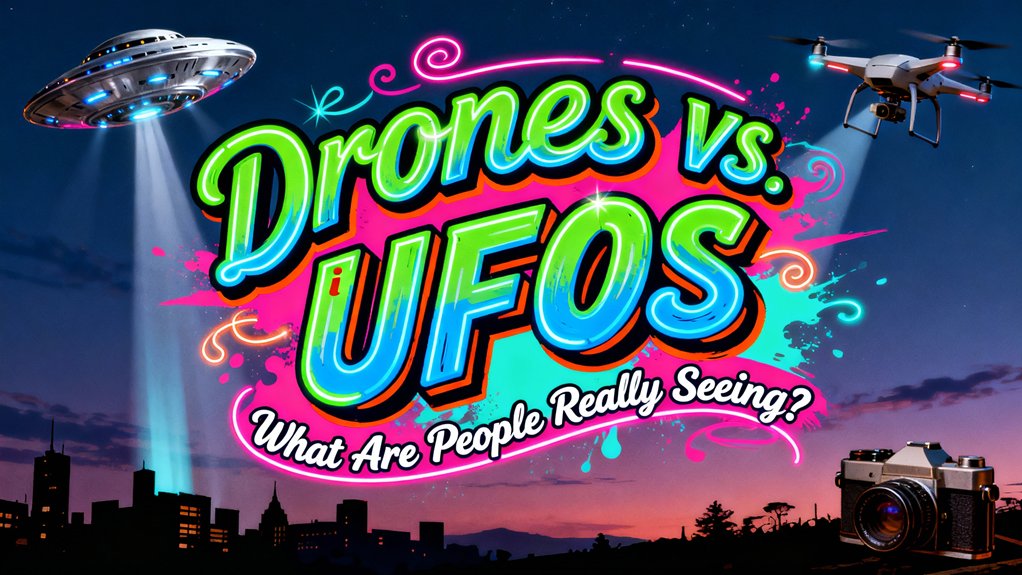
You’re likely seeing conventional aircraft, weather balloons, or consumer drones rather than anything extraterrestrial. The Pentagon’s AARO has resolved most of its 1,652 UAP cases through systematic analysis—identifying birds via infrared signatures and balloons through wind correlation data. Only 21 incidents remain unexplained, primarily near military installations. The FBI verified just 100 of 5,000+ recent drone reports as credible, while perceptual factors like altitude misjudgment and smartphone distortion create false positives. Understanding the identification methodology reveals what’s actually overhead.
The Pentagon’s Latest UAP Findings: By the Numbers
The All-domain Anomaly Resolution Office (AARO) processed 757 new UAP incident reports between May 2023 and June 2024, representing a 169% increase over the previous review period’s 281 reports. You’ll find that 485 incidents occurred during this timeframe, while 272 represent reporting discrepancies—events from 2021 and 2022 that weren’t previously documented. AARO’s total case load now stands at 1,652 incidents since its establishment.
The UAP assessment methodology employs morphology analysis, performance evaluation, and sensor reconstruction to classify encounters. Of the analyzed cases, 21 remain unexplained, particularly those near national security installations. High-confidence identifications (>95% likelihood) resolved specific 2023 and 2022 infrared videos as birds and balloons respectively, while wind speed correlation eliminated anomalous characteristics in additional footage. The majority of UAPs are likely airborne clutter or natural phenomena, according to expert assessments of the documented cases. Without clear reference points, it is difficult to judge the size, distance, and nature of objects in the sky, leading to frequent misidentification of planes, helicopters, and drones as UFOs. Military surveillance capabilities have evolved significantly, with unmanned aerial vehicles now providing the precision and reduced personnel risk that traditional methods could not achieve in monitoring sensitive airspace. Civilian drone operations face increasing scrutiny, as many state parks prohibit or heavily restrict recreational drone flights to protect wildlife and preserve visitor experiences. Most consumer drones lack waterproof protection, making them vulnerable to water damage and system failures when exposed to rain or high humidity conditions. Under a 2014 NPS policy, launching, landing, and operating drones is comprehensively banned across all U.S. National Parks to protect wildlife and preserve natural soundscapes.
Balloons and Drones: The Usual Suspects Behind Most Sightings
While spectacular explanations capture public imagination, systematic analysis of UAP reports reveals mundane origins for most sightings. You’ll find weather balloons consistently top misidentification lists due to their reflective properties and slow, drifting motion patterns. High-altitude research balloons create particularly convincing illusions when illuminated at night. Drone confusion accelerates with recreational and commercial UAV proliferation in 2024. FAA-mandated flashing lights make lawful drones highly visible during nighttime operations near populated areas. Recent data demonstrates this pattern: of 5,000+ reported drone sightings since mid-November 2024, FBI analysis classified only 100 tips as credible. The remaining cases traced to manned aircraft, stars, or routine hobby operations. Legal drone operations in populated areas require prior FAA authorization when flying in controlled airspace, meaning many legitimate flights near airports follow established approval processes. Drone operators must adhere to FAA regulations including flying below 400 feet, maintaining visual line of sight, and registering drones over 0.55 pounds. The Federal Aviation Administration enforces mandatory registration for drones weighing over 250 grams, which helps authorities track and identify legitimate operators during flight operations. A 2024 Pentagon report examining 757 anomalous sightings identified most as drones, birds, weather balloons, or satellite reflections rather than extraterrestrial craft. Many modern camera drones feature dedicated controllers that enable phone-free operation, making recreational flights increasingly common and visible to observers on the ground. Statistical evidence confirms that balloon sightings and standard drone activity account for the overwhelming majority of unexplained aerial phenomena reports. Historical records from the early 1970s show that UFO hotlines were established to help distinguish genuine anomalies from misidentified conventional objects.
What’s Really Happening in New Jersey’s Skies?
New Jersey’s aerial phenomenon timeline reveals a concentrated surge beginning mid-November 2024, with initial reports clustering near Picatinny Arsenal on November 13 before spreading systematically through Morris County by November 18, then expanding to Somerset County and the Raritan River corridor. You’re observing two distinct phenomena: conventional drone technology patterns versus unexplained UFO sightings exhibiting physics-defying capabilities. Eyewitness testimony documents objects with hypersonic acceleration and anti-gravity characteristics alongside standard hobbyist drones. The two thousand twenty-six data shows one UFO sighting weekly through early January and February, with atmospheric conditions enabling broad-daylight observations in Toms River and triangular formations in Somers Point. Federal analysis attributes most incidents to balloons and drones, yet specific cases remain unexplained, creating classification ambiguity across 40+ municipalities reporting aerial activity. Conventional drones rely on radio frequency signals transmitted from remote controllers to receivers onboard the aircraft, which differ fundamentally from the unexplained objects exhibiting anomalous flight characteristics. Most consumer drones use lithium polymer batteries that typically provide only 20-30 minutes of flight time, meaning extended aerial surveillance would require multiple battery swaps or larger commercial equipment. Advanced drones feature 3-axis gimbals that provide shake-free video capture and gyro stabilizers for precise control, which could explain some of the smoother flight patterns observed in legitimate aircraft. All drones weighing over 0.55 pounds must display a unique registration number externally, which can help distinguish legitimate recreational or commercial aircraft from unidentified objects. Recreational drone operators must pass the TRUST test to legally fly, while commercial pilots require Part 107 certification. All reported sightings have been submitted to the National UFO Reporting Center, which serves as a centralized resource for tracking and documenting these phenomena.
Why Certain Regions Report More Mysterious Objects Than Others
Geographic patterns in mysterious object reporting reveal systematic correlations with infrastructure density, environmental conditions, and sensor distribution rather than random occurrence. Regional biases cluster around military presence—you’ll find elevated reports near Area 51, Roswell, and U.S. nuclear facilities. The western United States demonstrates higher per-capita sightings due to minimal light pollution, reduced cloud cover, and expansive sight lines. Historical influences persist at culturally significant locations, reinforcing reporting culture through decades of media attention. Population density creates paradoxical effects: urban areas generate volume through observer concentration, while rural zones offer ideal environmental conditions for detection. Military presence drives 70% of AARO’s global hotspots, reflecting sensor capabilities rather than phenomenon distribution. Airport proximity correlates with increased reports, confirming infrastructure’s dominant role in shaping sighting patterns. Modern drone light shows utilizing GPS-coordinated fleets have contributed to misidentification cases, particularly in regions where such aerial displays remain unfamiliar to local populations. The proliferation of FPV drones equipped with live-streaming cameras has further complicated identification efforts, as their cockpit-perspective flight patterns can appear unusually maneuverable to ground observers unfamiliar with the technology. Commercial expansion of heavy-lift cargo drones with extended flight times exceeding 400 minutes has introduced new aerial profiles that differ significantly from traditional aircraft silhouettes, particularly during twilight observation periods. Professional-grade models like the DJI Mavic 3 Classic with 30km range capabilities can operate far beyond visual line of sight, contributing to unexpected sightings in remote areas. Emerging consumer applications including autonomous tracking systems featured in follow-me drones and experimental personal-shade devices demonstrate flight behaviors that can confuse observers unfamiliar with hovering, human-following capabilities. The Southeastern U.S. and Gulf of Mexico emerge as particularly active zones in recent Pentagon mapping of UAP concentrations.
When Drones Look Like Something Else: The Misidentification Problem
When observers scan the night sky for drones, they’re fighting against fundamental perceptual limitations that consistently produce false positives. Misidentification causes stem from multiple technical factors: aircraft approaching directly appear to hover, altitude underestimation transforms distant jets into nearby objects, and smartphone cameras compress dim lights into artifacts. Venus, planets, and meteor showers account for numerous New York City reports. The parallax effect makes stationary celestial objects seem mobile.
Psychological effects amplify these errors through predictive processing frameworks. Your brain expects drones based on media coverage, so it interprets ambiguous stimuli accordingly. Social media and institutional distrust intensify this cycle. Federal analysis of 5,000 sightings confirmed most were lawful aircraft. Law enforcement misidentified commercial jets as drone swarms, contributing to public confusion about the actual nature of aerial objects. Despite evidence, witnesses remain convinced—demonstrating how perception, not reality, drives these encounters.
Light Pollution, Smartphones, and the Limits of Eyewitness Accounts
Where you stand determines what you see—and data from 98,000 UAP reports across two decades proves this principle governs sighting patterns more than any extraterrestrial activity. Each standard deviation increase in light pollution reduces reports by 7.7%, while Western U.S. dark skies generate the highest sighting frequencies. Your smartphone compounds these eyewitness limitations through atmospheric interference that distorts captured lights, creating smartphone distortions difficult to verify against proliferating drones and satellites. Perception biases emerge when humidity, temperature gradients, and environmental particles alter light scattering unpredictably. Distance, angle, and air density transform perceived intensity and color. Tree canopy further obstructs sky views, reducing reports in vegetated areas. Cloud cover negatively correlates with sighting frequencies, as overcast conditions limit observers’ ability to detect aerial phenomena. Adding to the confusion, most drones operate under 400-foot altitude limits that keep them within the same airspace where atmospheric distortions peak, making accurate identification even more challenging. Meanwhile, agricultural and commercial drone deployment has surged, with precision agriculture applications deploying thousands of aerial vehicles for crop monitoring, soil analysis, and automated field management that frequently operate during dawn and dusk hours when lighting conditions maximize misidentification potential. Industries ranging from energy to construction now rely on drones for mapping and surveying, inspections, and photography, further saturating airspace with legitimately authorized aircraft that casual observers mistake for unexplained phenomena. Advanced platforms equipped with multispectral sensors for crop health assessment can appear as unusual light patterns to untrained observers, especially when their multiple camera wavelengths capture infrared and near-infrared bands invisible to human eyes. Agricultural drones employing GPS and sensor systems for precise application of pesticides and fertilizers create flight patterns that can resemble unexplained aerial movements to ground observers unfamiliar with automated farming operations. The data reveals visibility opportunities—not alien visitations—drive reporting patterns, with environmental conditions systematically constraining what you can observe and accurately document.
Social Media’s Role in Amplifying Aerial Mysteries
Social media platforms function as real-time amplification systems for aerial anomaly reports, transforming individual observations into viral phenomena through network effects that earlier generations of UFO witnesses couldn’t access. Analysis of 4,500 sightings reveals Twitter’s dominance with 3,459 posts, while Facebook contributed 906 mentions. November’s single-night event generated peak activity through cascading shares and retweets. You’ll notice dedicated accounts like @UFO_Research and @ufo_stalker systematically catalog reports, while witnesses tag @NASA and @POTUS to legitimize claims. This social media influence creates crowdsourced surveillance networks, though viral sightings correlate with declining verified reports—the “pictures or it didn’t happen” culture paradoxically reduces unverified submissions while amplifying documented cases. Misidentifications propagate rapidly through shares before factual corrections gain traction. The proliferation of consumer drones equipped with 8K resolution cameras has contributed to both higher-quality aerial imagery and increased potential for misidentification of conventional aircraft as anomalous objects. Recent reports from the East Coast describe brightly lit drones hovering over residential areas and critical infrastructure, with some incidents disrupting emergency services and causing significant public concern. Advanced waterproof drones with 4K cameras and extended flight times now enable aerial photography in diverse weather conditions, further complicating the identification of objects captured in marine and wet environments. Budget models under $100 with basic cameras and flip features have democratized aerial photography, exponentially increasing the number of flying objects that civilians might mistake for unexplained phenomena. Professional-grade drones utilizing power distribution boards with 400A peak current handling and support for 12 motors enable extended flight durations that increase the likelihood of public sightings in populated areas. Gender patterns emerged across state lines, with males dominating UFO discussions in Delaware and Connecticut, while Hawaii and South Carolina showed higher female participation in reporting sightings.
The Surge in UAP Reports: Destigmatization or Drone Proliferation?
Between 2019 and 2023, formal UAP reports increased 407% across military channels and 312% in civilian databases, a surge driven by two parallel mechanisms: institutional destigmatization reshaping who reports, and exponential drone proliferation reshaping what gets reported.
You’re witnessing regulatory expansion through AARO and mandated reporting channels, while FAA guidance now distinguishes lawful operations from incidents. Congressional hearings reduced stigma, prompting military sightings that previously went undocumented. The National UFO Reporting Center collects and investigates these reports as they flow in from diverse sources. Simultaneously, consumer drone registrations tripled, flooding airspace with LED-equipped platforms whose loitering and swarming behaviors match classic UAP descriptions. Affordable models like the DJI Mini 3 now offer extended flight times up to 51 minutes, enabling prolonged aerial presence that can be mistaken for unexplained phenomena.
The data shows correlation: regions with highest drone density report 340% more “anomalous” incidents. Enhanced sensor retention policies and remote ID mandates further inflate counts as unlawful drones near sensitive airspace trigger automated logs. You’re seeing surveillance infrastructure capturing more objects, not necessarily more anomalies. Many witnesses attempting to investigate these aerial objects establish smartphone connections to their own drones to capture footage and monitor the suspicious activity in real-time. Modern drones equipped with hand-control features allow operators to launch and track objects without visible physical controllers, further complicating visual identification of legitimate drone activity versus unexplained phenomena. Property owners confronting suspicious aerial activity should understand that airspace above private property is federally regulated by the FAA, not owned by landowners, making self-help remedies illegal and potentially dangerous. Commercial drone pilots have capitalized on this expanded airspace activity by offering aerial photography services for real estate, tourism, and infrastructure inspection, creating a lucrative industry that further increases legitimate drone traffic in contested zones.
Nuclear Sites and Sensitive Infrastructure: A Pattern Worth Noting
Since 1945, over 150 documented incidents involving unidentified aerial phenomena have clustered around nuclear weapons facilities, creating what researchers call the “nuclear correlation”—a pattern that’s either the strongest evidence of non-human surveillance or the most predictable consequence of observation bias at high-security sites.
You’ll find nuclear anomalies reported at Malmstrom AFB, Fukushima, and multiple power plants worldwide. AARO received 18 reports from the Nuclear Regulatory Commission, attributing them to drones. This raises critical defense implications: are foreign actors conducting systematic surveillance, or do heightened security protocols simply catch more conventional objects?
The surveillance concerns are legitimate—recovered drone wreckage near facilities confirms intrusion attempts. However, reporting accuracy suffers from detection bias. Nuclear sites maintain intensive monitoring systems that capture events ignored elsewhere, statistically guaranteeing clusters around defended infrastructure. Modern surveillance drones equipped with GPS positioning systems can achieve ranges up to 500 meters and altitudes of 120 meters, making them capable of detailed reconnaissance missions around sensitive installations. Advanced systems like the DJI Matrice 350 RTK extend capabilities with thermal imaging cameras that enable low-light operations at ranges up to 20km, making covert nighttime surveillance of critical infrastructure increasingly feasible. Professional drone swarms featuring ultra-bright LEDs and precision control software can create coordinated aerial displays, technology that shares operational similarities with sophisticated reconnaissance platforms. Extended surveillance operations require high-capacity LiPo batteries like the 5200mAh versions that enable prolonged flight times over sensitive installations. These incidents extend beyond visual observations to include malfunctions of nuclear missiles, with documented cases at Warren Air Force Base where UFO sightings coincided with communication blackouts affecting missile systems.
What Science Says About Extraordinary Claims
When examining extraordinary claims through scientific methodology, you’ll find a consistent pattern: systematic investigation collapses dramatic narratives into mundane explanations. The Robertson Panel, Condon Report, and multiple intelligence assessments subjected thousands of sightings to scientific scrutiny—none yielded extraterrestrial evidence. The data reveals 90% of cases resolve to astronomical phenomena, human-created objects, or atmospheric effects.
The principle remains straightforward: extraordinary evidence demands extraordinary proof. Ball lightning, lenticular clouds, and nuclear test debris account for previously puzzling observations. While 10% of cases remain unexplained, “unexplained” doesn’t equal “extraterrestrial”—it indicates insufficient data. Each investigation demonstrates that rigorous analysis transforms mystery into mechanism, revealing atmospheric physics rather than alien technology. Historical data analysis faces additional complications when researchers work with photographic copies rather than original plates, as artifacts from the reproduction process can create spurious detections that mislead interpretation.