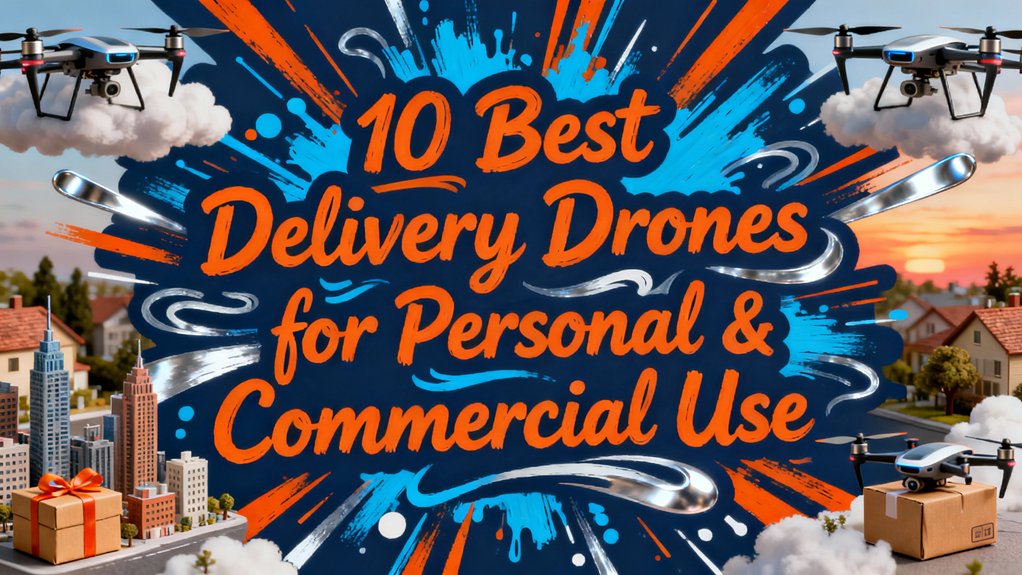
You’ll find the top delivery drones span from Zipline’s fixed-wing models reaching 150 km/h across 100-km medical routes to DJI’s FlyCart 100 handling 149.9 kg payloads. Amazon Prime Air MK30 delivers 5-pound packages within an hour using redundant navigation, while Wing manages 32 drones per pilot with sub-19-minute deliveries. Skydio X10 navigates GPS-denied environments with 360° obstacle avoidance, and Volansi VOLY C10 transports 10 pounds across 50 miles for cold-chain logistics. Each platform addresses distinct operational requirements through specialized capabilities you’ll want to understand before selection.
Zipline Drones – Long-Range Medical and Essential Deliveries
How do you deliver a unit of blood to a remote clinic 80 kilometers away in under 30 minutes? Zipline’s fixed-wing electric drones solve this medical logistics challenge through autonomous operations at speeds up to 150 km/h. Their Platform 2 system serves a 100-km radius from hub-and-spoke distribution centers, delivering blood, vaccines, and temperature-sensitive cargo via precision parachute drops—no landing required.
Rwanda deployments demonstrate measurable impact: 61% faster blood deliveries and 67% reduction in product expirations compared to ground transport. The cold-chain capability maintains frozen plasma and vaccines at required temperatures. Integration with clinical workflows via SMS enables immediate sortie generation, with 43% of orders classified as emergency-urgent. Automated launch and recovery systems achieve high sortie rates across national-scale healthcare networks. Like consumer drones such as the Vivitar DRC-188, Zipline’s systems utilize rechargeable battery technology to power extended flight operations, with gimbal stability ensuring payload integrity during transport.
Zipline operates from distribution centers that each cover a 20,100km² service area, enabling equal access to medical deliveries across large regions. The company has conducted over 40,000 commercial flights since inception, establishing itself as the only drone delivery company with national scale operations in Rwanda and Ghana. With over 1.4 million deliveries completed through their Platform 2 system, Zipline has demonstrated the viability of autonomous drone logistics for critical medical supply chains. By enabling targeted delivery of vaccines and other temperature-sensitive medical supplies, Zipline’s drones significantly reduce resource consumption and waste in healthcare distribution networks. Point-of-care diagnostics and organ transport capabilities further expand the scope of emergency medical applications beyond traditional supply delivery.
Amazon Prime Air MK30 – Urban Package Delivery With Advanced Safety
Amazon’s MK30 drone represents a complete architectural redesign optimized for urban last-mile delivery, achieving FAA certification for beyond visual line of sight operations in October 2024. You’ll benefit from industry-leading sense and avoid technology that detects people, pets, and obstacles like trampolines through in-flight cameras and machine learning algorithms. The platform delivers packages up to 5 pounds within one hour, doubling previous range capabilities while operating in light rain and expanded temperature conditions. Custom-designed propellers reduce perceived noise by 25% during descent, making urban delivery operations quieter than typical neighborhood sounds. Safety features include fully redundant navigation, control systems, and a separate monitoring computer that prevents single-point failures. The drone utilizes vertical take-off before transitioning to horizontal flight for efficient cruise performance, a design approach common among multirotor vs. fixed-wing cargo platforms optimizing for urban environments. Like other leading delivery drones such as the DJI FlyCart 30, the MK30 emphasizes operational versatility and cost-effective transportation across diverse urban terrains. The MK30’s autonomous tracking capabilities ensure precise package placement and real-time route optimization during delivery operations. For comparison, consumer-focused drones like the Sharper Image 10 Mach X demonstrate how streaming camera technology enhances situational awareness, though delivery platforms prioritize advanced obstacle detection over recreational video capabilities. While advertised maximum transmission ranges are achieved under optimal conditions, regulatory and legal line-of-sight limits still apply to all drone operations. After 6,300 test flights totaling 1,070 hours, it’s deploying across U.S. locations, Italy, and the UK.
Wing Delivery Drone – Suburban Retail and Food Delivery
While Amazon focuses on urban markets, Wing’s delivery drone system targets suburban retail environments through strategic partnerships with major retailers like Walmart and Walgreens. Their autonomous navigation technology enables flights at 60 mph and 150 feet altitude, covering 12-mile round trips with payload management up to 2.5 pounds. Delivery efficiency averages under 19 minutes, with one pilot overseeing 32 drones simultaneously—addressing regulatory challenges through beyond visual line-of-sight capabilities. The development of such sophisticated autonomous systems builds upon decades of innovation in remote-controlled flight technology, establishing Wing’s position as a leader in modern UAV logistics.
Wing’s suburban logistics network serves 1.8 million Dallas-Fort Worth households from 18 stores, completing over 75,000 deliveries since 2022. The customer experience utilizes precise drop-off confirmation via app, with winch systems lowering packages autonomously. To maintain safe operations and prevent collisions with other aircraft or obstacles, Wing’s delivery drones integrate radar systems and sensor technologies that continuously monitor their flight environment. Metro Atlanta expansion launches from six Walmart locations, demonstrating drone safety through battery-powered operations. Like enterprise drones featuring omnidirectional obstacle avoidance, Wing’s delivery systems prioritize collision prevention and autonomous flight safety. To enhance visibility and branding during delivery operations, operators can personalize their drones with premium vinyl wraps for distinctive identification. Purpose-built delivery drones like Wing’s systems incorporate specialized payload capacity designs similar to fishing drones optimized for specific missions. Wing’s drones have achieved over 500,000 deliveries globally across three continents, establishing operational expertise in diverse markets. Future innovations target nationwide availability by 2035, supported by FAA-proposed regulatory frameworks.
DJI FlyCart 30 – Precision Winch Delivery for Challenging Locations
DJI’s FlyCart 30 redefines heavy-lift drone logistics through its 4-axis, 8-propeller multirotor configuration, delivering up to 40 kg payloads in single-battery mode or 30 kg with dual batteries across challenging terrain. Its 20 m winch technology enables precision delivery to confined sites—rooftops, mountain stations, or vessel decks—with 0.8 m/s retraction speed and automatic touchdown-release functionality that eliminates landing zone requirements.
You’ll achieve centimeter-level positioning accuracy through dual RTK modules (±10 cm hover precision), while cargo optimization features include real-time weight/CG detection and a 70 L bay for secure transport. The platform maintains 12 m/s wind resistance and operates from −20° to 45° C with IP55 protection. Built-in safety protocols include front and rear phased array radars that provide comprehensive obstacle sensing during complex delivery operations. Like inspection drones utilizing modular payloads, the FlyCart 30 supports customizable sensor integration for specialized delivery scenarios. Enterprise adoption of the FlyCart 30 requires attention to regulatory compliance frameworks that vary by region and delivery corridor. Manufacturer testing confirms 16 km range at full 30 kg capacity, scaling to 28 km unladen—supported by dual radar arrays and O3 transmission extending 20 km.
DJI FlyCart 100 – Medium-Range Cargo Transport
Building on the FlyCart 30’s proven architecture, the FlyCart 100 scales commercial drone logistics to 149.9 kg maximum takeoff weight, transporting 80 kg payloads across 6 km in single-battery configuration or 65 kg over 12 km with dual batteries. You’ll achieve ideal cargo efficiency through its coaxial dual-rotor system featuring 62-inch carbon fiber propellers and 420A ESCs, with each single-axis generating 82 kg of lift. The platform’s delivery optimization capabilities include LiDAR processing 300,000 points per second, millimeter-wave radar, and quad-vision sensors for autonomous navigation. Its dual-motor winch extends 30 m at 1.2 m/s, enabling no-landing delivery in rugged terrains. Operating between -20°C and 40°C with 12 m/s wind resistance, you’ll maintain consistent performance across demanding environments while the integrated parachute system provides redundant safety above 80 m altitude. The aircraft achieves high-altitude performance at elevations up to 3,000 meters, making it suitable for mountainous and elevated terrain operations. The FlyCart 100 relies on Lithium-ion batteries to optimize flight time and cycle life for extended commercial operations. Unlike inspection drones that prioritize portability and obstacle avoidance, the FlyCart 100 focuses on autonomous flying capabilities for sustained cargo operations across extended distances. The FlyCart 100 demonstrates particular effectiveness for emergency rescue and medical supply drops where rapid payload delivery to inaccessible locations proves critical. For users prioritizing safety features and ease of operation, built-in prop guards and intuitive controls ensure reliable delivery missions even in challenging conditions. The FlyCart 100’s RTK accuracy capabilities enable precise positioning for consistent payload placement across multiple delivery routes.
DHL Parcelcopter – Express Logistics With VTOL Capability
The DHL Parcelcopter 4.0 delivers express logistics through a tilt-rotor VTOL architecture that bridges multirotor precision with fixed-wing efficiency, achieving cruise speeds of 130–150 km/h while carrying 6 kg payloads in its insulated underside bay. This Parcelcopter Efficiency stems from carbon-fiber construction and weatherproof pod design that minimizes airframe mass while protecting temperature-sensitive cargo during autonomous operations. You’ll find redundant autopilot systems paired with GPS and visual sensors ensuring operational reliability across medical and commercial deployments. The platform’s modularity enables rapid configuration swaps between standard delivery pods and medical containers for blood-sample return flights. Multi-sensor redundancy and tilt-system backups address safety requirements in beyond-visual-line-of-sight missions, positioning the Parcelcopter as a scalable solution for time-critical pharmaceutical and express parcel networks. Like fixed-wing drones designed for long-range endurance, the Parcelcopter optimizes efficiency through aerodynamic design to extend operational range. DHL partnered with GIZ through the Deliver Future initiative to transport medication across a 37-mile route from Mwanza to Ukerewe Island in Tanzania, completing deliveries in approximately 40 minutes.
Draganfly Heavy Lift – Industrial and Public Safety Applications
While express logistics platforms like the DHL Parcelcopter optimize for speed and payload protection in narrow operational corridors, industrial-grade heavy lifters address fundamentally different mission requirements across construction, infrastructure maintenance, and emergency response scenarios.
The Draganfly Heavy Lift delivers 30 kg payload capacity with 55-minute flight endurance across 30 km range, starting at $55,495. You’ll find heavy lift applications spanning powerline stringing, wildfire suppression, and granular spreading operations. The modular parcel system accommodates objects up to 15″ x 17″ x 34″. Comparable industrial drones like the JOUAV CW-80E support extended operations with 840-minute flight duration for ultra-long endurance missions. These systems rely on radio frequencies transmitted from ground-based transmitters to ensure reliable, real-time control during extended operations. EXO Drones exemplifies how American drone design combined with advanced manufacturing partnerships creates professional-grade solutions for diverse operational needs.
Public safety integration includes interchangeable payloads for search and rescue missions, with Long Range LiDAR mapping hazardous terrain to 750 meters. For GPS-denied underground environments, LiDAR and SLAM technologies enable autonomous navigation in confined spaces beyond traditional line-of-sight operations. Unlike consumer-grade quadcopters that often feature exaggerated performance specifications, heavy-lift platforms provide verified flight endurance ratings critical for mission planning. LTE-enabled autonomous navigation supports BVLOS operations, while triple IMU and intelligent battery management guarantee mission reliability through challenging weather conditions. The platform’s engineering is specifically optimized for durability against heavy winds and high-elevation operations.
Matternet M2 – On-Demand Healthcare and Laboratory Deliveries
How do you deliver time-critical medical specimens across urban environments when minutes determine patient outcomes? The Matternet M2 quadrotor addresses healthcare logistics with FAA type certification—the first delivery drone approved for commercial package deliveries. You’ll transport payloads up to 2 kg across 20 km ranges at 110 m altitude, operating in temperatures from -10 to +40°C.
The M2’s safety architecture includes redundant parachute systems, encrypted communications, and active collision avoidance (FLARM). It’s designed for autonomous 24/7/365 operations over populated areas, with Swiss FOCA certification enabling flights over cities day or night. The system features automatic battery exchange that enables continuous operations without manual intervention. According to FAA regulations, the M2 is equipped with anti-collision lighting that strobes between 40-100 cycles per minute to ensure visibility during all operational periods. Unlike recreational gift drones that prioritize 4K video quality, the M2 prioritizes obstacle avoidance and redundant safety systems for critical infrastructure applications.
Navigating drone regulations through Part 135 air carrier framework, the system integrates automated Landing Stations with battery swapping and temperature-controlled payload bays. At $7,500, you’re deploying field-tested technology for laboratory specimens and emergency medical supplies.
Skydio X10 – Autonomous Inspection and Emergency Response
When emergency responders need real-time situational awareness in GPS-denied environments or infrastructure inspectors face hazardous confined spaces, the Skydio X10 delivers autonomous navigation through NVIDIA Jetson Orin processing and six 360° obstacle-avoidance cameras. Visual-Inertial Odometry maintains flight stability when GNSS signals fail, while modular payloads adapt to mission-specific requirements—radiometric thermal sensors (640×512 FLIR Boson+) detect electrical hot spots, parachutes enable over-people operations, and precision droppers deliver emergency supplies. The platform’s 50 MP wide, 64 MP narrow, and 48 MP telephoto cameras generate inspection-grade imagery at 45 mph transit speeds across 40-minute sorties. IP55 weatherproofing and NightSense zero-light autonomy extend operational windows, while sub-40-second deployment timelines compress response intervals. Wireless range reaches 7.5 miles via direct RF, expandable through 5G cellular for beyond-line-of-sight logistics coordination. The X10’s 10X computing power represents a substantial leap from its X2 predecessor, enabling continuous AI improvements in data capture and synthesis for complex inspection workflows.
Volansi VOLY C10 – Long-Distance Heavy Payload Transport
Mid-range logistics gaps—the 30–50 mile corridors too expensive for ground couriers yet too short for traditional aircraft—find a hybrid-electric solution in Volansi’s VOLY C10, which merges vertical takeoff with fixed-wing cruise efficiency to deliver 10-pound payloads across 50-mile radii without runway infrastructure. Volansi capabilities extend beyond basic parcel transport: the twin-boom airframe has demonstrated cold-chain medical deliveries for Merck, ship-to-ship military resupply, and statewide BVLOS network trials integrating detect-and-avoid systems with multiple datalinks. The drone technology employs four lift rotors for hover operations shifting to a rear pusher propeller for efficient cruise, while modular payload bays accommodate temperature-controlled packaging and telemetry sensors. The airframe measures 6.9 feet in length with a 9.6-foot wingspan, providing a compact footprint for deployment in constrained operational environments. Fleet-management software coordinates multi-vehicle operations, though the 10-pound ceiling and electric-propulsion range constraints position the C10 specifically within time-sensitive small-package segments rather than heavy logistics.