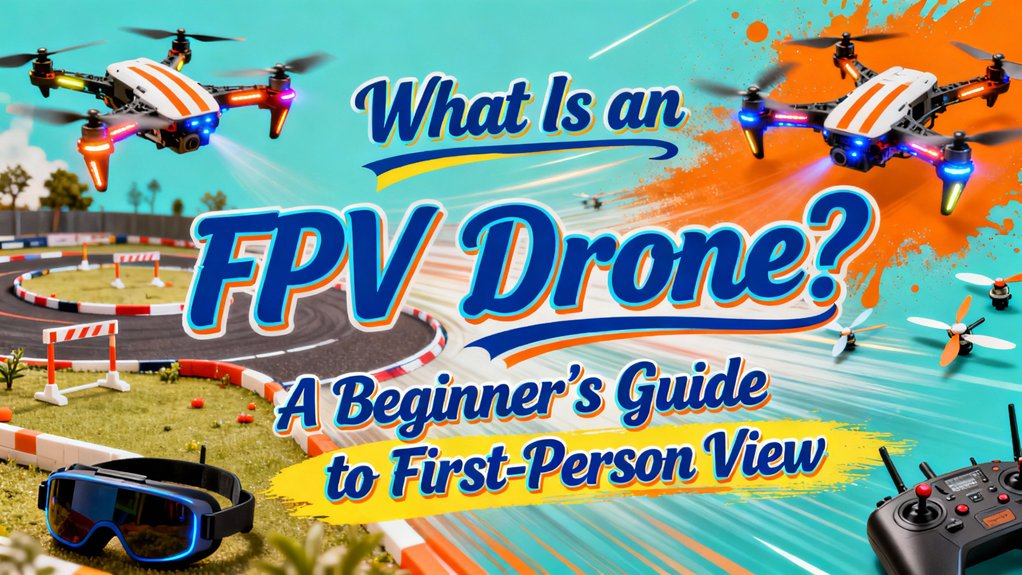
An FPV drone transmits live video from its onboard camera to your goggles or monitor via a 5.8GHz wireless link, placing you in the pilot’s seat for immersive beyond-visual-line-of-sight control. You’ll navigate through real-time footage with 10–20 ms latency on analog systems or higher-definition streams on digital platforms like DJI and Walksnail. Core components include the flight controller, VTX unit, ESCs, and motors, all working together for responsive maneuvering. This guide covers everything from video transmission systems to legal requirements you’ll need to master.
Understanding FPV Technology and How It Differs From Standard Drones
When you pilot an FPV drone, you’re operating through a live video feed transmitted directly from the aircraft’s onboard camera to your goggles or ground station monitor—fundamentally transforming how you interact with the aircraft. This represents the core of FPV fundamentals: real-time wireless transmission, typically via 5.8GHz frequency, delivering low-latency footage for precise beyond-visual-line-of-sight control.
Unlike standard line-of-sight drones that rely on smartphone displays or direct visual observation, FPV systems create an immersive experience where you’re effectively positioned in the cockpit. Digital HD systems now surpass analog transmission quality, while head-tracking integration enables pan-tilt camera control. Popular video systems like DJI, Walksnail, and HDZero offer different tradeoffs between image quality, latency, and range depending on your skill level and goals. For beginners, the DJI Goggles 3 provide superior picture quality and compatibility across multiple systems. For those seeking integrated solutions with advanced safety features, premium options like the DJI Mavic 4 Pro combine professional-grade cameras with obstacle avoidance capabilities. The choice between video transmission systems should also consider your radio control link, as FPV pilots often pair their video systems with dedicated transmitter and receiver setups for independent control authority. Beginner-friendly drones like the DJI Neo and Avata 2 offer modular designs and pre-installed HD systems to help new pilots get started with confidence. This technical configuration supports advanced applications—from competitive racing and freestyle maneuvers to professional cinematography in confined spaces—though it demands steeper learning curves than conventional UAV operation. The precision and control inherent in FPV technology enable accurate navigation through tight spaces that would be impossible with traditional line-of-sight piloting methods.
Essential Components That Make FPV Drones Work
Before you can pilot an FPV drone, you’ll need to understand its six core components: the frame, motors, electronic speed controllers (ESCs), flight controller, propellers, and power system. Frame materials like carbon fiber provide lightweight strength, with 5-inch configurations standard for beginners. Motor selection depends on KV ratings—higher values suit smaller props, requiring ESC ratings that exceed motor current draw. Your controller compatibility hinges on processor choice: F4, F7, or H7, with mounting holes matching your frame. Propeller types include tri-blade configurations, requiring two clockwise and two counterclockwise for proper drone balance. ESCs regulate power delivery through firmware-compatible units, while the flight controller processes sensor data and pilot commands. The flight controller serves as the brain of the drone, utilizing algorithms and sensors to stabilize and control flight throughout your session. When selecting FPV components, prioritize camera resolution and gimbal stabilization to ensure stable, high-quality footage during aggressive maneuvers. High-quality 4K video capture] and obstacle avoidance systems found in advanced drones can also enhance FPV performance during racing and freestyle maneuvers. For users prioritizing portability and regulatory compliance, sub-250g drone models offer lighter alternatives without compromising essential FPV functionality. Advanced drones featuring dual 1/1.28-inch sensors] capable of 8K/30fps demonstrate how premium camera technology can elevate FPV videography capabilities. Budget-friendly options like BETAFPV kits provide excellent entry-level platforms with features such as altitude hold and turtle mode for beginner progression. These components integrate as tested systems in stack or all-in-one configurations.
The Video Transmission System Explained
Your drone’s physical components mean nothing without real-time visual feedback from the aircraft to your position on the ground. The video transmission system centers on the VTX unit, which converts camera output into RF signal transmission at 5.8 GHz. Analog advantages include minimal video latency (sub-10ms) and broad receiver compatibility across vendors, though image quality remains standard-definition. Digital benefits deliver HD resolution and superior interference rejection, but require matched air units and goggles. Antenna selection between omnidirectional and directional patterns directly impacts range and multipath performance—circular polarization (RHCP/LHCP) proves essential for acrobatic flight. Output power (25–1200mW) and bandwidth management determine obstacle penetration and multi-pilot coordination requirements. For competitive racing applications, pilots often select high-performance FPV frames paired with low-latency video transmission systems to maintain the split-second responsiveness required in MultiGP events. When choosing your first FPV drone, consider ELRS-compatible radios for future-proofing and compatibility with evolving technology standards. The DJI Avata 2 stands out as a professional-grade option for those seeking 4K video capabilities with immersive first-person view performance. Beginner-friendly options like the DJI Neo provide an affordable entry point with 4K video capabilities for pilots discovering FPV flight. For those prioritizing stability and ease of use, traditional camera drones like the DJI Mavic 3 offer excellent flight stability and adaptable flight modes for aerial filming. Leading manufacturers like DJI, HDZero, and Walksnail now offer digital FPV systems with ranges extending up to 31 km for long-distance applications. Proper antenna mounting often matters more than nominal transmit power for reliable signal transmission.
How Pilots Control FPV Drones in Real-Time
Real-time control of an FPV drone relies on a bidirectional RF link between your handheld transmitter and the aircraft’s flight controller, with command packets traversing this path in under 20 milliseconds to enable responsive maneuvering. Transmitter types range from compact two-stick layouts to multi-channel rigs that send control signals over 2.4 GHz or 900 MHz bands. Popular hand-held options like the RadioMaster GX12 feature 1000Hz digital gimbals and Gemini X technology to deliver precise control even in challenging flight conditions. You’ll configure stick response curves—exponential and dual-rate settings—to balance sensitivity and smoothness. Flight modes (angle, horizon, acro) determine how stabilization algorithms interpret your inputs; PID loops process gyroscope and accelerometer data to generate motor PWM outputs. The onboard sensors like accelerometers and gyroscopes work continuously to stabilize your drone and respond to your control inputs. Latency effects degrade pilot feedback quality, so protocols like ExpressLRS minimize packet loss. If your transmitter begins beeping unexpectedly, consult your manual for beep code meanings to diagnose potential issues. Sensor integration and telemetry streams provide real-time battery voltage and RSSI updates for informed flight decisions, and maintaining batteries above 60°F ensures optimal performance during extended winter flights. Advanced FPV systems now incorporate object detection algorithms that can identify obstacles and other aircraft during flight, enhancing situational awareness for pilots operating in complex environments. Since FPV drone regulations vary by location, pilots should understand local drone surveillance laws in their jurisdiction before operating.
Analog Vs Digital Video Systems
When you select a video system for your FPV drone, you’re choosing between two fundamentally different signal architectures that shape image quality, latency, and link behavior under RF stress. Analog transmits continuous FM-modulated waveforms on 5.8 GHz, delivering 10–20 ms latency and graceful noise degradation—key analog advantages for racing pilots demanding split-second responsiveness. Digital encodes compressed HD streams with forward error correction, yielding action-camera clarity and spectrum efficiency but introducing codec latency and potential freeze-frames under packet loss—common digital challenges. Analog degrades into snow while preserving motion continuity; digital exhibits blockiness or frame drops. Modern digital implementations optimize ASIC pipelines to approach analog responsiveness, yet latency-sensitive acro pilots often prioritize analog’s minimal pipeline delay over digital’s superior resolution and dynamic range. Leading digital systems like DJI Goggles 3 and Walksnail have significantly reduced latency differences through hardware optimization, making them competitive for acro flying despite their image quality advantages. For specialized night operations or low-light inspection missions, thermal sensors and starlight cameras can complement FPV systems when mounted on larger platforms requiring advanced sensor payloads. Both systems rely on a video transmitter to broadcast the camera feed to your goggles or monitor in real time. When traveling with your FPV drone, remember that TSA regulations allow drones through airport security in either carry-on or checked baggage. Extended flight capability depends on battery management, as flight time degradation occurs naturally over the battery’s operational lifespan. The choice ultimately hinges on whether you value responsiveness over image quality for your specific flying style.
Speed, Agility, and Flight Performance Capabilities
Peak velocity in FPV platforms depends on three interrelated engineering domains: aerodynamic efficiency, power-system capability, and propulsion matching. Speed optimization requires streamlined canopies and tapered profiles that reduce drag by up to 18%, critical when drag scales quadratically with velocity. You’ll need thrust-to-weight ratios exceeding 8:1–10:1 for agility enhancement and aggressive maneuvers. High-discharge 6S LiPo packs deliver power for speeds surpassing 300 km/h, while motor KV selection must align with propeller pitch and diameter to avoid thermal runaway. CFD analysis and wind-tunnel testing eliminate turbulent buffeting above 200 km/h. Balanced propellers prevent vibration degradation of flight control. ESC thermal headroom and active cooling manage sustained high-power runs. Propeller-canopy integration minimizes interference drag, essential for F1-tracking projects achieving 310 km/h on straights. Elite racing builds have demonstrated velocities reaching 603 km/h, marking significant milestones in competitive drone speed achievements.
Popular Uses for FPV Drones
FPV platforms have evolved beyond hobbyist racing to occupy distinct roles across broadcast media, commercial inspection, emergency operations, and precision agriculture. In film applications, you’ll achieve controlled chase sequences and interior shots faster than traditional crane setups, reducing costs while delivering cinematic footage. Real estate marketing leverages interior walkthroughs and multi-level flythroughs as low-cost alternatives to helicopter aerials. Listings with drone content sell significantly quicker, giving sellers a competitive advantage in crowded markets. During emergency response missions, you’ll deploy FPV systems for rapid reconnaissance in collapsed structures, pairing thermal imaging with real-time feeds to command centers. For wildfire operations, FPV drones can assist in hot-spot detection and structural assessment to guide firefighting strategies. Agricultural monitoring enables low-altitude crop health assessment and targeted pest detection across large fields. Industrial inspection workflows utilize close-proximity flights for bridge defect detection, tower assessments, and warehouse inventory audits through confined spaces. Modern inspection drones like the Autel Robotics EVO II Dual 640T combine thermal and visual sensors to detect hidden damage and provide superior image quality for complex assessments. For long-range autonomous delivery operations, heavy-lift platforms like the DJI FlyCart 30 offer substantial payload capacities and advanced obstacle avoidance systems that enable reliable cargo transport across extended distances. Specialized applications like fishing operations benefit from 4K HDR cameras and waterproof designs that enable safe aerial scouting and bait delivery over water. For beginners exploring aerial videography, lightweight drones like those featuring built-in HD cameras and beginner-friendly functions such as one-key takeoff and altitude hold provide an accessible entry point into FPV technology.
FPV Racing and Freestyle Flying
Beyond applied commercial work, competitive FPV racing and freestyle flying represent the sport’s most demanding disciplines, where millisecond latency advantages and precision control separate podium finishes from elimination rounds. Competition formats range from circuit-style timed laps to head-to-head elimination heats, with class divisions segregating pilots by aircraft size and skill level.
Drone design priorities diverge sharply: racing quads optimize thrust-to-weight ratios and aerodynamics for maximum velocity, while freestyle builds emphasize durability and agility through beefier frames. Equipment choices—high-KV motors, DShot ESC protocols, low-latency analog video—minimize control lag critical for race strategies.
Pilot skills develop through simulator training (10+ hours recommended), progressive stick coordination drills, and course breakdown analysis. Training methods prioritize “slow is smooth; smooth is fast” fundamentals before advancing to acrobatic maneuvers and competitive hotlaps. Expect crashing as part of the learning process, with pilots prepared for regular repairs and component replacements to maintain competitive performance.
Range Limitations and What Affects Them
Operational range in FPV systems spans 0.8 to 6.5 kilometers depending on frequency selection, antenna configuration, and environmental variables—though regulatory compliance and video link reliability typically constrain practical operations well below theoretical maximums. Signal interference from Wi-Fi networks and urban structures greatly degrades range factors, particularly with 5.8 GHz systems limited to 500 meters. Lower frequencies like 1.3 GHz quadruple penetration capabilities compared to higher bands. Environmental impacts including headwinds, cold temperatures, and humidity reduce battery efficiency and effective distance. Equipment weight directly correlates with power consumption—heavier payloads drain cells faster. Aerodynamic profiles minimize drag while efficient motor-propeller combinations optimize thrust-to-power ratios. Buildings and terrain masking eliminate line-of-sight communication entirely, making open-field operations essential for maximum range achievement. Digital systems like DJI O3 deliver superior clarity and specified range capabilities, while analog alternatives remain more affordable though requiring proper antenna setup to exceed 1 km transmission distance.
Legal Requirements and Safety Regulations for FPV Pilots
Understanding range capabilities means little if regulatory violations ground your aircraft before takeoff. You’ll need TRUST certification for recreational operations or Part 107 Remote Pilot Certificate for commercial use. Regulatory compliance mandates VLOS operation—FPV goggles don’t satisfy this requirement alone. You must employ a co-located visual observer in direct communication during flight. Remote ID compliance is mandatory unless operating within FRIAs. Secure LAANC authorization before entering controlled airspace (Class B, C, D, surface E). Risk mitigation demands preflight inspections of antennas, goggle systems, and backup links. Maintain 400-foot AGL altitude limits, yield right-of-way to manned aircraft, and avoid careless operations. Document TSA vetting and obtain your FTN during certification processing. Drones exceeding 250 grams require FAA registration at a cost of $5, valid for three years. These aren’t suggestions—they’re enforceable requirements.