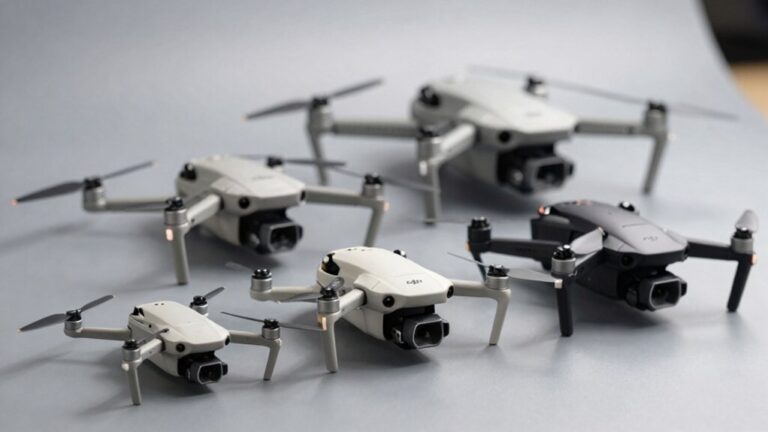
DJI drones aren’t currently banned in the U.S.—you can still legally operate existing models under FAA regulations. However, Section 1709 of the FY2025 NDAA mandates a national security audit by December 23, 2026. If that deadline passes without completion, DJI automatically joins the FCC Covered List, blocking new equipment authorizations while leaving existing drones in regulatory limbo. Commercial operators need Remote Pilot Certificates, and all drones over 250 grams require FAA registration. Understanding what’s ahead can help you prepare for potential restrictions.
Current Legal Status of DJI Drones Under the FY2025 NDAA
When the FY2026 National Defense Authorization Act reached finalization on December 19, 2024, it particularly excluded the Countering CCP Drones Act but retained Section 1709—a provision that mandates a national security audit of DJI and Autel’s communications and video-surveillance technology. This audit process targets security risk determination within one year, though no specific agency has been designated to conduct the required study. The legal implications are significant: if agencies like DoD, DHS, or Commerce fail to complete the audit by December 23, 2026, DJI automatically joins the FCC Covered List. You’ll face automatic consequences including blocked FCC authorizations for new radios, import prohibitions on future drones and accessories, and restricted use on U.S. communications infrastructure. Existing DJI drones with current FCC approvals remain legal to operate. Despite these regulatory challenges, DJI continues to innovate in the delivery drone sector with models like the DJI FlyCart 30, which showcases robust payload capacity and advanced logistics capabilities. DJI offers a range of products across different price ranges, from the affordable Mini series starting around $300 to the professional Mavic 3 models that can cost several thousand dollars. Operators must still comply with FAA regulations including flying below 400 feet, maintaining visual line of sight, and registering drones over 0.55 pounds. Many states have also enacted their own drone surveillance laws that require law enforcement to obtain warrants before deploying drones for surveillance, especially over private property or for extended periods. The expanded FCC authority now enables bans on subsidiaries and affiliates of covered companies, with strengthened enforcement measures across the entire supply chain. Understanding the distinction between FPV drones and traditional line-of-sight drones is important for operators navigating these new regulatory requirements, as both types fall under federal oversight.
What Happens If DJI Is Added to the FCC Covered List
If DJI lands on the FCC Covered List by December 23, 2026, the company faces immediate prohibition from obtaining new FCC equipment authorizations for any products containing radio frequency transmitters. You’ll see this affect drone control systems, video downlinks, and communication modules requiring FCC regulations compliance. The company can’t secure Supplier’s Declaration of Conformity approvals or exemptions for consumer-market equipment. However, pre-authorized DJI products already in distribution remain legal for sale until the FCC decides whether to revoke existing authorizations—a decision with significant compliance implications. New October 28, 2024 rules enable retroactive restrictions on previously approved devices. You won’t be able to purchase modified equipment requiring additional FCC authorization, and DJI can’t circumvent these restrictions through subsidiaries or alternative branding strategies. Operating drones without valid FCC approval constitutes illegal wireless transmitter operation, creating legal risks for users if certification revocations occur. Pilots flying DJI drones in controlled airspace must still obtain prior authorization from the FAA through systems like LAANC, regardless of the equipment’s FCC certification status. Commercial drone operators must also hold a Remote Pilot Certificate issued by the FAA, which requires passing an aeronautical knowledge test and renewing certification every two years. Recreational drone pilots must still register drones over 250 grams with the FAA, even if they don’t need commercial certification. All compliant drones must broadcast Remote ID signals to enable authorities to identify aircraft during flight and enhance airspace safety. Beyond recreational use, specialized drones equipped with radiation detection tools serve critical roles in nuclear safety inspections and emergency response operations.
Why the U.S. Government Is Scrutinizing DJI
The U.S. government’s scrutiny of DJI stems from Section 1709 of the FY2026 National Defense Authorization Act, which mandates a national security agency to assess whether DJI equipment poses an unacceptable risk by December 23, 2026. This examination reflects broader U.S.-China technology and trade tensions, with DJI’s position as a China-headquartered market leader driving regulatory compliance concerns.
The Department of Homeland Security has initiated examinations of Chinese drone imports, while Customs and Border Patrol allegations create import difficulties. Despite independent audits since 2017 by Booz Allen Hamilton and FTI Consulting confirming no unauthorized data transmission to Chinese authorities, federal restrictions have expanded. The Department of Defense, Department of Justice, and state agencies including Florida have implemented bans citing cybersecurity concerns, requiring regulatory compliance that extends beyond DJI’s voluntary security measures and Government Edition drone offerings. The 2025 NDAA targets Chinese drone manufacturers by potentially banning future drones from these companies unless cleared by security agencies such as the DoD, NSA, or FBI, thereby impacting purchasing and technology upgrades for governmental agencies. DJI has introduced features like Local Data Mode to address privacy concerns and prevent data leakage during drone operation. All registered drones must comply with Remote ID broadcasting requirements as of 2025, either through built-in capabilities, external modules, or operation within FAA-Recognized Identification Areas.
How Potential Restrictions Would Impact Commercial and Public Safety Operations
Beyond regulatory scrutiny, proposed DJI restrictions would create immediate operational disruptions across commercial and public safety sectors. You’d face halted FCC authorizations for new drone models essential in mapping and infrastructure inspections, blocking imports of updated payloads and critical firmware updates. Commercial mapping projects would stall as you shift to costlier alternatives, while inspection operations for power lines and utilities face delays from component bans. Public safety units encountering challenges due to lack of support for existing drones would struggle to maintain operational readiness even with currently authorized equipment. Public safety agencies dependent on DJI’s thermal imaging for search and rescue can’t access new models after December 23, 2026. The cost implications escalate considerably—you’d need to replace certified equipment while managing operational gaps, including obtaining necessary Part 107 Remote Pilot Certificates for new commercial drone platforms. Existing drones remain legal unless FCC revokes prior certifications, forcing agencies to stockpile pre-ban inventory for continuity. Agencies relying on obstacle avoidance systems for safe close-range operations would face challenges sourcing equivalent technology in compliant platforms. Alternative enterprise solutions like the DJI Matrice 350 RTK offer 55-minute flight times and RTK precision, but access to such heavy-duty models would be severely limited under proposed restrictions. Construction teams requiring centimeter-level positioning for accurate surveys and photogrammetry would need to transition to compliant RTK-enabled platforms at significantly higher costs. Operators conducting high-altitude inspections may also lose access to parachute systems designed to reduce crash damage and liability, as aftermarket safety integrations for alternative platforms lag behind DJI’s established vendor ecosystem.
What DJI Drone Owners and Operators Should Do Now
Given the accelerating regulatory timeline, you must conduct an immediate inventory of your DJI fleet, documenting each asset’s model, serial number, FCC ID, purchase date, and warranty status to identify replacement risks and parts dependencies. Prioritize equipment procurement of critical spare parts, batteries, and accessories before potential FCC restrictions block future sales. Secure extended service contracts or third-party drone maintenance options to cover post-restriction support gaps. Implement Local Data Mode immediately, disable automatic syncing, and enforce strict flight-log handling procedures to limit data transmission to DJI servers. Harden endpoint devices used for flight control apps by enforcing OS updates, app permissions, and network restrictions. Establish standard operating procedures for data retention, export, and sanitization of onboard storage after each flight. Ensure all drones display the FAA registration number as required by federal regulations to maintain compliance during this transitional period. Monitor the status of the mandated national security review that must be completed by December 23, 2025, as failure to complete this assessment will result in DJI’s automatic addition to the FCC Covered List. Consider that Pakistan’s military has successfully diversified its unmanned aircraft capabilities by leveraging strategic partnerships with Turkey and China, demonstrating how organizations can reduce dependence on single suppliers. If you’re planning to operate drones commercially, ensure your Remote Pilot Certificate remains current, as certification is valid for two years and requires recurrent training every 24 months. The FAA Part 107 knowledge test costs $175, and combined with the $5 drone registration fee, initial licensing expenses total approximately $180. Evaluate alternative platforms from companies like Autel Robotics, Skydio, and Parrot that offer U.S.-compliant solutions with advanced autonomous capabilities and enterprise-grade security features. Develop a phased shift plan documenting operational impacts, budget requirements, and procurement timelines for alternative platforms.