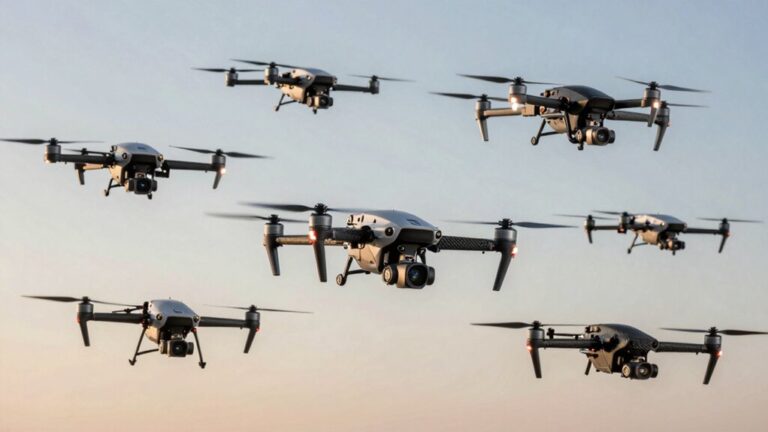
Your DJI drone’s battery life depends on the model you’re flying. Consumer drones like the Mini 4 Pro deliver 34-45 minutes, while the compact Neo manages just 18 minutes due to its 135g weight. Professional models extend further—the Matrice 400’s TB100 battery achieves 59 minutes despite weighing 4.72kg. Real-world conditions typically reduce manufacturer ratings by 20-30%, so expect 23-29 minutes from a drone rated at 36 minutes. Environmental factors, maintenance practices, and flight techniques greatly influence these durations.
Flight Time Performance Across Consumer DJI Models
DJI’s consumer drone lineup demonstrates significant variation in flight performance, with battery endurance ranging from 18 minutes in the compact Neo to 45 minutes in the Air 3S. The DJI Mini series shows progressive flight efficiency improvements, with Mini 3’s Intelligent Battery Plus extending duration to 51 minutes. Battery comparisons reveal weight implications directly impact endurance—the 135g Neo sacrifices flight time for portability, while the Air Series prioritizes extended operation. Avata performance centers on FPV applications, delivering 23 minutes at speeds reaching 97.2 kph. Consumer preferences drive design advancements toward sub-249g configurations, balancing registration-free operation with acceptable flight duration. The Mini 4 Pro exemplifies this trade-off, offering 34-45 minutes depending on battery selection while maintaining regulatory advantages. Models like the DJI Mini 5 Pro demonstrate advanced sensor integration that supports extended operational capabilities without significantly compromising portability. For professional-grade mapping applications, specialized drones like the DJI Matrice 350 RTK offer significantly extended flight times designed for comprehensive 3D surveying missions. Proper battery storage at moderate temperatures with partial charge helps extend the lifespan of DJI batteries beyond their typical 200-300 charge cycles. Unlike consumer DJI models that rely on LiPo technology, understanding LiPo battery specifications such as C-rating and mAh capacity helps optimize drone selection for specific flight requirements. The DJI Air 3S leads the premium segment with its dual lenses and LiDAR obstacle avoidance system enabling superior endurance performance. The evolution from Mavic Mini’s 31-minute capability to Mini 2’s 36-minute max flight time demonstrates incremental endurance improvements across successive generations.
Professional and Industrial DJI Drone Battery Capabilities
Professional-grade DJI platforms deploy substantially more powerful battery systems than their consumer counterparts, with energy capacities spanning from 131.6 Wh in the Matrice 30’s TB30 cells to 977 Wh in the Matrice 400’s TB100 configuration. You’ll find these industrial applications demand extended operational windows—the TB65 delivers 55 minutes unloaded, while the TB100 achieves 59-minute flights despite its 4.72 kg mass. The T30’s agricultural-focused BAX501 battery technology provides 29,000 mAh capacity with IP54 water-resistance and 11.5C discharge rates for high-demand spraying operations. Each system maintains 400-cycle longevity ratings, ensuring consistent performance across commercial deployments. The Matrice 4 series introduces Li-Ion chemistry (LiNiMnCoO2) at 149.9 Wh, offering 54-minute forward flight with optimized power-to-weight ratios for surveying missions. These professional DJI batteries leverage electrochemical redox reactions where lithium ions move between the anode and cathode to create electrical current, enabling the sustained power delivery required for extended missions. Like military drone operations that depend on secure communication systems for reliable command and control, professional DJI systems prioritize robust connectivity to maintain uninterrupted mission execution. Professional drone operators must document all flight activities and obtain proper landowner consent before conducting operations over residential areas. When transitioning drones between operators, users should properly unbind the drone from controller accounts to ensure seamless handoffs in professional environments. The TB30’s built-in self-heating capabilities ensure optimal performance in temperatures lower than 10°C, automatically activating during charging to maintain operational readiness in cold environments. These professional systems enable choreographed aerial displays through synchronized GPS technology and precise flight path programming, allowing multiple drones to execute complex synchronized animations in coordination with ground stations for safety and real-time monitoring.
Environmental and Operational Factors That Impact Battery Duration
Wind resistance represents the single most variable drain factor during flight operations, with power consumption escalating 10-30% as your drone compensates for air currents exceeding 10 mph. Temperature effects prove equally significant—battery capacity drops substantially below 0°C, while the ideal 22-28°C range maximizes efficiency. Your flying style directly correlates with duration; aggressive maneuvers increase power draw by 20-50% compared to steady flight. Altitude considerations become critical above 1,000 meters, where thinner air reduces propeller efficiency and shortens flights by 10-20%. Humidity factors accelerate depletion in moisture-rich environments, particularly when combined with cold conditions. Storing batteries at approximately 3.7V per cell in cool, dry environments helps maintain their capacity and performance across multiple charge cycles. Different battery chemistries respond differently to these environmental stressors, with Li-ion batteries providing superior performance consistency across varying temperature and altitude conditions. For maximum safety during varied flight conditions, consider drones equipped with propeller guards that help maintain stable performance even in challenging environmental scenarios. Modern DJI batteries incorporate smart battery management systems that monitor these environmental variables in real-time to optimize performance and safety during flight operations. Understanding these environment influence variables enables precise flight planning and duration optimization across varying operational scenarios.
Understanding DJI Battery Lifespan in Charge Cycles
Battery longevity hinges on understanding DJI’s charge cycle methodology, where one complete cycle registers after you’ve consumed 75% of rated capacity—a calculation that includes self-discharge alongside active flight depletion. Effective battery management demands strategic discharge practices: maintain 20-25% minimum levels during regular operations, execute deep cycling to 50% every 25-30 flights for capacity maintenance, and implement storage recommendations of 40-65% for extended periods. Your lifespan optimization strategy should incorporate charge efficiency protocols—avoid frequent top-offs that accumulate partial cycles, perform quarterly full discharge-recharge sequences, and leverage auto-discharge features when storing above 60%. Always allow batteries to cool to room temperature before charging to prevent thermal stress that can degrade cell performance. DJI drone batteries use Lithium-Polymer and Lithium-Ion chemistry, which directly impacts how they respond to your charging and storage practices. These operational tips translate to 300-500 cycles across properly managed LiPo cells, with DJI warranties covering 200 cycles. Proper storage in cool, dry places and cycling batteries every few months further extends their longevity. Leading DJI batteries are praised for their high power-to-weight ratio and stable voltage performance, which contribute significantly to overall cycle life efficiency. Understanding how the power system integrates with your drone’s overall performance helps you make informed decisions about battery management strategies. Cycle counting accuracy depends on consistent adherence to manufacturer specifications. Monitor battery health indicators through DJI Fly or DJI GO4 apps to track voltage and cycle count effectively.
Calculating Expected Flight Time for Your DJI Drone
When calculating your DJI drone’s expected flight time, you’ll apply the fundamental formula: time (hours) = capacity (Ah) × discharge rate / average amp draw (AAD). Standard practice uses 80% discharge to preserve battery longevity, leaving a 20% reserve. For battery capacity, convert mAh to Ah by dividing by 1000 (e.g., 8800 mAh = 8.8 Ah).
Your average amp depends on all-up weight, propulsion efficiency, and payload. Calculate AAD using: AUW × power factor / voltage. A quadcopter with 4.25 kg takeoff weight drawing 7.98 A per motor at hover yields approximately 32 A total draw. With a 6S 30 Ah battery: 30 × 0.8 / 32 = 0.75 hours (45 minutes). However, increased payload elevates amp draw proportionally, reducing flight duration despite higher battery capacity. Professional-grade drones like the DJI Mavic 3 Pro achieve flight times of 40–45+ minutes through advanced battery technology and aerodynamic design. The choice of firmware support and controller compatibility can also influence optimal battery management settings. Before flying, ensure your drone and controller are properly synced by pushing the left throttle stick all the way up and then down until both devices show solid indicator lights. Environmental factors like temperature extremes and aggressive flying styles also accelerate battery drain and degradation. Flying conditions significantly impact actual flight time, with hovering and slight movements delivering roughly 75% of your calculated duration, while strong winds or aggressive maneuvers may reduce it to just 50%. To protect your battery during transport, store it in a carrying bag designed for secure storage and optimal preservation.
Proper Storage Practices to Preserve Battery Health
Since lithium polymer chemistry degrades through calendric aging even when unused, you’ll maximize your DJI battery’s service life by maintaining a storage state of charge between 40–65% for any period exceeding 10 days. Store at 22–28°C in well-ventilated, dry locations away from direct sunlight and extreme temperatures; heat accelerates non-recoverable capacity loss. Remove batteries from aircraft to prevent parasitic drain, and position them on stable surfaces with terminals covered to avoid short-circuit risk. Configure auto-discharge settings via Time to Discharge for automatic descent from full charge. Execute full charge-discharge cycles every three months for health preservation, and monitor voltage levels periodically—recharge any unit dropping below storage threshold to prevent deep-discharge hibernation. Always use manufacturer-approved chargers to ensure safe and efficient charging of your batteries. Never leave batteries in the charger after they reach full charge, as indicated by the charger’s LED indicator, to prevent overheating and potential damage. For extended missions requiring extended flight time, consider deploying multi-drone networking to rotate battery loads across fleet platforms. High C-rating specifications determine the discharge rate capability of your battery during demanding flight operations. Smart chargers with automatic cell balancing prevent uneven charging and optimize battery performance across multiple cells. Label storage containers with charge date and SOC for effective battery storage rotation tracking. Keep batteries away from heat sources such as radiators, stoves, or direct sunlight exposure during storage periods.
Maintenance Guidelines for Extending Battery Longevity
Maximizing DJI battery longevity requires systematic charge-cycle management paired with disciplined charging protocols. Execute full discharge cycles quarterly to recalibrate battery management systems, but land before reaching 15–20% capacity to minimize lithium-ion stress. Distribute flight hours evenly across your battery fleet to prevent accelerated degradation of individual packs. For ideal battery maintenance, allow cells to cool to ambient temperature before charging and avoid environments exceeding manufacturer temperature specifications. Never store batteries at 100% charge beyond 24 hours—enable auto-discharge features when available. Utilize only DJI-approved chargers to guarantee correct charge profiles. Track cycle counts and capacity metrics to identify degradation trends and schedule proactive replacements. Store batteries at 40-60% charge for periods exceeding 10 days to prevent cell damage from prolonged full capacity. Maintain current firmware on both aircraft and batteries to leverage updated management algorithms that enhance cycle longevity and safety performance. Monitor battery health regularly for warning signs such as reduced flight time, swelling, overheating, and rapid voltage drops to catch potential issues before they compromise flight safety.
Signs Your DJI Battery Needs Replacement
Even with ideal maintenance protocols, DJI batteries exhibit measurable degradation indicators that demand replacement to maintain flight safety and performance standards. Monitor for critical undervoltage occurring prematurely above 30% indicated capacity—this signals chemical degradation from 150-300 charge cycles. You’ll notice reduced flight runtime and battery warning alerts appearing earlier than specified ranges. Watch for cell voltage imbalances exceeding 0.07V differential, particularly when individual cells drop below 3.3V consistently. Charging anomalies manifest through abnormal LED patterns: LED 2 blinking three times per second indicates short circuits, while four LEDs blinking simultaneously denotes damaged cells requiring immediate replacement. Physical swelling from over-discharge or impact necessitates DJI support contact. Replace batteries exhibiting persistent communication errors with your flight controller despite firmware updates. If LED 3 blinks twice per second, this indicates an overcharge condition requiring immediate attention and potential battery replacement.
Maximizing Flight Sessions With Multiple Battery Strategy
Professional drone operations require systematic battery rotation protocols to achieve sustained flight sessions exceeding single-battery limitations. You’ll implement battery enhancement techniques by prioritizing your fullest battery for initial flights, then depleting others sequentially across multiple locations. Allocate one battery per site, flying to 40% while maintaining a 20% safety buffer. Your recharge timing strategies depend on charger specifications: a 65W+ unit charges two batteries simultaneously in 70 minutes, while a 30W charger completes single-battery cycles in 56-78 minutes. For extended operations, you’ll need batteries that outpace charger speed, enabling 5-minute swaps for continuous flights. Power banks facilitate on-location charging, maintaining charge readiness during multi-site shoots. FPV enthusiasts typically deploy 8-10 batteries to sustain longer session durations. Plan adequate rest intervals between flights for optimal battery efficiency.
Real-World vs. Manufacturer-Rated Flight Times
When evaluating DJI battery performance, you’ll find manufacturer-rated flight times consistently exceed real-world durations by 20–30% due to testing methodology differences. Manufacturers measure under controlled lab conditions—hovering with minimal payload at ideal temperatures—excluding forward flight, wind resistance, and active gimbal use. For example, a Mini claiming 36 minutes typically delivers 23–29 minutes under normal operation, constrained by software RTH limits and low-battery cutoffs. Flight time variability increases with environmental stressors: wind forces higher motor throttle, altitude reduces efficiency through thinner air, and temperature extremes affect cell chemistry. Your actual battery performance depends on flight profile aggressiveness, obstacle avoidance activation, and battery health. Cycle count and storage conditions further degrade capacity, making real operational windows considerably shorter than advertised specifications. Users should prioritize fast charging capabilities as a practical alternative to compensate for reduced flight durations in real-world scenarios.