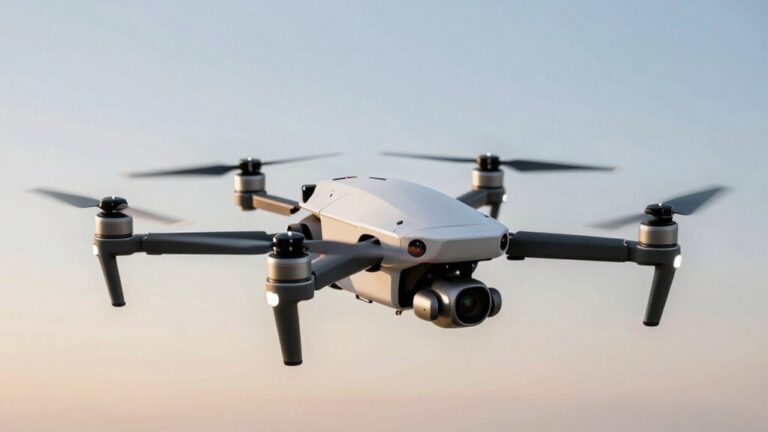
DJI drones are consumer and professional aerial photography platforms that control 70-85% of the global civilian market through accessible pricing and reliable flight technology. Founded in 2006, the Chinese manufacturer transformed aerial imaging with innovations like omnidirectional obstacle avoidance, advanced camera sensors up to 4/3 CMOS, and proprietary flight-control systems. You’ll find four main product families—Mavic, Air, Mini, and Enterprise—serving everyone from beginners to commercial operators. Below, you’ll uncover how DJI’s technological breakthroughs and vertical integration created an industry-defining advantage that competitors still struggle to match.
The Story Behind DJI: From Dorm Room to Industry Leader
While many tech giants trace their roots to garages in Silicon Valley, DJI’s origin story began in a Hong Kong University of Science and Technology dorm room in 2006, where student Frank Wang (Wāng Tāo) assembled his first flight-control prototypes. His founder vision centered on developing reliable autonomous flight systems, initially selling components to universities and Chinese companies. The early challenges were significant: operations moved to a cramped Shenzhen warehouse to access suppliers and manufacturing infrastructure, funded by roughly $90,000 from family friend Lu Di. Wang’s perfectionist approach drove rapid iteration but triggered high turnover among early team members. The founding team included Chen Jinying, Lu Zhihui, and Chen Chuqiang, though internal disagreements led to the departure of these key members by the end of 2008 and within six months thereafter. By 2009, breakthrough flight-control systems and brushless-motor gimbal stabilization positioned DJI to shift from component supplier to integrated consumer drone manufacturer. Like earlier pioneers such as Abraham Karem, who developed the first modern drone in the 1970s, Wang recognized that refined flight stabilization technology would be essential to advancing the industry. DJI’s commitment to precision engineering extended to developing thermal imaging capabilities that would later enable advanced applications like solar panel inspections across the industry. The company established its primary manufacturing operations in Shenzhen, China, where its headquarters remains based today. The company’s relentless focus on innovation, accessibility, and user-friendly design enabled DJI to expand beyond its initial market position, ultimately dominating the global market with innovations like obstacle avoidance and advanced cameras that would set it apart from competitors.
Understanding What Makes DJI Drones Different
DJI’s journey from flight-control component supplier to market leader wasn’t accidental—it stemmed from technological innovations that competitors struggled to match.
You’ll find omnidirectional obstacle avoidance across models like the Air 3 and Mini 4 Pro, while the Air 3S adds lidar sensors for enhanced low-light detection. These drone features represent DJI’s commitment to safety through redundancy. For enhanced nighttime operations, many DJI drone users opt for anti-collision strobe lights that provide 360-degree visibility and FAA compliance.
Camera technology innovations set DJI apart further. The Air 3S employs a 1-inch sensor with advanced image processing, while the Mavic 3 Pro integrates Hasselblad’s 4/3 CMOS sensor delivering 5.1K/50fps video. For professional surveying and mapping applications, DJI’s enterprise platforms like the Matrice 350 RTK support RTK/PPK positioning workflows that achieve centimeter-level accuracy. The Mini 4 Pro remains popular among travel creators seeking a sub-250g weight advantage that simplifies regulatory compliance. To ensure safe landings in various environments, many operators use drone landing pads that provide stable, clean surfaces for consistent touchdowns.
Intelligent flight modes like ActiveTrack 360° and QuickShots democratize professional cinematography. DJI’s QuickShots include automated maneuvers like Dronie, Circle, Rocket, Spotlight, Helix, and Boomerang that transform complex aerial shots into simple one-tap operations. For travelers prioritizing portability without sacrificing capability, the DJI Air 3S combines dual lenses with 45+ minute flight times, making it an ideal choice for photography adventures. Combined with transmission ranges reaching 20km on the Mini 4 Pro, DJI delivers reliability that professionals demand and beginners appreciate.
The Phantom 1: How DJI Changed Consumer Drones Forever
The Phantom 1’s 2013 release marked the turning point when aerial photography shifted from specialized equipment requiring thousands of dollars to an accessible $679 package. You got a complete ready-to-fly system featuring the Naza-M GPS autopilot, which delivered 2.5m horizontal hovering accuracy and automatic return-to-home functionality. The Phantom performance impressed with 15-minute flight times, 10m/s maximum velocity, and 1000m communication range—specs that rivaled professional systems. Drone features included a 3-axis gimbal supporting the GoPro HERO3, enabling stable 1080p aerial footage previously impossible at this price point. The lightweight 670-gram airframe combined with self-tightening propellers and intuitive 7-channel controls eliminated the complexity that kept consumers from entering aerial photography. Before purchasing a Phantom 1 or any drone, operators should verify that their intended flying location complies with National Park Service regulations, as many public lands prohibit unmanned aircraft operations. As regulations tightened against foreign drone manufacturers, American-made alternatives emerged to meet government and enterprise needs for secure domestic operations. The 14-megapixel photo capability delivered high-quality still images alongside video recording, expanding creative possibilities for hobbyists and aspiring professionals alike. The Phantom 1’s success established DJI as the market leader, a position reinforced by subsequent releases like the Mini and Air series that maintain obstacle avoidance and advanced sensor technology across price points. Unlike FPV drones that require pilots to fly from the drone’s viewpoint through video goggles, the Phantom 1 utilized a more accessible line-of-sight approach with visual feedback from an onboard camera streaming to external monitors. DJI’s commitment to accessibility set the stage for future innovations like the DJI Mini 5 Pro, which continues the brand’s mission of making professional-grade aerial photography available to travel photographers and enthusiasts. DJI fundamentally democratized the industry overnight.
Major Breakthroughs That Shaped DJI’s Success
Building on the Phantom 1’s foundation, DJI’s GPS advancements transformed consumer drones from unstable hobby aircraft into reliable aerial platforms. The Phantom 3’s Lightbridge system and GLONASS support connected to more satellites, delivering unprecedented accuracy.
Obstacle detection arrived with the Phantom 4, featuring front and bottom-facing sensors that revolutionized flight safety. The Phantom 4 Pro later achieved 360-degree avoidance, setting new industry standards. For night operations, DJI drones can be equipped with anti-collision strobes to meet FAA visibility requirements. Built-in anti-collision lights must meet the three-statute-mile visibility requirement to ensure safe nighttime flying.
Camera evolution progressed from the Phantom 2 Vision’s 1080p system to the Phantom 4 Pro’s 20-megapixel 1-inch sensor, dramatically improving image quality. The company’s acquisition of Hasselblad further strengthened its camera technology capabilities and professional imaging focus. Professional models like the DJI Mavic 4 Pro feature advanced imaging systems such as 100MP cameras and 6K video recording for demanding photography applications. DJI also developed the DJI FPV Remote Controller 3 for pilots requiring precise hand-based control in advanced aerial operations.
Agricultural innovations emerged through the Agras MG-1 and T16, with AI integration enabling 3D orchard routes and intelligent recognition systems. These agricultural drones represent DJI’s commitment to autonomous tracking and intelligent systems across diverse commercial applications.
Mini drone development reached new heights with the Mini 4 Pro’s omni-directional sensing and advanced O4 transmission technology.
DJI’s Product Lines: From Phantom to Mavic and Beyond
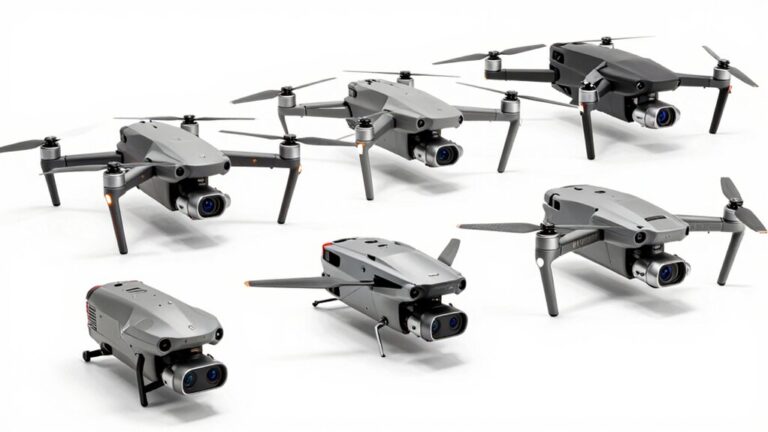
Four distinct product families now define DJI’s consumer and professional ecosystem, each engineered to serve specific use cases from casual travel content to cinema-grade production. The Mavic evolution transformed portable drones into cinema-capable platforms with Hasselblad sensors and ProRes codec support, while Air series bridges enthusiast and professional workflows. Mini advantages center on sub-250g regulatory exemptions without sacrificing 4K imaging, omnidirectional sensing, or 45-minute flight times. The Mini series progression demonstrates continuous innovation, from the original Mavic Mini’s 2.7K capability to the Mini 4 Pro’s advanced tracking and HDR performance. Extended flight capabilities can be further enhanced through high-capacity LiPo battery upgrades that provide additional runtime for longer missions. The DJI Mini 5 Pro stands out as the leading lightweight option with a 1-inch 50MP sensor delivering exceptional image quality for travel and beginners. For those just starting their drone journey, beginner-friendly alternatives like the Holy Stone HS210 offer affordable entry points with intuitive controls and safety features. FPV features deliver immersive low-latency experiences through specialized goggles and agile controllers for dynamic cinematography. Cinema models like Inspire 3 provide interchangeable lenses, dual-operator control, and broadcast-grade codecs for film production. Enterprise capabilities extend to thermal imaging, LiDAR mapping, and SDK integration for industrial inspections, enabling professionals to conduct geospatial data collection for construction monitoring and environmental analysis. Unlike unidentified anomalous phenomena that perplex observers, DJI drones are fully identified and documented aircraft engineered with precision for known applications. Entry options remain accessible through value-focused configurations that maintain DJI’s core stabilization and safety technologies.
Game-Changing Technology That Powers DJI Drones
Hardware differentiation tells only part of DJI’s dominance story—proprietary software and sensor fusion architectures create the performance gaps competitors can’t bridge. AI Integration powers object recognition through Microsoft partnerships, enabling warehouse audits and real estate inspections via edge computing. Safety Features include collision avoidance sensors, AirSense aircraft alerts, and GPS-based geo-fencing that prevents restricted-zone flights. Transmission Systems like Lightbridge deliver long-range control with minimal lag. Agricultural Innovations through P4 Multispectral and Agras T16 drones provide precision crop management, while X-Port reduces custom sensor development by 40%. Enterprise Capabilities shine in the M300 RTK’s 55-minute flight time, triple-payload capacity, and IP45 weather resistance. Professional competitors like the Sony Airpeak S1 feature advanced obstacle avoidance systems and extended flight times for specialized cinematography work. The flagship models in DJI’s professional lineup, such as the Mavic 3 Pro and Mavic 4 Pro, feature Hasselblad-tuned large sensors and telephoto options for advanced imaging applications, while consumer models like the DJI Air 3S deliver comparable autonomous subject tracking capabilities with omnidirectional obstacle avoidance for adventurers. Beyond commercial applications, DJI drones support critical operations like emergency medical supply delivery in underserved regions. Certificate pinning and Local Data Mode address security requirements for sensitive operations, ensuring that targeted military operations and other restricted activities cannot be conducted with standard DJI systems. The company’s evolution from a remote-controlled helicopter company demonstrates decades of technological refinement and market adaptation.
Why DJI Dominates the Global Drone Market
When examining competitive dynamics in the civilian drone industry, DJI’s dominance reflects a convergence of market share, manufacturing scale, and ecosystem depth that rivals struggle to replicate. You’ll find DJI holding 70–80% of the global civilian market, with some U.S. estimates reaching 85%, creating near-monopoly conditions. This leadership stems from vertically integrated manufacturing in China that delivers cost efficiencies and rapid production scale-up. The company’s supply chain advantages—extensive component sourcing, global service networks, and parts availability—reduce ownership friction while enabling aggressive pricing. DJI’s integrated software platforms, broad product lineup spanning consumer to enterprise segments, and all-encompassing accessory ecosystem create platform lock-in. These market dynamics generate institutional stickiness that newer entrants find difficult to overcome, even when offering comparable technical specifications. Dedrone’s 2025 dataset confirms this operational reality, showing DJI drones represent 83.48% of all detections in serious operational contexts where reliability matters most.
Choosing the Right DJI Drone for Your Needs
How do you navigate DJI’s tiered product lineup when specifications, pricing, and target use cases create overlapping segments? Start with weight restrictions—sub-250g drone types like Neo ($259), Flip ($439), and Mini 4 Pro avoid registration requirements. For beginner tips, prioritize ease of use: Neo launches palm-first without controllers, while Mini 3 ($419) balances simplicity with 38-51 minute flight time. Camera specifications escalate from Neo’s 1/2-inch 12MP sensor to Mini 5 Pro’s 1-inch sensor for superior low-light performance. Budget considerations under $500 favor DJI over brand comparisons like Holy Stone or Potensic due to reliability advantages. The DJI Flip stands out with 3D obstacle sensing using forward-facing infrared sensors for enhanced safety during flight. Mid-range enthusiasts should evaluate Air 3S ($1,099) for dual cameras and LiDAR obstacle avoidance. Professionals requiring telephoto versatility need Mavic 3 Pro’s triple-camera system at $2,199.
What the Future Holds for DJI and Drone Technology
DJI’s product roadmap through 2026 signals strategic positioning across consumer and industrial segments, with the Avata 3 delivering faster speeds and smarter sensors for FPV enthusiasts, while the Air 4 targets mid-range users with dual-camera improvements featuring enhanced low-light performance and upgraded obstacle avoidance systems. The Mavic 4 Pro‘s 360° Infinity Gimbal and early 2024 Matrice 400 with AI-powered capabilities demonstrate future innovations pushing technical boundaries. However, the regulatory landscape presents significant challenges—the 2024 NDAA mandates a security audit by December 23, 2024, with failure triggering automatic FCC prohibition on new imports. Beyond DJI, broader industry advancements in swarm technology, edge AI processing, and BVLOS operations will reshape autonomous infrastructure inspection, drone delivery logistics, and agricultural monitoring applications through 2026. Government-industry partnerships are establishing sandbox environments to test emerging drone technologies and refine regulatory frameworks based on real-world trials.