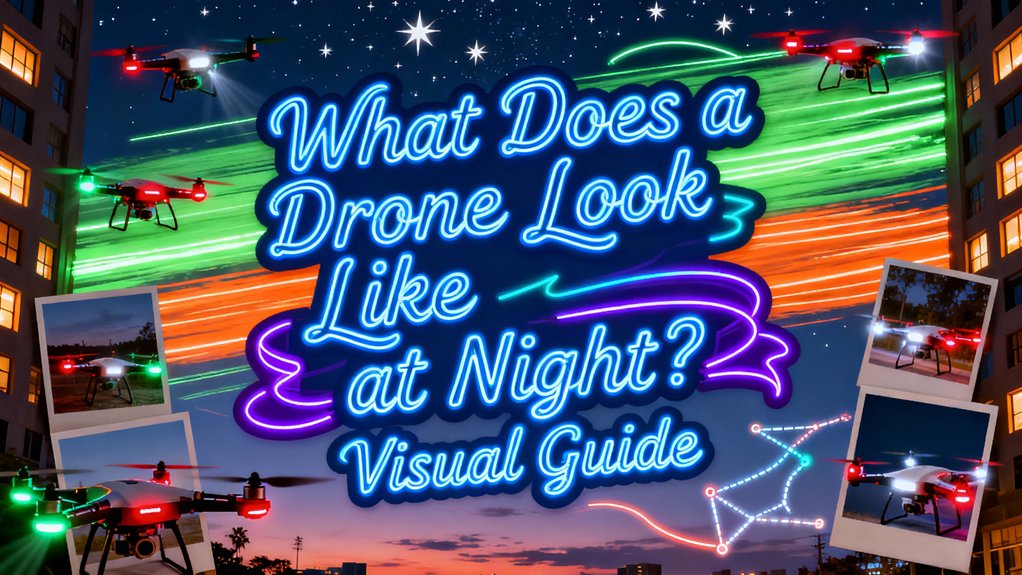
You’ll spot a compliant drone at night by its distinctive light pattern: red on the left, green on the right, and a white anti-collision strobe flashing 40-100 times per minute. These lights must be visible from three statute miles away per FAR 107.29. The cluster of LEDs appears smaller than manned aircraft, often accompanied by a high-pitched buzzing sound. Police drones display blue and red flashers, while surveillance models use dimmed infrared LEDs. Understanding these signatures helps you distinguish drones from aircraft and assess compliance risks.
Understanding Navigation Light Configuration and Colors
When operating drones at night, you must comply with FAA regulation FAR 107.29, which mandates anti-collision lighting visible for at least three statute miles in all directions. This lighting must strobe at 40-100 cycles per minute—solid lights alone don’t meet standards. Navigation light functions extend beyond basic compliance, helping you maintain visual line-of-sight and orientation in darkness. The color significance follows aviation standards: red lights mount on the left side, green on the right, and white provides additional navigation or anti-collision capability. You’ll notice drones use these colors together, with navigation lights remaining solid while anti-collision strobes flash. Multiple colors are permissible on a single aircraft, offering design flexibility while ensuring manned aircraft pilots can determine your drone’s heading from distance. Modern drones often incorporate customizable LED strips that enhance visibility during low-light conditions and improve orientation awareness for pilots. While red and green navigation lights are strongly recommended for orientation and directional awareness, they are not required by the FAA for Part 107 commercial drone operations. Understanding these lighting differences helps explain why drones may be misidentified as traditional aircraft at night. Drone operators should also be aware that state privacy laws may impose additional restrictions on nighttime flights, particularly when conducting surveillance operations over private property. Advanced models like the DJI Mavic series combine compliant lighting systems with quiet operation for professional nighttime filming and inspection work.
Identifying Anti-Collision Strobe Patterns
The FAA mandates anti-collision strobes operate between 40 and 100 flashes per minute—a specific range that distinguishes compliant lighting from inadequate alternatives. You’ll find operational checklists typically confirm a 60 bpm rate, ensuring visibility while meeting compliance standards. Solid lights or slow pulses don’t satisfy regulatory requirements; the flash pattern itself serves as the attention-grabbing mechanism that separates anti-collision from navigation lighting.
You can use white or red strobe patterns, with white offering superior contrast against dark backgrounds. Devices like LumeCube and LitraTorch 2.0 provide adjustable strobe settings—fast, slow, or S.O.S.—but only rhythmic flashing qualifies for anti-collision purposes. Solid modes switch your light to navigation-only function. High-performance options like the Firehouse Technologies ARC series deliver up to 1000 lumens with visibility ranges extending to four miles, making them particularly effective for nighttime operations. For DJI Mini series pilots, lightweight alternatives like the VIFLY Strobe offer 3+ mile visibility at just 6 grams with multi-color modes and 4-hour battery life. Law enforcement drones like the DJI Matrice 30T integrate thermal, zoom, and rangefinder capabilities for portable public safety missions requiring enhanced night visibility. While most modern DJI drones include built-in anti-collision lights, these stock lights typically don’t meet the FAA’s three-statute-mile visibility requirement for commercial or nighttime operations. Strobes should be mounted on top of the drone to maximize visibility to manned aircraft overhead. Anglers deploying drones for surf fishing should verify strobe visibility across GPS waypoint routes to maintain awareness of the aircraft’s position during extended line drops. Pre-flight verification of strobe function and 360-degree coverage remains critical for maintaining regulatory compliance and operational safety.
Recognizing Characteristic Flight and Movement Behaviors
Unlike manned aircraft constrained by momentum and human limitations, drones exhibit flight behaviors that immediately reveal their identity—if you know what to observe. Watch for stationary hovering techniques that maintain position against wind for 30-60 seconds with minimal drift—capabilities impossible for conventional aircraft. Police and survey drones demonstrate this persistent station-keeping during operational loitering.
Following hovers, you’ll notice distinctive acceleration patterns: short, rapid speed bursts with abrupt directional changes lacking smooth banking shifts. These mechanical movements appear deliberate and stepwise, particularly vertical ascents in discrete increments.
Grid-line patterns indicate survey operations, featuring systematic parallel tracks with intersection pauses. Orbiting behaviors reveal surveillance missions through tight, continuous loops with intermittent positional adjustments. This repeated repositioning—hover, shift, re-hover cycles—confirms drone operations versus transient aircraft flyovers. The duration of these flight patterns often depends on the drone’s battery capacity, with LiPo batteries enabling shorter high-intensity missions while Li-ion batteries support extended operational times. Some advanced military drones employ flapping wing designs that mimic bird flight patterns, creating smooth gliding movements rather than the typical mechanical hovering of conventional quadcopters. Modern consumer drones equipped with GPS lock maintain exceptionally stable navigation during extended hovering sequences, minimizing positional drift even in moderate wind conditions. Legal nighttime drone operations require anti-collision lights that flash at specific rates to distinguish them from manned aircraft in the sky. The flight controller processes real-time sensor data to execute these precise movement patterns and maintain stable positioning throughout various operational maneuvers. Effective identification relies on monitoring the combination of lights, sound, and movement behaviors to distinguish drones from other nighttime aerial objects.
Listening for Distinctive Sound Signatures
Beyond visual observation, acoustic signatures provide critical identification capabilities within 1 km range—particularly in low-visibility conditions where optical detection fails. You’ll detect drones by analyzing their distinctive sound frequency patterns using MFCC extraction methods that achieve 96% accuracy in controlled environments. Drone acoustics reveal unique propeller signatures through spectral analysis, with 13 MFCC coefficients providing key discriminative information. Process audio in 5-second frames at 48 kHz sampling rates, applying peak normalization before coefficient extraction. However, you must account for significant limitations: wind interference, ambient noise, and Doppler effects degrade detection beyond 1 km. Deploy SVM or LSTM classifiers trained on spectrograms for reliable make-model identification. Real-world accuracy drops to 86% in open-set scenarios, requiring robust preprocessing and frame-based validation protocols. Most observers can identify drones within a few hundred feet by their characteristic high-pitched electric buzzing or whirring sound, which serves as an accessible detection method without specialized equipment. Consumer drones typically operate at 70-90 decibels, comparable to vacuum cleaners or busy city traffic, though the sound diminishes significantly with altitude. Modern drone detection systems achieve optimal performance through sensor fusion techniques that combine acoustic monitoring with optical, infrared, and radio frequency detection modalities. Acoustic detection methods complement radar-based systems that excel in poor visibility conditions where visual identification becomes unreliable. Security platforms equipped with AI object detection can automatically classify drone models based on acoustic patterns, enhancing nighttime surveillance capabilities. Advanced systems integrate RF detection capabilities to passively monitor communication signals between drones and pilots, providing additional verification when acoustic signatures are masked by environmental noise.
Differentiating Drones From Aircraft and Celestial Objects
When operating in nocturnal environments, you’ll identify drones by their distinctive navigation light configurations that differ fundamentally from both manned aircraft and celestial objects. Aircraft display standardized port-side red and starboard-side green lights with ADS-B signals trackable through commercial flight monitoring systems. Drones lack these transponder emissions and exhibit smaller, clustered LED patterns rather than widely-spaced wingtip lights.
Effective drone identification techniques require distinguishing erratic movement from celestial movement patterns. Stars maintain fixed positions while planets follow predictable trajectories. Drones execute hovering maneuvers, sudden directional reversals, and grid-like scanning patterns that violate conventional flight paths. You’ll need optical detection equipment—400mm telephoto lenses, 50mm binoculars, or spotting scopes—to resolve these behavioral characteristics at distance. Blinking LED sequences and position-holding capabilities confirm unmanned aerial systems versus natural astronomical objects. Their ability to capture high-resolution imagery makes drones valuable tools for nighttime surveillance and inspection operations. Additionally, listening for the characteristic buzzing or humming noise from drone propellers provides auditory confirmation that distinguishes these devices from silent aircraft at altitude or celestial bodies. Monitoring battery health is critical for nighttime operations, as sudden power loss during flight can cause a drone to fall from the sky, posing risks to people and property below. All drones must comply with federal Remote ID requirements as of 2025, which transmit identification and location information that can aid in verification. If you observe a drone hovering over your property, be aware that state and local laws may provide additional privacy protections beyond federal regulations, particularly concerning surveillance and repeated overflights. Camera-equipped drones can capture images through windows just like conventional cameras, creating reasonable expectations of privacy concerns that vary by jurisdiction and location on your property.
Spotting Police and Law Enforcement Drones
Law enforcement drones stand out from civilian models through standardized operational protocols that prioritize regulatory compliance and mission-critical surveillance capabilities. You’ll identify them by steady anti-collision lights meeting drone regulations, distinct from recreational strobes. Detection technology like RF sensors captures police-specific models—Skydio or Flock DFR—while radar tracks loitering patterns under 400 feet. They hover stationary over incidents for extended periods, responding to ShotSpotter alerts or traffic stops. Thermal imaging reveals concentrated heat signatures from surveillance payloads like LPR scanners and facial recognition cameras. Unlike hobbyist drones, they maintain precise GPS holds and execute BVLOS operations across wide areas. Multi-sensor triangulation confirms pilot locations near real-time crime centers, distinguishing authorized law enforcement flights from unauthorized activity through verified radio frequencies and predictable deployment patterns. Police drones often carry high-resolution cameras up to 48 MP that enable detailed surveillance and evidence gathering during nighttime operations. Advanced models utilize low-latency transmission systems like O4 or OcuSync 4 to stream live HD video directly to command centers for real-time tactical decision-making.
Detecting Surveillance and Stealth Models
Surveillance and stealth drones exploit multi-spectral signature reduction to evade conventional detection methods, requiring you to employ layered counter-surveillance strategies that account for radar-absorbent materials, thermal masking, and visual camouflage. These drone types incorporate flying wing configurations, blended fuselage designs, and serrated panel edges that scatter radar returns. You won’t spot traditional navigation lights or reflective surfaces—stealth features include dark, non-reflective finishes and flush-mounted components. Thermal detection proves challenging due to buried engines with baffled intakes and concealed exhausts. Advanced autonomous combat drones like those employing low-observable shapes represent the evolution of stealth technology previously limited to manned aircraft. However, vulnerabilities emerge during operational moments: open payload bays temporarily increase radar cross-sections, and extended datalink antennas compromise low-observable profiles. Monitor for subtle infrared signatures near engine exhausts and watch for geometric silhouettes against ambient light sources to identify these advanced platforms.
Distance and Visibility Factors at Night
Beyond the stealth technologies that complicate detection, the baseline physics of light propagation and atmospheric transmission impose hard limits on how far you can spot any drone at night. Regulatory-compliant anti-collision strobes must achieve visibility range of three statute miles in clear air, yet real-world conditions frequently degrade that baseline. Urban light pollution cuts detection distance by tens of percent; fog and mist can collapse strobe visibility range from miles to mere hundreds of meters. Without strobes, naked-eye detection distance for small quadcopters drops below a few hundred meters under moonless conditions. High-intensity white strobes (40–100 flashes per minute) penetrate haze most effectively, but color contrast, ambient brightness, and atmospheric scatter all combine to impose practical ceiling on nighttime drone detection far below regulatory visibility standards. Flight duration also affects detection probability, as consumer drones typically achieve only 20-30 minutes of airborne time, creating limited windows for observation and tracking. Environmental factors like temperature extremes further reduce battery capacity, shortening operational time and making detection windows even more unpredictable. Advanced platforms equipped with thermal scanning capabilities can enhance nighttime detection by identifying heat signatures from drone motors and electronics, though this technology remains primarily in professional and enterprise applications. The FAA defines night as the period from civil twilight, specifically 30 minutes after sunset to 30 minutes before sunrise, when visibility conditions are at their most challenging and these detection limitations become most pronounced. In contrast to individual drones, drone light shows featuring hundreds or thousands of illuminated aircraft create vivid displays visible for miles, as each drone acts as a moving pixel with LED colors that stand out dramatically against the night sky. If you observe a drone flying suspiciously low or violating privacy boundaries during nighttime hours, property owners can report the activity to local law enforcement or the FAA rather than attempting to interfere with the aircraft themselves.
Common Viewing Scenarios and What to Expect
When you’re scanning the night sky for drone activity, standard consumer quadcopters present the most predictable visual signature: a tight cluster of navigation lights—red on the port side, green on starboard, white forward or aft—punctuated by periodic white strobe flashes at 40–100 pulses per minute. This configuration aids drone identification from up to three statute miles under clear conditions.
Police or emergency drones deviate from this pattern with blue and red flashing lights, executing controlled grid movements for operational tasks. Surveillance platforms deliberately minimize night visibility through dimmed infrared LEDs and matte finishes, making detection challenging. Border patrol surveillance drones like the Teal Golden Eagle and Autel EVO Max 4T often employ thermal imaging capabilities combined with high-altitude positioning to remain virtually invisible while monitoring large areas. Professional surveillance models such as the DJI Matrice 4T feature laser rangefinders extending up to 1200 meters for precise tactical targeting in low-light conditions.
Movement differentiates drones from aircraft: expect precise hovering, abrupt yaw rotations, sideways drift, and sudden altitude changes. Most nighttime drone operations occur within the 400 feet altitude limit mandated by aviation authorities to maintain airspace safety and prevent conflicts with manned aircraft. Mapping operations produce methodical back-and-forth patterns, while videography drones circle repeatedly around target locations. Advanced FPV racing drones equipped with DJI Goggles 3 can achieve extended flight times up to 30 minutes with enhanced low-light visibility through their O4 transmission system. Many modern security operations integrate drones with existing monitoring systems to enable automated patrols that launch instantly when perimeter alarms trigger, providing comprehensive aerial coverage without human intervention. Alongside visual cues, a consistent buzzing sound from the propellers can provide an early warning of drone presence, especially when the aircraft hovers nearby or changes altitude.