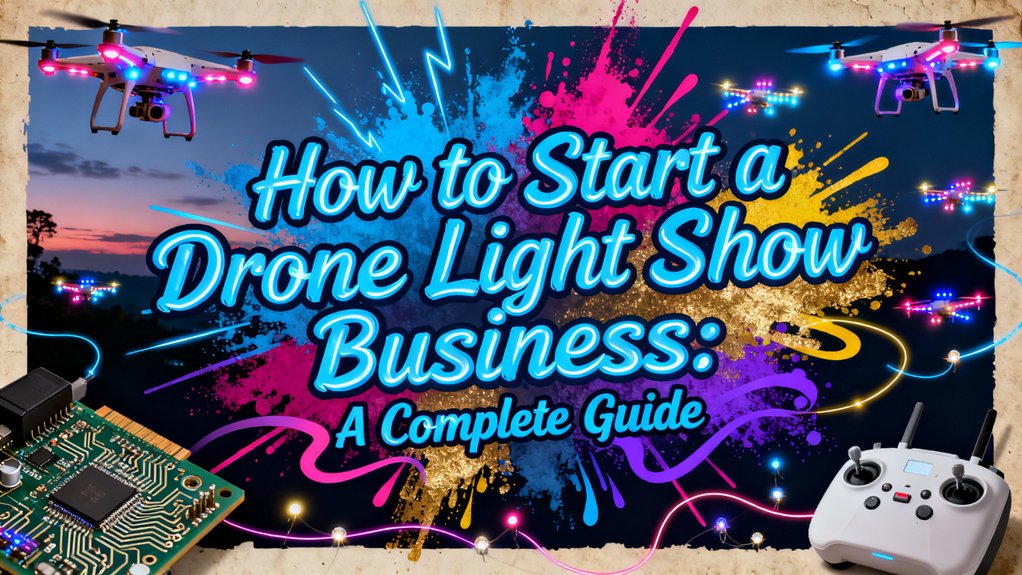
You’ll need $75,000–$250,000 in startup capital to acquire a commercial-grade drone fleet, control systems, and choreography software. First, obtain your Part 107 certificate and secure night operation waivers from the FAA. Invest 350+ hours in technical training covering flight operations, show design, and safety protocols. Build tiered service packages starting at $18,000–$25,000 for 100-drone shows, then target corporate clients and event planners through LinkedIn and portfolio demonstrations. This guide breaks down each component—from equipment specifications to client acquisition strategies—so you can enter this billion-dollar market effectively.
Understanding the Drone Light Show Market and Revenue Potential
Before you invest capital and time into launching a drone light show operation, you need to grasp the market’s trajectory and monetization mechanics. The global sector is expanding at 15–21% CAGR, with valuations ranging from USD 1.56–1.95 billion in 2024 and projections reaching USD 4.6–14.1 billion by the early 2030s depending on methodology. North America commands 35–38% market share, while Asia-Pacific shows the fastest growth.
Your revenue streams will span event production (ticketed shows, corporate contracts), retainer agreements with municipalities and sports franchises, creative licensing for branded campaigns, and hardware sales or leasing. The growing demand for eco-friendly alternatives to fireworks has opened new opportunities in public festivals and environmental initiatives where traditional pyrotechnics face increasing restrictions. Professional operators have demonstrated the medium’s commercial viability on high-profile platforms, with teams like Sky Elements performing drone light shows on *America’s Got Talent* using industry-leading equipment. While light show drones differ from surveying platforms, understanding the broader UAV ecosystem—including mission planning software used across commercial applications—can inform your operational workflows and fleet management systems. Behind every successful aerial display is a 3D animation team that transforms creative concepts into precisely choreographed flight paths using specialized software to coordinate hundreds of illuminated drones. Each drone in the fleet is equipped with bright LED lights that enable synchronized color changes to create intricate patterns and animations across the night sky. Advanced platforms now feature omnidirectional obstacle avoidance systems that enhance fleet safety during complex choreographed maneuvers in confined airspace. Understanding these market trends early shapes your go-to-market strategy, pricing architecture, and capital allocation decisions before you acquire your first drone fleet.
Essential Equipment and Technology Requirements
Every drone in your fleet functions as a luminous three-dimensional pixel, which means hardware selection directly determines your creative ceiling and operational reliability. Your drone specifications should include RGB LEDs (2–4W), RTK-enabled navigation technology, and redundant flight control systems. Battery management demands LiPo packs (1500–6000 mAh, 20C–45C rating) delivering 8–12 minutes of full-bright performance with adequate reserves.
Power infrastructure extends beyond aircraft: budget for multi-channel fast chargers, mission-control workstations, RTK base stations, and networking gear—even small 20-drone operations require 1,500W+ continuous capacity. Communication systems need low-latency RF links with spectrum coordination for fleet scalability. As your fleet grows, you’ll also need to consider RF detection systems that monitor communication signals to prevent unauthorized drones from interfering with your coordinated light show operations. While consumer drones feature omnidirectional sensors for collision avoidance, enterprise light show platforms integrate similar technology into synchronized fleet operations to prevent mid-air incidents during complex formations.
Your show choreography software must synchronize all assets, simulate flights pre-event, and implement fail-safe protocols. Modern ground control systems provide real-time 3D video previews that allow you to visualize formations before actual flight execution. Advanced systems can incorporate GPS and GLONASS guidance for enhanced positioning accuracy and redundancy in satellite navigation. Temperature-controlled charging areas and thorough safety measures aren’t optional—they’re regulatory and insurance prerequisites that protect your investment. Consider incorporating obstacle avoidance systems from consumer drone technology to add an extra layer of collision prevention during complex maneuvers. For commercial nighttime operations, ensure your drones meet the FAA’s three-statute-mile visibility requirement with appropriately bright anti-collision lights, as standard built-in lights often fall short of this regulatory standard.
Calculating Your Startup Investment and Ongoing Costs
Your capital allocation breaks into three distinct buckets: initial fleet acquisition, operational infrastructure, and working capital for permits and compliance. A 10-drone starter fleet runs $7,500–$10,000, while serious operators invest $75,000–$250,000 for commercial-grade systems with control software and spares. Your startup budget must also account for entity formation ($50–$500), pilot licensing ($150), and software training ($27/month). Operational expenses include setup and compliance costs ($1,000–$5,000 per event), accounting tools ($0–$60/month), and potential broadcast module retrofits ($115 per drone). A 300-drone fleet averaging $540,000 can generate $2.9M annually, delivering payback within six months when executing weekly shows. Calculate your break-even by dividing total investment by per-show profit margins ($3,000–$10,000 hourly rates minus operational expenses). Budget for liability insurance coverage at $450–$1,200 annually to protect against operational risks and meet client requirements. Understanding drone navigation lights—red on the left, green on the right, and white strobes pulsing at 40-100 cycles per minute—helps you verify proper pre-flight equipment functionality and ensures your fleet meets visibility requirements for nighttime operations. Equip each drone with FAA-compliant anti-collision strobes like the FireHouse Arc V or LumeCube Strobe for 360-degree visibility and reliable night flying performance. If you’re testing aerial choreography concepts on a budget, consider using a 125g FAA registration-free drone like the HOVERAir X1 for practice runs and pre-event scouting before deploying your full commercial fleet. For promotional content and marketing materials, invest in a drone with dual-camera systems like the DJI Air 3S to capture high-quality bird’s-eye footage of your light shows with extended flight times up to 45 minutes. Advanced operators can also leverage photogrammetry software to create 3D models of event venues from overlapping aerial images, enabling precise pre-show flight path planning and virtual rehearsals.
Obtaining Licenses, Permits, and Meeting Regulatory Requirements
Regulatory compliance forms the operational backbone of every drone light show, and steering through aviation authorities will consume weeks—sometimes months—of your launch timeline. You’ll start by securing a Part 107 certificate and then layer night-operation waivers, airspace authorizations, and Remote ID exemptions. Since 2021, certified Part 107 pilots can operate drones at night without special waivers if their aircraft are equipped with anti-collision lights visible from at least three statute miles and flashing at 40-100 times per minute. The FAA enforces mandatory registration for drones over 250 grams, which applies to virtually all light show aircraft used in commercial operations. Local jurisdictions add event permits, landowner consent, and public-safety approvals. Prepare thorough operations manuals and site-specific risk assessments (SORA frameworks are common in advanced regulatory frameworks) demonstrating geo-fencing, fail-safes, and emergency procedures. Staff qualifications, rehearsal logs, and compliance audits will be scrutinized. When flying over venues, respect privacy expectations and obtain consent from property owners, as state laws may impose additional restrictions on overflights even when federal FAA regulations are satisfied. Professional providers typically manage FAA filings and coordinate site assessments to streamline the approval process for clients. As of 2025, Remote ID capability is mandatory for most flights, requiring compliance through either built-in drone features, add-on modules, or FAA-Recognized Identification Areas. As the drone industry evolves, advanced models like the DJI RoboMaster S1 with robotic arms and Skydio X2 are expanding operational possibilities beyond traditional light shows into package delivery and inspection tasks. Finally, procure commercial liability insurance with limits matching your audience size—third-party coverage isn’t optional. Track every authorization in a centralized document library; regulators expect audit-ready records at each show.
Training Programs and Skill Development for Your Team
With permits secured and regulatory frameworks in place, building a proficient team becomes your next operational priority—and the learning curve for drone light show systems is steep. You’ll need defined team roles: a Show Designer/Choreographer for creating formations, and Ground Crew (one person per 50 drones) for setup and operations.
Training providers offer structured pathways. SPH Engineering delivers mandatory 3-day programs ($179-$990) covering drone software like Drone Show Designer and GCS operation. Vimdrones provides extensive system training including Blender integration and maintenance protocols, with comprehensive courses priced at $1,000 per participant. For budget-conscious startups, Drone Dojo offers self-paced online courses, while DroneBlocks supplies DIY kits supporting 10-200 drone swarms with complete curriculum.
Formats vary: on-site sessions in Latvia, Zoom-based instruction with recordings, or hybrid models combining theory and practical application. Expect 350+ hours for full proficiency across choreography, flight operations, and repair. Teams can practice with affordable camera drones from retailers like Walmart to develop basic piloting skills before transitioning to specialized light show hardware. Beginner-friendly brands like Holy Stone offer models with GPS and return-to-home functions that help new pilots build foundational flying skills safely. The DJI Mini 5 Pro stands out for training purposes with its sub-250g weight, omnidirectional obstacle avoidance, and beginner-friendly portability ideal for developing fundamental flight skills. For pilots developing manual control proficiency, the RadioMaster GX12 offers 1000Hz digital gimbals and Gemini X technology that provides precise tactile control in challenging conditions. As your operation scales, investing in affordable 3D printers like the Ender 3 V3 SE or Bambu Lab A1 Mini enables in-house production of replacement brackets, frames, and props to minimize downtime.
Building Your Service Packages and Pricing Strategy
Revenue architecture in drone light shows hinges on fleet size as your primary pricing lever. You’ll establish pricing models starting at $18,000-$25,000 for 100-drone basic packages, scaling to $50,000+ for 500+ drone productions. Your competitive analysis should benchmark regional operators while emphasizing service differentiation through package customization—offer tiered options from stock animations to fully custom storyboards with 3D rendering previews.
Structure your value proposition around turnkey execution: concept sessions, FAA Part 107 compliance, insurance, site evaluation, and soundtrack synchronization. Client communication must address show length (typically 15-18 minutes), travel costs from your operational base, and enhancement options like pyrotechnics or projection mapping. Deploy volume pricing for multi-show contracts at single locations, and pitch sponsorship integrations to municipal clients seeking cost offsets through branded sky displays. Your fleet must meet FAA requirements for nighttime operations, specifically equipping each drone with anti-collision lights that flash between 40 and 100 times per minute and remain visible from at least three statute miles away. While light shows require different technology than logistics operations, understanding how autonomous capabilities have enabled companies like Wing to complete over 450,000 deliveries demonstrates the maturity and reliability of commercial drone systems that also benefit entertainment applications. As urban air mobility evolves, the same eVTOL technology powering passenger drones like the EHang 184 demonstrates how battery and flight control innovations will continue reducing operational costs across all commercial drone sectors. When budgeting for fleet expansion, prioritize spare-battery options to minimize downtime between performances and ensure backup power for mission-critical shows. Consider how emerging bioinspired designs like flapping-wing ornithopters are advancing stealth and efficiency metrics that may influence future entertainment drone aesthetics and flight dynamics. As the technology matures and becomes more accessible, anticipate that small shows starting around $20,000 will become the industry standard entry point for basic productions.
Marketing Your Drone Light Show Business and Landing Your First Clients
Your pricing foundation means nothing without a systematic client acquisition engine. Deploy targeted client outreach through LinkedIn for corporate events and Instagram for weddings. Your marketing strategies must showcase visual proof—post show reels demonstrating logo formations and custom animations. Leverage social media platforms like TikTok and YouTube for viral potential, establishing branding techniques that emphasize eco-friendly positioning. Focus audience engagement on high-traffic events: city festivals, sports halftimes, product launches. Secure promotional partnerships with event planners and venues for reciprocal referrals. Pursue event collaboration opportunities at crowded locations during national celebrations. Maximize networking opportunities through industry conferences and chambers of commerce. Document every activation professionally—this content becomes your sales engine, converting spectators into clients through earned media coverage and shareable moments. Just as specialized equipment like waterproof drones has revolutionized fishing technology, invest in weather-resistant hardware that demonstrates your commitment to performance in challenging conditions. Consider capturing shows with 360-degree cameras mounted on drones to create immersive VR content that gives potential clients a first-person perspective of your formations. Position your drone shows as a sustainable alternative to fireworks, highlighting the pollution reduction benefits that resonate with eco-conscious clients and municipalities. Emphasize how specialized software enables you to transform any logo, mascot, or brand message into a synchronized aerial performance that creates unforgettable moments for audiences. Incorporate drones with LED lighting for night visibility to ensure your formations remain clearly visible during evening performances, maximizing visual impact for audiences and demonstrating professional-grade equipment capabilities to prospective clients. Equip your fleet with models featuring omnidirectional obstacle avoidance to ensure safe operations in complex environments with multiple drones flying simultaneously, reducing collision risks during intricate formations.