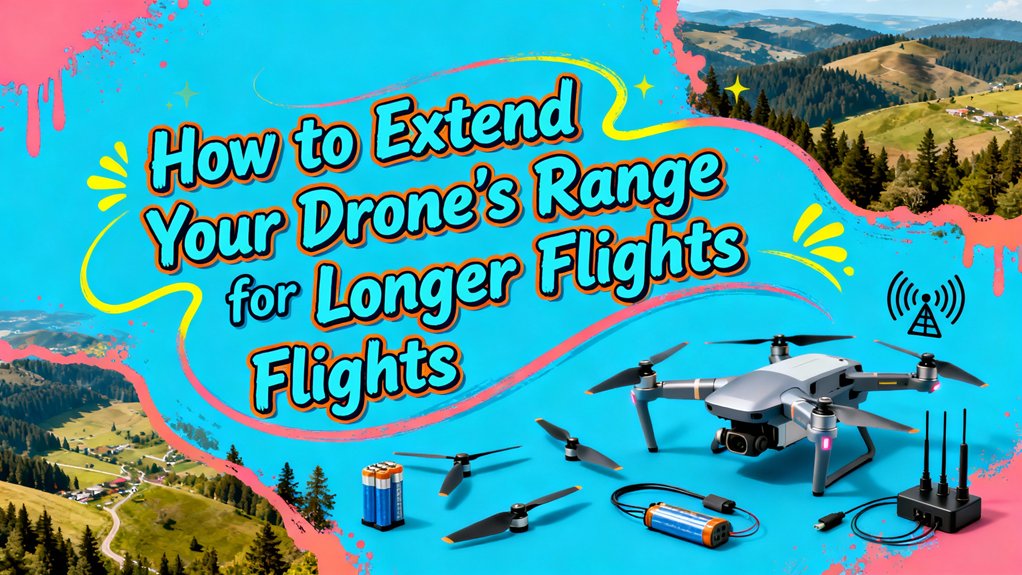
You’ll extend your drone’s range by upgrading to high-energy-density batteries (300–420 Wh/kg), reducing airframe weight by 10–30% with carbon-fiber materials, and optimizing motor-propeller combinations for up to 19% efficiency gains. Install RF amplifiers and directional antennas to achieve 3-5X transmission range increases, while implementing smart power management that adapts thrust dynamically during flight phases. Strategic route planning using high-resolution wind data and shallow battery cycling (20–80% SoC) further maximize operational distance—the complete methodology involves nine integrated system modifications that transform flight capabilities.
Upgrade to High-Energy-Density Batteries and Smart Power Management
Because energy storage remains the fundamental bottleneck in multirotor endurance, upgrading to advanced battery chemistries offers the most direct path to meaningful range extension. Solid-state and silicon-anode lithium cells deliver 300–420 Wh/kg versus conventional LiPo’s 140–200 Wh/kg, translating to 20–50% flight-time gains. NMC variants at 250–330 Wh/kg provide proven supply chains with strong performance. Yet battery advancements alone aren’t sufficient—proper pack configuration (6S to 14S series arrangements) and thermal management prevent derating under high discharge.
Smart energy management amplifies these gains. Advanced BMS monitors per-cell voltage, temperature, SoC, and SoH, preventing weak-cell drag. Adaptive power-scaling adjusts thrust dynamically based on remaining capacity and mission phase, eliminating wasted energy during cruise. Shallow cycling (20–80% state-of-charge) and predictive mission planning preserve cycle life while pushing usable range closer to theoretical limits with controlled risk. Different capacity options ranging from 5,000mAh to 100,000mAh accommodate diverse mission profiles, from compact racing drones to heavy-lift industrial platforms. Pairing appropriate C-rating specifications with voltage configurations ensures batteries can sustain high-discharge demands during aggressive maneuvering without performance degradation. Leading manufacturers such as DJI and Tattu offer configurations optimized for long cycle life and stable voltage output across demanding flight profiles. For specialized applications, platforms like the Autel Robotics EVO II Pro demonstrate how extended flight times enable precise manipulation tasks in challenging environments where battery endurance directly determines mission success. Pilots must also consider how FPV goggles battery capacity affects overall system runtime, particularly when flying freestyle or long-range cine missions where both aircraft and display endurance matter. When planning extended-range operations, ensure compliance with Remote ID requirements, as aviation authorities now mandate location broadcasting for all registered drones to maintain safe integration with controlled airspace.
Reduce Weight and Optimize Aerodynamics for Maximum Efficiency
While battery chemistry sets the upper bound on stored energy, airframe efficiency determines how far each watt-hour actually carries you. Reducing structural weight through lightweight materials—carbon-fiber fasteners, topology-optimized additive-manufactured ribs, and mission-matched payloads—can cut airframe mass by 10–30% and directly extend endurance. Replace metal brackets with high-strength polymers and streamline wiring harnesses to shed hundreds of grams. Simultaneously, minimize drag by adopting aerodynamic shapes: swap square booms for airfoil profiles, enclose electronics behind smooth fairings, and integrate sensors flush with the fuselage. Even modest drag reductions translate to measurable range gains. Match propeller geometry to your motor using performance maps rather than off-the-shelf sizes, and apply smooth surface finishes to maintain laminar flow. For specialized applications, consider payload capacity requirements early in the design phase, as fishing drones and industrial platforms often need to carry additional equipment that affects flight dynamics. Positioning the root trailing edge at or behind the fuselage trailing edge achieves maximum streamlining and improves stability. For beginners learning to optimize their first platforms, entry-level models like those with propeller guards offer durability while testing efficiency modifications before scaling to advanced builds. These optimizations are particularly valuable in industries like energy, construction, and agriculture, where extended flight times help reduce operational costs and improve data collection efficiency. In agricultural applications, advanced GPS and sensor systems enable precise delivery of substances while maximizing flight efficiency and coverage area. Together, weight reduction and aerodynamic optimization maximize efficiency across your flight envelope.
Enhance Motor and Propulsion System Performance
The propulsion system represents your drone’s single largest energy consumer, typically accounting for 60–80% of total power draw during forward flight. Motor selection directly impacts this consumption—optimization tools can identify motor-propeller combinations delivering 19% efficiency gains over baseline configurations. Conduct efficiency analysis through systematic testing across voltage ranges and thrust requirements to match components to your mission profile.
Advanced control strategies further enhance performance. Particle Swarm Optimization-tuned Fuzzy PID controllers reduce overshoot while improving stability during dynamic operations. Coordinate motor torque with propeller pitch and governor speed to minimize input power for required thrust levels. Systems that dynamically adjust power bus voltage with altitude changes ensure optimal performance across varying flight conditions. For extended-range applications, hybrid propulsion systems combining electric motors with smaller combustion engines reduce fuel consumption while maintaining energy availability. Reinforcement learning algorithms optimize power distribution in real-time, adapting to altitude-induced air density variations. Modern drones like the DJI Air 3S demonstrate how efficient propulsion paired with advanced obstacle avoidance technology extends operational range while maintaining flight safety. Premium models such as the DJI Mavic 4 Pro achieve flight times exceeding 45 minutes through optimized propulsion design combined with intelligent power management systems. The Skydio X2 incorporates detachable arms supporting up to 2 kg for package delivery and inspections, enhanced by its advanced obstacle avoidance system that maximizes operational efficiency. Adding LED lighting to your drone can improve visibility during extended-range missions without significantly impacting flight duration when using efficient systems. When conducting aerial testing, be aware that unidentified anomalous phenomena have been reported by military and commercial pilots, though most sightings are eventually explained as conventional objects like weather balloons or drones.
Install RF Range Extenders and Directional Antennas
When radio frequency transmission becomes your range-limiting factor, RF amplifiers and directional antennas deliver measurable performance gains that extend operational boundaries beyond stock configurations. RF booster installation requires connecting the unit to your controller’s antenna port, selecting the appropriate frequency band (2.4G for maximum distance, 5.8G for reduced latency), and maintaining vertical antenna orientation while avoiding metal obstructions. Systems like the ROC-4 provide 10W amplification, achieving 3-5X range increases up to 5 miles in unobstructed environments. Directional antenna benefits include concentrated signal patterns that enhance forward transmission strength and maintain link stability during extended operations. The ROC-4’s built-in 8000mAh battery eliminates dependence on external power sources, delivering 6-8 hours of continuous signal boosting for all-day operations. Monitor signal metrics via LED displays and verify FCC compliance—4W operates license-free, while higher outputs require permits. Real-world performance typically shows range extensions of 30% to 70% under optimal conditions, with results varying based on environment and interference levels. Extended range operations must comply with FAA regulations requiring visual line of sight maintenance and adherence to altitude restrictions when flying over both public and private property. Modern drone range capabilities trace back to innovations in radio-controlled technology, pioneered by inventors like Nikola Tesla who demonstrated wireless remote control in 1898. Be aware that these enhanced transmission capabilities make your drone more detectable to RF detection systems that monitor drone communication signals and control transmissions. Always power units with antennas connected to prevent controller damage.
Switch to Long-Range Telemetry and Communication Systems
Amplified RF signals strengthen your controller’s reach, but long-range telemetry modules fundamentally transform operational capabilities by establishing dedicated data channels that maintain connectivity across distances exceeding 30-60km. Military-grade D03 modules deliver non-line-of-sight data transfer with anti-jamming protection, supporting TTL/RS232 interfaces at 345bps through XT30 power connections. These modules feature compact and lightweight construction at just 43g without antenna, making them ideal for installations with space and weight constraints while maintaining power efficiency for UAV control systems. For video-critical missions, InfoFly-SDI communication systems achieve 100km range with 1080P transmission at 6Mbps bandwidth and sub-250ms latency. These platforms transmit battery voltage, GPS coordinates, altitude, and airspeed in real-time while operating across -10~+50℃ temperature ranges. L/S band operation ensures rapid link establishment under 10ms with electromagnetic compatibility that won’t interfere with GPS or gimbals. Modern telemetry systems enable persistent surveillance and real-time intelligence gathering that have become essential for extended-range operations. Long-endurance VTOLs like the JOUAV CW series and Dragonfish leverage these advanced communication systems for wide-area search and persistent ISR missions. For truly global operations, satellite-based command and control enables BVLOS missions by allowing operators to send commands and receive telemetry data from drones anywhere in the world using networks like Iridium. SiK Telemetry Radios provide budget-conscious alternatives starting at $58.99, delivering robust long range telemetry without significant weight penalties.
Plan Flight Routes and Weather Conditions Strategically
Strategic route planning and weather analysis directly impact mission endurance by reducing unnecessary energy expenditure through optimized flight paths and atmospheric conditions. Maximize route efficiency by designing straight-line legs, minimizing sharp turns, and maintaining consistent altitudes to avoid energy-costly climbs. Use mission-simulation tools to model battery consumption across alternative routes before takeoff. Enable terrain-follow modes over variable topography to prevent inefficient altitude corrections.
Leverage weather forecasting to schedule flights during favorable conditions. Obtain high-resolution wind data at your planned altitude and configure routes to exploit tailwinds while avoiding headwinds. Avoid operations during gusty or turbulent periods that increase control effort. Schedule missions during temperature windows that optimize battery performance—cold conditions notably reduce usable capacity. Monitor precipitation and icing risks that add weight and drag, forcing mission aborts. Ensure battery capacity is adequate for the entire planned flight duration including contingency reserves. Consider that drone weight significantly affects flight duration, as heavier payloads require more power to maintain altitude and forward motion. Remember that aggressive maneuvers drain batteries significantly faster than smooth, steady flight patterns, so maintain consistent velocity and gradual heading changes throughout your mission. Practice smooth stick movements during flight operations to minimize unnecessary drone corrections that consume additional power. Real-world conditions like wind, temperature, and flying style can reduce actual flight time by 10-30% compared to manufacturer specifications. Always verify that your planned flight altitude complies with FAA regulations, as airspace restrictions may limit operational ceiling and require route adjustments.
Implement Field Charging Solutions for Extended Operations
Effective route and weather planning reduces in-flight energy consumption, but sustained operations in remote locations require robust on-site power infrastructure to maintain continuous sortie cycles. Portable power stations (500–3000+ Wh) deliver multiple battery charges without grid access, while generators provide high sustained output at the cost of fuel logistics and noise. Select ruggedized inverters with pure sine output and sufficient peak current for fast-charger demands. Mobile stations—vehicle-integrated charging hubs with onboard battery banks and DC–DC converters—enable silent operation and rapid swaps during multi-drone missions. Automated hangars with contact-based docking support 24/7 BVLOS operations through weatherproof enclosures and redundant UPS backup. Match chargers to battery chemistry and manufacturer profiles to prevent cell damage during expedited recharge cycles. Intelligent Battery Management Systems monitor cell health and prevent overcharging to enhance both performance and safety during field operations. Li-ion batteries offer superior cycle life compared to LiPo alternatives, making them ideal for industrial operations requiring frequent field recharging. When selecting replacement batteries, verify voltage requirements and physical dimensions to ensure compatibility with your drone’s power specifications and charging infrastructure. Professional platforms with extended flight times of 41-42 minutes demand higher-capacity field charging solutions to maintain operational tempo during long-duration missions. Maintain batteries in dry environments with consistent temperatures to prevent moisture-related corrosion and preserve optimal performance between field charging sessions.
Explore Tethered and Hybrid Power Options
When battery swaps and field charging can’t meet mission duration requirements, tethered power systems eliminate endurance constraints by delivering continuous electricity through reinforced cables that combine high-voltage conductors with fiber-optic data links. A tethered drone receives up to 9kW via 400V DC transmission, which onboard converters step down to operational voltages for propulsion and payload systems. The tether supports 40-100 Gbps encrypted data transfer while enabling unlimited flight time at altitudes up to 200 feet. Hybrid power configurations integrate onboard batteries for surge capacity and emergency landing capability if tether connection fails. These systems deploy in under 10 minutes for ISR missions, communications relay, and surveillance operations where persistent aerial presence outweighs mobility requirements. Ground stations feature actively cooled reels with auto-tensioning mechanisms. Tethered systems achieve up to 30 days of continuous flight time for extended surveillance missions.
Navigate Regulatory Requirements for Beyond Visual Line of Sight Operations
Beyond Visual Line of Sight operations face strict regulatory barriers under FAA Part 107, which mandates that remote pilots maintain visual contact with their aircraft using unaided vision—excluding FPV systems as primary observation methods. You’ll need to submit waiver applications demonstrating thorough safety measures, including detect-and-avoid systems and ADS-B tracking capabilities. Regulatory compliance requires detailed operational procedures, equipment specifications, and risk mitigation protocols—a process that’s time-consuming and approval-uncertain. Current operational limitations restrict most flights to 400 feet altitude in Class G airspace. The FAA’s proposed rule change and anticipated Part 108 framework aim to streamline BVLOS authorization by September 2025, establishing standardized certification requirements for collision-detection systems, cybersecurity protocols, and pilot ratings while eliminating case-by-case waiver dependencies for routine operations. Under the proposed regulations, drones must launch from FAA-approved locations to ensure controlled deployment zones for beyond visual line of sight missions.