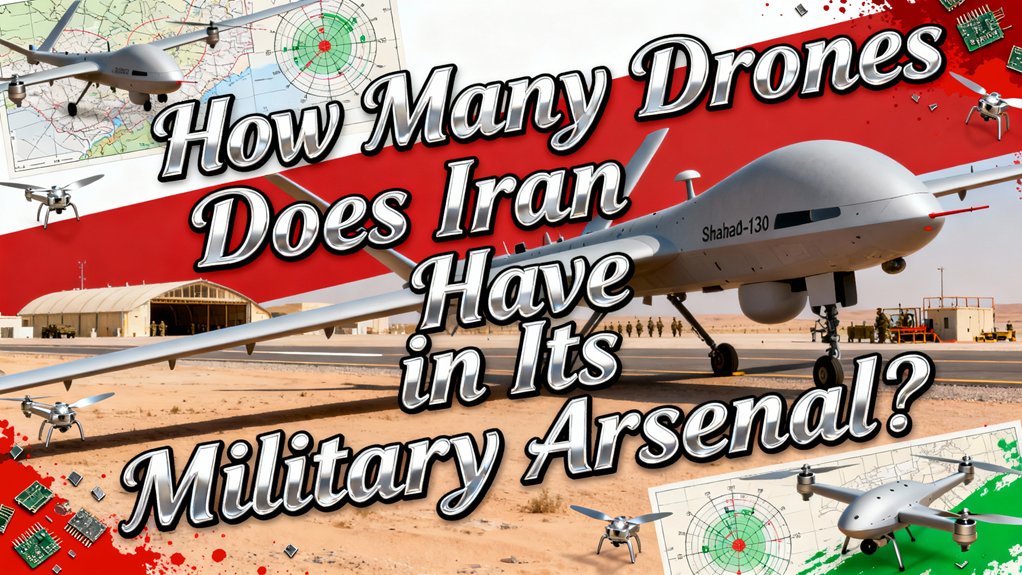
Iran’s military operates approximately 3,894 unmanned aerial vehicles across all branches, though Western intelligence assessments often undercount this fleet by thousands of units. You’ll find diverse platforms ranging from tactical Ababil reconnaissance drones to mass-produced Shahed-136 loitering munitions that cost just $20,000-$50,000 each. Iran’s production facilities can manufacture up to 6,000 airframes annually, with recent modernization efforts incorporating AI-powered targeting and jet-propulsion systems. This arsenal supports both domestic operations and extensive exports to Russia and regional proxies, with detailed specifications revealing the strategic implications of each platform.
Total Inventory Numbers Across All Branches
Iran’s unmanned aerial vehicle fleet comprises approximately 3,894 aircraft across all branches, positioning the nation among the world’s largest drone operators. You’ll find these inventory estimates reflect significant inconsistencies in official reporting, making precise counts challenging. Global Firepower lists 551 total aircraft, though this figure excludes dedicated drone breakdowns and differs substantially from extensive assessments.
The arsenal encompasses diverse drone types serving intelligence, surveillance, reconnaissance (ISR), and direct-attack roles. You’re looking at capabilities ranging from loitering munitions to long-range strike platforms, many reverse-engineered from foreign designs. Recent acquisitions have substantially expanded operational capacity, with the army alone receiving 1,000 new long-range drones. These additions underscore Iran’s strategic emphasis on unmanned systems as force multipliers, compensating for conventional air power limitations through asymmetric capabilities. The inventory includes more than a dozen distinct models with varying specifications, from the compact Meraj-521 carrying just 3 kilograms of explosives to the sophisticated Shahed-149 Gaza, Iran’s most advanced platform featuring a 22-meter wingspan and 2,500-kilometer operational range. The Shahed-136, measuring 3.5 meters in length with a 2.5-meter wingspan, represents a particularly significant component of Iran’s arsenal, weighing approximately 200 kilograms and carrying 30-50 kilogram warheads capable of striking targets over 2,000 kilometers away. The widespread deployment of these affordable platforms creates a negative cost-exchange ratio that challenges traditional air defense systems, as interceptor missiles often cost significantly more than the drones they target. Iran has extended its drone proliferation beyond domestic use by supplying allied groups such as Houthis, Hezbollah, and militias in Iraq. While military drones operate under different regulatory frameworks than civilian aircraft, commercial operators must adhere to FAA regulations including altitude restrictions and registration requirements when flying unmanned systems. As drone technology continues advancing, delivery systems featuring robust payload capacity are transforming logistics by enabling rapid and cost-effective transportation of goods across diverse terrains.
Ababil Series: The Army’s Recon-Attack Workhorse
Among Iran’s most prolific unmanned platforms, the Ababil series represents a multi-generational family of tactical reconnaissance and attack drones that have evolved from basic surveillance assets into capable combat systems. The Ababil features progression across five variants demonstrates Iran’s incremental capability development. The Ababil-2, revealed in 1999, operates with ranges up to 120 kilometers carrying 40 kilograms of explosives. The Ababil-3 provides 100-kilometer range with night-vision capability and four-hour endurance. Tactical applications expanded considerably with the Ababil-4, extending operational distance to 480 kilometers and 30-hour flight time while carrying four Almas anti-tank missiles. The latest Ababil-5 variant achieves 2,400-kilometer range, 24-hour reconnaissance endurance, and accommodates six precision-guided munitions across two hardpoints, powered by a 141-horsepower Rotax engine with 1,000-kilogram maximum takeoff weight. The Ababil-5’s body incorporates sharp angles and lines to minimize radar cross section, enhancing its survivability in contested airspace. Modern reconnaissance variants utilize video transmitters to relay real-time intelligence feeds to ground control stations, ensuring commanders receive continuous battlefield awareness during extended missions. Advanced systems now integrate AI-powered predictive analytics to automate threat detection and enhance operational decision-making during reconnaissance missions. Pre-flight procedures require operators to verify that the battery is properly inserted and charged before activating the remote controller and aircraft systems. Beyond military applications, drone technology has expanded into agricultural sectors where GPS and sensor systems enable precise delivery of pesticides,
Shahed-131 and Shahed-136: Long-Range Loitering Munitions
The Shahed-131 and Shahed-136 represent Iran’s entry into mass-produced loitering munitions, designed as expendable kamikaze drones that navigate to pre-programmed coordinates and detonate on impact rather than return to base. You’ll find the Shahed-131 carries a 10–20 kg warhead with ranges around 700–900 km, while the larger Shahed-136 delivers 30–50 kg across 1,000–2,000 km using a rear-mounted piston engine. Both rely on commercial GPS/GLONASS navigation with inertial backup, enabling mid-flight retasking via satellite links in some variants. Their operational effectiveness stems from mass-launch tactics and low unit costs rather than individual lethality. The Shahed-136 features a delta-wing shape design with stabilizing rudders, measuring 3.5 m in length with a 2.5 m wingspan. These platforms benefit from multi-sensor integration and autonomous flight capabilities that allow flexible deployment across diverse operational environments. While civilian drones increasingly use high-resolution imagery for agricultural monitoring and crop health assessment, these military systems prioritize target coordinates over dynamic recognition features. Unlike consumer models with AI subject tracking used for recreational photography, these military systems prioritize target coordinates over dynamic recognition features. Contemporary consumer drones employ autonomous tracking systems for applications ranging from photography to personal convenience gadgets, contrasting sharply with military-grade navigation protocols. Unlike dedicated reconnaissance drones such as the RQ-4 Global Hawk that prioritize intelligence gathering through advanced sensors, the Shahed series focuses exclusively on one-way strike missions. The strategic implications are clear: widespread deployment in Ukraine and the Middle East demonstrates how affordable, composite-airframe munitions can overwhelm air defenses through attrition.
Mohajer Series: Medium to Long-Range Strike Platforms
Spanning four decades of iterative development, the Mohajer series has evolved from basic reconnaissance platforms into multi-role strike systems that form the backbone of Iran’s tactical UAV fleet. You’ll find the Mohajer-2’s modest 50 km range and 70 kg airframe has progressed to the Mohajer-10’s 2,000 km operational reach and 300 kg payload capacity. Mohajer 10 features include an electro-optical turret with 100x zoom capability and eight guided munition hardpoints carrying Qayam bombs. Mohajer 6 upgrades deliver four Qaem-5 precision weapons with fire-and-forget targeting through the Oghab-4 system’s 36x zoom and laser rangefinder. The series maintains operational flexibility with 24-hour endurance at 7,000 m altitude, enabling persistent surveillance and strike missions across extended battlespaces. While commercial drones increasingly incorporate advanced obstacle avoidance and autonomous tracking capabilities, military platforms like the Mohajer series prioritize payload capacity and operational range for strategic missions. The Mohajer series’ range capabilities fall between consumer drones limited to 3 kilometers and top-tier military reconnaissance drones like the RQ-4 Global Hawk with its 14,000-mile operational radius. First operational units were deployed with IRGC ground forces in 2024, marking the transition from development to active service. Ground control stations integrate high-brightness displays to ensure operators maintain visibility of real-time telemetry and targeting data during daylight field operations. Night operations frequently require thermal sensors to maintain target acquisition and navigation capabilities in low-visibility conditions. Intelligence-gathering variants integrate LiDAR compatibility for generating detailed topographic maps and three-dimensional terrain models of strategic areas.
Jet-Powered Kamikaze Drones: Speed and Penetration
While reconnaissance and strike platforms like the Mohajer series provide sustained battlefield presence, Iran’s jet-powered kamikaze drones represent a doctrinal shift toward speed-based penetration of defended targets. You’ll find the Shahed-238 achieves 500 km/h with a 1,200 km range, while the Hadid-110 reaches 510 km/h—nearly triple the piston-powered Shahed-136’s 185 km/h. These speed advantages reduce interception windows against layered air defenses. The Hadid-110’s faceted airframe enhances penetration efficiency through radar signal diffusion, mirroring Western stealth cruise missile design. Both systems carry seekers (IR/RF) for precision strikes, though reduced endurance—2 hours for Shahed-238, 1 hour for Hadid-110—limits loiter capabilities. The Shahed-238’s operational ceiling of 30,000 ft enables engagement profiles beyond the reach of many short-range air defense systems. Unlike commercial models with obstacle avoidance features like the DJI Air 3S, military kamikaze drones prioritize terminal velocity and target penetration over collision prevention. In contrast to recreational drones which require FAA registration for units over 250 grams, these military systems operate under entirely different regulatory frameworks. Unlike multi-rotor drones prized for hovering ability and precise control, these fixed-wing kamikaze platforms sacrifice maneuverability for speed and range in their terminal attack profiles. Advanced military reconnaissance drones now incorporate AI-powered subject tracking for autonomous target acquisition, a capability that enhances precision engagement in contested environments. While military drones prioritize speed and payload capacity, consumer platforms focus on flight stability and user-friendly controls for recreational pilots. You’re observing Iran’s evolution from expendable swarm tactics toward fast, penetrating strikes against fixed infrastructure.
Hull Age and Modernization Status
Iran’s modernization timeline accelerated dramatically between 2022-2026, transforming legacy platforms and introducing specialized capabilities. You’ll notice the Shahid Bagheri represents this shift—converted from a commercial container ship between 2022-2024, now spanning 240 meters with integrated weapons systems. The platform demonstrates how Iran repurposed aging hulls into forward-deployed drone carriers. Enhanced drone capabilities emerged through systematic upgrades: GPS navigation replaced older systems by October 2023, while AI integration enabled autonomous target selection. The January 2026 delivery of 1,000 Arash drones with 2,000 km ranges marked a quantitative leap. By May 2026, specialized variants like Homa VTOL and Dideban electronic warfare systems expanded operational flexibility. Modern drones now feature embedded GPS for stable positioning, Return to Home functionality, and Follow Me mode that enhances autonomous operations. These unmanned aerial vehicles enable surveillance and engagement operations while allowing Iran to reduce risk to military personnel during targeted strikes. Advanced systems now integrate thermal imaging capabilities that enhance search and detection operations in challenging environments and low-visibility conditions. Iranian drone operations face varying international legal constraints, as state laws in different jurisdictions impose distinct requirements for surveillance activities, particularly regarding altitude, duration, and technology deployment. The incorporation of 360-degree camera technology in some reconnaissance variants enables immersive real-time intelligence gathering for ground control stations. This rapid modernization timeline transformed dated assets into multi-domain strike platforms supporting sustained autonomous operations. The drone program’s foundations trace back to the Iran-Iraq War, when limited access to U.S. military aircraft forced Iran to develop indigenous UAV capabilities beginning in the 1980s.
Export Sales to Russia and Financial Impact
Beyond domestic fleet expansion, Tehran’s drone program generates revenue through strategic exports, with Russia becoming its primary customer since 2022. You’ll find Shahed-131 and Shahed-136 models supplying Moscow’s Ukraine operations, with Russia manufacturing them locally as Geran-2. This drone financing model proves economically asymmetric—each unit costs approximately $35,000, potentially under $20,000 in production, yet forces adversaries to deploy million-dollar air defense systems. Iran’s export strategies leverage low-cost commercial components sourced globally, enabling mass production that funds broader military expansion despite sanctions. The recent introduction of the jet-powered Hadid-110 represents Iran’s shift toward faster strike capabilities, reaching speeds up to 517 km/h compared to the propeller-driven Shahed-136’s 185 km/h cruise speed. US Treasury sanctions target Iran’s MODAFL and front companies facilitating these transfers, while intercepted shipments reveal hundreds of drone engines destined for proxy forces. These exports simultaneously deplete Tehran’s stockpiles—over 1,000 drones launched at Israel—while generating capital for jet-powered variants like Shahed-238.
Proliferation to Regional Proxies and Allied Nations
Tehran’s proxy warfare strategy distributes drones across a network spanning Yemen to Venezuela, amplifying regional influence while maintaining operational deniability. You’ll find Iranian UAVs deployed by Houthis disrupting Red Sea shipping routes, Hamas militants operating weaponized systems with U.S.-origin components procured through Chinese entities, and Iraqi militias conducting strikes like the 2024 Jordan attack killing three U.S. soldiers. This drone technology enables low-cost asymmetric warfare across regional conflicts.
Iran outsourced Mohajer-6 production to Venezuela while fulfilling requests for advanced systems featuring 1,000 km range and GPS jamming capabilities. The IRGC supplies Hezbollah and Syrian proxies despite Israeli strikes damaging manufacturing infrastructure. Western sanctions target these supply chains, though Iran’s distributed production model and Chinese procurement networks sustain proxy capabilities throughout the Middle East and beyond. Tehran’s ability to deliver requested military equipment faces uncertainty following recent conflict-related depletion of stockpiles that require rebuilding.
Domestic Production Capacity and Industrial Support
Industrial facilities under Islamic Revolutionary Guard Corps Aerospace Force management form the backbone of Iran’s drone production infrastructure, with specialized sites assembling Shahed-136 variants and other UAV platforms. You’ll find these facilities operate shift-based systems targeting 10 drones per shift initially, demonstrating impressive manufacturing efficiency. Iran’s recent delivery of 1,000 long-range drones to its army, featuring 2,000km capabilities like Arash models, showcases this capacity. Production costs range from $20,000-$50,000 per unit, enabling mass deployment strategies. Ongoing drone innovation emphasizes stealth features, reduced radar cross-sections, and nap-of-the-earth flight capabilities. Iran’s technical blueprints now enable partner facilities like Russia’s Alabuga to produce 407 airframes monthly, with planned annual outputs reaching 6,000 units by mid-2025, considerably extending Iran’s strategic reach. The contracted delivery deadline of September 2025 aligns with strategic deployment schedules for large-scale drone operations.