You’ll extend your drone’s flight time by selecting the right battery chemistry—LiPo for high discharge, Li-ion for efficiency, or LiFePO4 for stability. Calculate required capacity by multiplying cruise power by desired flight duration, then add 20-30% reserve. Match your C-rating to application demands, optimize weight distribution near center-of-gravity, and maintain a 2:1 thrust-to-weight ratio. Implement proper charging protocols, store at 30-60% charge, and conduct systematic ground testing. The specifics of maximizing each variable reveal substantial performance gains.
Understanding Battery Chemistry and Energy Density
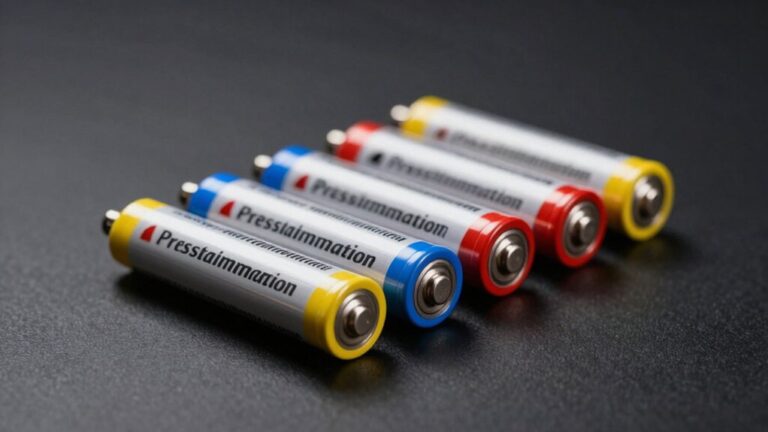
When you’re upgrading your drone’s battery, you’re really choosing between competing chemistries—each with distinct tradeoffs between energy density, power delivery, cycle life, and thermal stability. LiPo dominates hobby drones because it delivers high discharge rates and resists voltage sag during aggressive maneuvers. Li-ion offers superior energy efficiency and longer cycle life but sacrifices peak power. LiFePO4 excels in thermal stability yet reduces flight duration due to lower energy density. Advanced chemistries—high-nickel ternary and semi-solid cells—promise 300–500 Wh/kg, extending endurance by 20–50%. Your weight impact depends on chemistry selection; heavier packs compromise payload capacity and agility. Match discharge rates to your motor demands; undersized cells cause voltage collapse and ESC faults. Leading brands like DJI, Tattu, and Gens Ace offer reliable options across various configurations to ensure compatibility with your specific drone model. Popular configurations include 6S 4000–6200mAh 60–100C packs for long-range quads and smaller 1S–4S packs for micro whoops. A Battery Management System protects your battery from overcharging and deep discharging, extending overall lifespan through intelligent cell balancing. Proper battery management prevents thermal runaway. LiPo batteries require careful handling to avoid damage and ensure safe operation during storage and flight. These batteries function through electrochemical redox reactions where lithium ions move between the anode and cathode to create electrical current. Using high-quality chargers] prevents battery degradation and maintains optimal performance across charge cycles.
Calculating Optimal Pack Capacity and Weight Balance
Because your drone’s endurance and handling depend critically on battery sizing, you’ll need to balance energy capacity against the weight penalties it introduces. Start by calculating required watt-hours: multiply your cruise power (W) by desired flight time (h), then convert to amp-hours at your pack voltage. Add 20–30% reserve capacity for safety and cycle longevity.
Next, weigh the trade-offs. Pack weight reduces payload and increases hover power, diminishing returns beyond certain thresholds. Position heavier packs near your aircraft’s center of gravity to minimize trim changes and preserve flight stability. Verify your frame can handle increased static loads, and confirm thrust-to-weight ratio remains above 2:1. Remember that higher capacity results in longer flight durations but can add significant weight, so testing various batteries is recommended to identify your optimal configuration. Most consumer drones see real-world flight time reduced by 10-30% due to wind and temperature conditions, so account for these practical limitations when selecting your upgrade. Ensure you comply with FAA regulations regarding safe battery operation and drone registration requirements. This systematic approach prevents overbuilding while maximizing practical endurance.
Selecting the Right C-Rating for Your Application
How do you know if your battery can safely deliver the power your motors demand? Understanding C rating importance is fundamental to battery compatibility with your drone’s components.
Calculate your peak current draw by multiplying C-rating by capacity (mAh/1000). Your result must meet or exceed your motor and ESC requirements. For instance, motors demanding 25A need a battery yielding at least 25A output.
Match your application needs precisely. Racing drones require 100C+, while general use demands only 10C-20C. Professional cinematography falls between 30C-90C. Higher C-ratings deliver power quickly, reducing overheating and enabling maximum motor performance safely. For optimal longevity, consider that battery chemistry types like LiPo support standard charging rates of 0.5C–1C, which affects both performance and lifespan. Popular options like CNHL Racing Series offer high C-ratings specifically designed for demanding FPV applications. For immersive FPV flying experiences, pairing your battery selection with quality FPV goggles and controllers ensures your power delivery matches your equipment’s capabilities. Reliable brands ensure that batteries meet safety and performance standards through rigorous testing, which is critical for maintaining consistency across your drone operations.
Don’t exceed your actual requirements—doing so adds unnecessary cost without performance gains. Your ESC limits current regardless of battery capability, making precise matching essential for ideal battery compatibility and flight safety.
Upgrading Your Power System for Efficiency Gains
Now that you’ve matched your battery’s C-rating to your drone’s power demands, you can push further by optimizing how that power flows through your system. Upgrade your power distribution by replacing low-voltage rails with a higher-voltage bus architecture—48V systems reduce resistive losses considerably. Install high-efficiency DC-DC converters exceeding 95% efficiency to minimize conversion waste between battery and avionics.
Implement intelligent management through real-time monitoring systems that prioritize critical loads and shed nonessential consumers during high-demand phases. This adaptive control preserves battery energy for propulsion when you need it most. Dynamic communication power management adjusts transmission strength based on signal quality, preventing wasteful power consumption in your communication systems. Before implementing major system upgrades, verify that physical dimensions and connector compatibility align with your drone’s specifications to avoid performance degradation.
Consider energy sources augmentation: integrate super-capacitor banks to handle takeoff surges, or explore hydrogen fuel cells for extended missions. For extreme endurance requirements, gas-powered systems offer approximately 50 times greater energy density than traditional batteries, enabling long-distance operations. Many commercial applications now favor compact drone models that optimize weight and power efficiency for practical deployment. Hybrid power systems that combine multiple energy sources with intelligent switching between piston engines, generators, and batteries offer superior efficiency compared to single-source architectures. For industrial applications requiring maximum endurance, semi-solid state batteries provide exceptional cycle life and extended flight times compared to conventional lithium options. These efficiency upgrades compound, delivering measurable flight-time gains without increasing battery capacity.
Choosing High-Performance Propellers and Motors
Your battery and power system improvements mean nothing if your propellers and motors can’t convert that energy into efficient thrust. Propeller selection and motor compatibility form the foundation of flight efficiency gains.
Match your motor’s KV rating to your chosen propeller diameter and pitch—lower KV pairs better with larger props for efficient low-RPM operation. Verify your motor’s torque capacity exceeds the propeller’s demand to avoid overheating and efficiency loss. High-performance motors like the EMAX ECO II series offer excellent thrust-to-weight ratios ideal for optimizing endurance configurations.
For endurance flights, select two-blade propellers with high aspect ratio to minimize induced losses. Pair them with lightweight, stiff materials like carbon fiber that maintain airfoil geometry under load, preserving aerodynamic efficiency. Like premium micro drones that achieve up to 45-minute flight times, optimizing your propeller and motor combination is essential for maximizing endurance. Research shows that propeller efficiency peaks at specific RPM ranges, typically when thrust generation balances motor output for optimal energy conversion. The choice between racing-oriented and endurance-focused propeller designs significantly impacts your overall flight duration and energy consumption profiles.
Reference manufacturer test data for thrust, RPM, and power curves. Choose the largest propeller diameter your frame and motor torque limits allow, maximizing thrust-per-watt and reducing current draw during hover. Professional-grade applications like fixed-wing drones demonstrate that optimized motor-propeller systems can achieve exceptional endurance results comparable to commercial platforms. Remember that all drones over 250 grams must comply with Remote ID regulations to ensure legal operation.
Implementing Proper Charging and Maintenance Practices
Maximizing your drone battery’s lifespan and performance hinges on mastering charging and maintenance fundamentals. You’ll want to use manufacturer-recommended chargers supporting PD and QC charging protocols for stable voltage delivery. Before each session, inspect your battery for swelling, punctures, or corrosion on terminals.
Charge on non-flammable surfaces in well-ventilated areas, monitoring the process constantly. Maintain charging environments between 50°F to 77°F, disconnecting immediately upon full charge to prevent degradation. Avoid overnight charging sessions as they increase the risk of overheating or overcharging. Most DJI controllers require typical charging times of approximately 90 to 120 minutes depending on the specific model. The 1100 mAh lithium-polymer battery pack can typically handle over 200–300 charging cycles before requiring replacement. To prevent battery degradation during travel, consider using high-capacity power banks for convenient charging during outdoor adventures. For battery maintenance, allow batteries to cool after flights before charging, and store units at 30-60% charge for long-term preservation. Regularly clean terminals with dry cloths and update your battery management system with the latest firmware to optimize performance monitoring and detection accuracy. These practices promote peak performance and extend your investment’s operational life considerably.
Navigating Firmware Settings and Safety Parameters
Three critical components—aircraft, controller, and battery—must maintain firmware synchronization to access full power-management capabilities and prevent operational lockouts. You’ll need to update all three simultaneously; mismatched versions trigger incompatibility warnings and ground your aircraft until resolved.
Before updating, charge batteries to at least 80% and keep all devices powered throughout the process. You’ll install updates one battery at a time using your manufacturer’s recommended pathway—mobile app OTA, desktop utility, or MicroSD card method. Don’t interrupt the installation. Consistent firmware across your fleet reduces support issues and ensures efficient preflight checks through controller-aircraft communication consistency.
Updated firmware recalibrates safety protocols, including discharge limits, voltage cutoffs, thermal-management responses, and return-to-home calculations. You may notice reduced usable flight time as firmware tightens safety margins. LiPo and lithium-ion batteries typically offer 300-400 charge cycles before capacity degradation becomes significant. For advanced aerial applications requiring extended flight capabilities, consider integrating hyperspectral camera systems that can optimize power management alongside your battery firmware updates. Proper battery storage practices, such as maintaining charge levels between 40% and 65%, can help preserve capacity alongside firmware optimization. Storing batteries in cool, dry places away from extreme temperatures further extends their service life and maintains stability. After updates, conduct ground testing to measure actual flight-time changes before operational missions.
Evaluating Aftermarket Battery Options Versus DIY Modifications
Once you’ve synchronized your firmware across all three components, you’ll face a critical decision: whether to upgrade with manufacturer batteries or explore aftermarket options. Aftermarket packs offer superior energy density and flexible form factors, but they demand careful vetting. Prioritize vendor safety validation and BMS quality—especially for Li-ion chemistries—to mitigate thermal and failure risks. Evaluate watt-hour per kilogram metrics to predict real flight-time gains against added mass. Testing actual capacity through discharge at slower rates (~2C) reveals whether manufacturer C-Rating claims match real-world performance. For extended storage of your current or new batteries, properly discharge them to 3.80-3.90V if unused beyond 3 days to preserve cell health. Most DJI drones rely on Lithium-Polymer and Lithium-Ion batteries for their high energy density and extended flight capabilities. Models like the DJI Mini 3 demonstrate how manufacturer-optimized batteries can deliver exceptional flight durations of 38-51 minutes when properly maintained. Environmental factors like temperature extremes and aggressive flying styles can significantly accelerate battery degradation and reduce the lifespan of your investment. Each drone model is engineered with specific voltage, capacity, and connector requirements that vary across brands and models, making cross-model battery swapping inadvisable. DIY modifications carry substantial risks; undersized connectors and poor solder joints compromise safety under high current. Unless you’re experienced with battery engineering, aftermarket options from reputable vendors provide superior reliability than DIY modifications. Verify mechanical fit to prevent center-of-gravity shifts that degrade handling.
Testing and Validating Your Battery Upgrades Before Flight
Before you take your upgraded battery to the skies, you’ll need to verify its performance through systematic testing that measures capacity, internal resistance, and cell balance.
Your test procedures should include constant power discharge tests at multiple wattage levels—50W, 75W, 100W, and 125W—to simulate realistic flight conditions. Check individual cell voltages using the balance leads to confirm cells remain balanced and prevent over-discharging. Measure internal resistance using the VDA Current Step Method with a 20C pulse over 18 seconds, evaluating resistance at 2s, 10s, and 18s intervals. Use programmable loads with data logging capabilities connected to PC software to ensure accurate measurements throughout testing.
Perform burst tests incrementally increasing current by 2C per second until reaching 3.3V per cell. This performance validation reveals capacity fade rates, voltage curves, and Coulombic efficiency. Ensure your battery specifications match your drone’s motors, ESCs, and flight controller to prevent performance degradation or safety issues. DJI’s intelligent battery management systems incorporate multiple safety protections that monitor battery status in real-time during testing and operation. Before finalizing your testing protocol, inspect the battery for physical damage such as water exposure or impact that could compromise performance. Additionally, proper battery lighting and anti-collision lighting visibility during testing helps ensure safe operational validation. To maintain optimal battery health during testing, ensure charging occurs at temperatures between 0°C and 40°C to prevent thermal stress. Document all measurements against manufacturer specifications before flight operations commence.