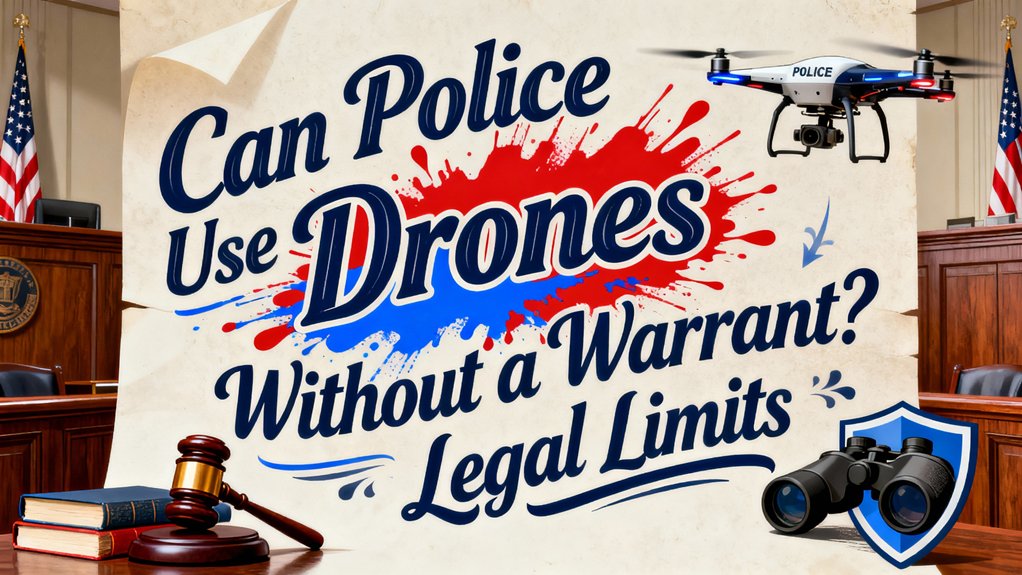
Police can use drones without a warrant only under narrow emergency exceptions—imminent threats, active shooters, or search-and-rescue operations—though you’re protected by Fourth Amendment standards and state-specific legislation. Eighteen states require warrants for drone surveillance, applying precedents like *California v. Ciraolo* while courts scrutinize altitude, duration, and technological capabilities. Federal regulations remain minimal, creating jurisdictional variations in privacy protections. Your rights depend greatly on your state’s statutory framework, and understanding these constitutional boundaries, operational restrictions, and oversight mechanisms will clarify exactly where law enforcement authority ends and your privacy begins.
Federal Legal Framework for Police Drone Surveillance
While the Fourth Amendment prohibits unreasonable searches and seizures, the Supreme Court hasn’t explicitly addressed whether police need warrants to deploy drones for surveillance. You’ll find courts instead rely on aerial observation precedents like *California v. Ciraolo*, though drones differ fundamentally from manned aircraft through persistent low-altitude capabilities and advanced sensors. Federal regulations governing surveillance technology remain significantly absent—no extensive national law establishes warrant requirements or data handling protocols. The FAA regulates airspace operations, not privacy protections, leaving a critical gap. Approximately 18 states have filled this void by mandating warrants, while federal baseline standards continue tolerating warrantless aerial observations. Many states have enacted stricter regulations than federal law, with over a dozen requiring law enforcement to obtain a warrant before deploying drones for surveillance, especially over private property or for extended periods. Modern police drones connect to smartphones through Wi-Fi and Bluetooth connections, allowing officers to operate surveillance equipment with touch-screen inputs and real-time video streaming capabilities. Police drone operations are generally restricted to below 400 feet in uncontrolled airspace, though authorization is required in controlled airspace near sensitive locations. The emerging national security considerations reflected in recent legislation like the 2025 NDAA demonstrate how national security priorities are reshaping the regulatory environment for all drone operations. However, *Kyllo v. United States* suggests advanced sensor technologies like thermal imaging may trigger warrant requirements, creating doctrinal uncertainty around sophisticated drone capabilities. State and local laws may also impose additional restrictions concerning privacy and surveillance beyond federal requirements. The expanding drone technology used by law enforcement necessitates meaningful regulations to establish guardrails that protect civil rights, particularly as courts continue considering factors such as altitude, duration, technology capabilities, and the nature of the property observed.
State-by-State Warrant Requirements and Variations
At least eighteen states have enacted legislation mandating warrants for police drone surveillance, creating a patchwork of privacy protections that markedly exceeds federal baseline standards. These state statutes include Alaska, Florida, Idaho, Illinois, Indiana, Iowa, Maine, Montana, Nevada, North Carolina, North Dakota, Oregon, Tennessee, Texas, Utah, Vermont, Virginia, and Wisconsin. Eleven of thirteen states with extensive drone regulations require warrants before governmental deployment. The first drone-related legislation emerged in 2013 across states including Florida, Texas, and Virginia.
Judicial precedents further strengthen these protections. California’s *Cook* decision requires warrants for aerial surveillance of private property, extending explicitly to drones. Pennsylvania’s *Edmunds* and *Alexander* cases emphasize independent state constitutional analysis, while Michigan’s *Long Lake* ruling rejects altitude-based exceptions. Illinois specifies probable cause requirements for drone deployment over private property. Vermont, Virginia, and Wisconsin prohibit warrantless UAS surveillance absent exigent circumstances, establishing robust fourth amendment analogues. Professional-grade surveillance drones equipped with thermal imaging and laser rangefinders have heightened privacy concerns among legislators seeking to regulate law enforcement capabilities. These high-capacity surveillance systems can carry specialized sensors weighing several kilograms, requiring careful consideration of payload capacity limitations when law enforcement agencies assess operational feasibility. Like civilian drone operators, law enforcement agencies must also obtain FAA authorization when deploying drones in controlled airspace to ensure safe coordination with manned aircraft. Law enforcement agencies operating drones at night must ensure their aircraft are equipped with anti-collision lights that meet federal visibility standards to maintain safe airspace compliance. Many jurisdictions are also considering standardization of law enforcement drone programs through mission-planning software integration to enhance operational accountability and oversight.
Emergency Exceptions That Permit Warrantless Drone Use
State warrant mandates govern routine police drone operations, yet nearly every jurisdiction carves out emergency exceptions that permit warrantless deployment when specific threats materialize. You’ll find exigent circumstances authorize immediate drone use when probable cause establishes an imminent threat to life or serious bodily injury—active shooters, hostage crises, or rapidly deteriorating medical emergencies. Search-and-rescue missions for missing persons typically bypass warrant requirements, leveraging thermal imaging and rapid area coverage to locate endangered individuals. Agencies deploying drones in SAR operations benefit from obstacle avoidance and autonomous navigation systems that enable rapid deployment and systematic area scanning. Advanced SAR drones can achieve 70 minutes of flight time, allowing comprehensive coverage of expansive terrain during critical search operations. Imminent public safety threats—explosive devices, chemical releases, mass incidents—justify warrantless aerial assessment for tactical decision-making and hazard mapping. Modern SAR drones feature extended flight endurance capabilities that allow extended coverage of large search areas. These drones can be instantly deployed when alarms trigger to provide real-time situational awareness during evolving emergency situations. Hot pursuit with probable cause permits drone tracking of fleeing suspects. Modern law enforcement drones deployed in these scenarios feature capabilities like real-time video feeds, AI detection systems, and extended flight endurance that enhance emergency response effectiveness. However, agencies must document exigency through sworn affidavits, limit mission scope narrowly to the threat, and maintain detailed operational logs to withstand judicial scrutiny and prevent evidence suppression. Written consent from property owners or individuals provides another exception, allowing law enforcement to collect personal information through drone surveillance without obtaining judicial authorization.
Privacy Protections and Constitutional Boundaries
Fourth Amendment protections against unreasonable searches apply to police drone surveillance, but you’ll encounter a fact-intensive inquiry that hinges on whether you possess a reasonable expectation of privacy in the surveilled location and whether the technology employed reveals details otherwise shielded from public view. Under *Kyllo v. United States*, sense-enhancing technology that penetrates your home’s interior constitutes a search requiring a warrant. Technological advancements like thermal imaging and high-zoom optics trigger heightened scrutiny when they reveal information unavailable to naked-eye observation. The privacy implications of prolonged, persistent drone monitoring—capturing movement patterns over time—invoke mosaic theory concerns, treating aggregated data collection as a Fourth Amendment search. Drones at night can be identified by their distinctive navigation light patterns, which distinguishes them from aircraft and other airborne objects. State constitutions often impose stricter warrant requirements than federal baselines, reflecting varied judicial interpretations of evolving surveillance capabilities. More than 20 states have enacted statutes regulating drone use, with some jurisdictions mandating warrants for law enforcement aerial surveillance operations. In New York City specifically, law enforcement drone operations are further constrained by local permit requirements that govern all FAA-registered drone activities within city limits. Commercial drone operators must obtain a Part 107 Remote Pilot Certificate to legally conduct professional aerial operations, and law enforcement agencies using drones for surveillance should similarly adhere to established licensing and operational standards. Property owners should understand that the FAA regulates airspace] above private property, and drone pilots have a responsibility to respect privacy and obtain consent before conducting surveillance, and drone detection systems can help identify unauthorized monitoring activities in your airspace.
Prohibited Applications and Oversight Mechanisms
How extensively may law enforcement deploy drones before crossing constitutional thresholds? Drone regulations impose categorical prohibitions beyond warrant requirements. Federal and state statutes ban weaponized unmanned aircraft systems, with Oregon, Maryland, Vermont, North Dakota, Florida, and West Virginia codifying explicit prohibitions. You’ll find restrictions targeting specific applications: voyeurism, hunting interference, and deployment near correctional facilities in New Jersey, North Carolina, South Dakota, and Texas. Florida’s Freedom from Unwarranted Surveillance Act establishes thorough evidence-gathering prohibitions, while Texas restricts flights over private property and critical infrastructure. Most countries enforce a 400 feet altitude limit above ground level for all drone operations to ensure airspace safety and prevent conflicts with manned aircraft. Modern law enforcement drone detection systems increasingly employ sensor fusion techniques to identify unauthorized unmanned aircraft and prevent illicit surveillance operations. Surveillance oversight mechanisms include mandatory flight record retention for public scrutiny and inadmissibility of unlawfully gathered data. California enforces privacy laws prohibiting capturing images or recordings without consent to protect residents from unauthorized surveillance. Law enforcement agencies must distinguish between reconnaissance drones used for intelligence gathering and combat-capable systems in their operational protocols. Domestic drone use remains subject to audits and oversight designed to prevent operational misuse and ensure accountability. Drone operations in National Parks are comprehensively prohibited under federal policy to protect wildlife and preserve the visitor experience. FAA compliance under Title 14 CFR remains compulsory, restricting nighttime operations, flights over populated areas, and controlled airspace access without operational waivers.