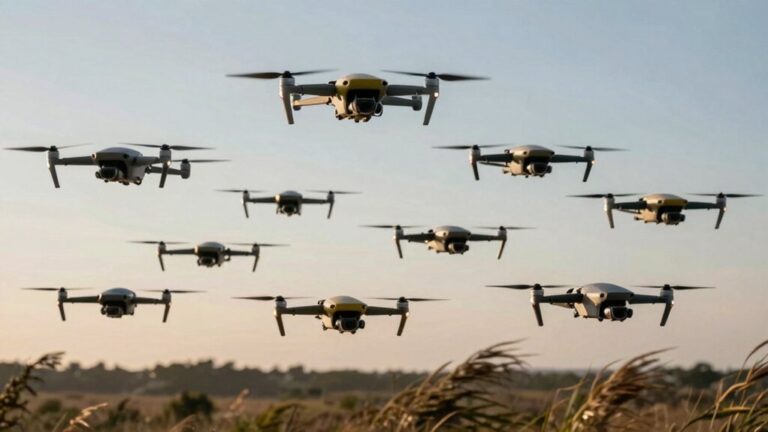
You’ll find the DJI Mini 3 and Mavic 4 Pro leading consumer drones with 51-minute maximum flight times, while the Air 3 delivers 46 minutes with advanced obstacle avoidance. Enterprise fixed-wing VTOL hybrids extend operations to 24+ hours using hydrogen fuel cells that provide 3–6x the endurance of lithium-ion batteries. Real-world performance typically runs 10-30% lower than manufacturer claims due to wind, temperature, and payload factors. Understanding battery technologies, platform types, and hot-swap systems will help you maximize mission duration.
Consumer Drones With Maximum Single-Battery Flight Times
Flight endurance separates flagship consumer drones from budget alternatives, and recent advances have pushed single-battery times beyond 50 minutes for select models. The DJI Mini 3 with Intelligent Flight Battery Plus leads consumer drone selection at 51 minutes advertised, while the Air 3 family achieves 45–46 minutes and Mavic 3 variants reach 43–46 minutes depending on configuration. Autel’s EVO series competes with 40–42 minute maximums. Real-world performance typically falls 10–30% below manufacturer claims due to wind, payload, temperature, and flight profile. The DJI Mavic 4 Pro extends this further with 51 minutes of flight time and an impressive 25.5-mile range based on 2026 expert tests. The DJI Air 3S delivers exceptional endurance with 45+ minute flight times while incorporating dual lenses and LiDAR obstacle avoidance for enhanced reliability. Effective battery management demands warm storage in cold conditions, clean propellers, and firmware updates that optimize ESC efficiency. High-resolution filming and heavy gimbals reduce endurance substantially compared to hover or cruise modes. Advanced models like the Mavic 4 Pro feature a triple-camera system with telephoto lenses that enables versatile shooting without requiring battery-draining altitude changes. Experienced pilots can extend flight times through smooth control inputs that minimize unnecessary power consumption. Budget models like the ProMark P70 GPS Shadow Drone typically offer shorter flight durations but incorporate Return to Home functionality that ensures the aircraft returns safely before battery depletion. Safety features like auto-return help preserve battery life by automatically bringing the drone home when power reserves reach critical thresholds.
Enterprise and Industrial Drones Built for Extended Endurance
Enterprise operations demanding multi-hour coverage have driven development of fixed-wing VTOL hybrids and alternative-energy platforms that dwarf consumer flight times. You’ll find hydrogen fuel cells delivering 3–6× endurance gains over lithium-ion—systems like the CW-25H report 330-minute missions versus sub-150-minute battery equivalents. Hybrid architectures combine internal combustion with electric motors, enabling 2–24+ hour sorties for mapping, pipeline inspection, and maritime patrol while preserving vertical takeoff capability. Heavy fuel UAVs powered by piston or turbine engines push endurance beyond 25 hours for ISR and BVLOS surveying, though they carry higher acoustic signatures and regulatory burdens. Fixed-wing platforms like the HN-VF40P achieve 12-hour endurance through hybrid VTOL design, making them ideal for precision mapping and extensive surveying operations. Endurance optimization trades payload capacity: high-power sensors can slash flight time 20–70%. Weather conditions including wind speed and temperature directly influence battery efficiency and operational duration. These platforms require specialized ground support, refueling infrastructure, and case-by-case flight approvals.
Ultra-Portable Travel Drones Optimized for Long Runtime
When portability constraints demand sub-250g airframes, you’ll sacrifice the multi-hour endurance of enterprise platforms but gain regulatory exemptions and pack-anywhere convenience. The DJI Mini 3 leads compact portability with 51 minutes maximum flight time using its Intelligent Flight Battery Plus, while maintaining 249g weight and 25km transmission range. DJI’s Mini 4 Pro delivers 45 minutes runtime with 4K video capabilities in a sub-250g package designed for one-day exploration. The Air 3, though heavier, extends travel convenience with 46 minutes flight time, omnidirectional obstacle avoidance, and dual-camera versatility for car-based trips. Autel’s EVO Nano+ offers 28 minutes at 4K@30fps with subject tracking features. The Mavic 3 Classic provides 45 minutes endurance with 5.1K@50fps recording and OcuSync 3.0 for backpacker-focused applications. The DJI Mini 5 Pro stands out with its 1-inch sensor enabling 4K/120fps video and true vertical shooting capabilities while remaining under 250g for maximum portability. For specialized applications beyond aerial photography, models like the DJI FlyCart 30 integrate winch systems to deliver payloads up to 30kg in challenging terrains. The DJI Flip offers 31-minute flight time with 48MP photos and 4K/60fps HDR video capabilities, featuring advanced forward and downward obstacle sensing for enhanced safety. The DJI Neo provides an ultra-compact solution under $200 with 4K camera capabilities and AI-powered tracking features for budget-conscious travelers. These travel drones serve various commercial drone applications including real estate photography, construction site surveys, and infrastructure inspections. Advanced models feature dual-frequency transmission at 2.4GHz and 5.8GHz to enhance signal stability during extended flights.
Battery Technologies and Capacity Metrics That Determine Flight Time
Because every drone’s endurance hinges on the electrochemical system powering its rotors, understanding battery technologies and capacity metrics reveals why flight times span from fifteen minutes to multiple hours across market segments. Battery evolution has progressed from standard lithium-ion graphite cells (150–260 Wh/kg) to emerging lithium-metal prototypes delivering 410 Wh/kg—effectively doubling flight duration in trials. You’ll find lithium-polymer dominates consumer drones for high C-rates and flexible packaging, while lithium-sulfur research targets exceeding 1,000 Wh/kg despite cycle-life challenges. Energy tradeoffs appear in every design: usable capacity depends on depth-of-discharge limits, C-rate capability determines peak-power delivery, and pack-level factors like thermal management and interconnect weight reduce system-level specific energy. LiPo batteries offer high discharge rates and lighter weight but degrade faster, typically lasting 300-500 charge cycles before significant capacity loss occurs. LiFePO4 batteries deliver exceptional cycle life and superior safety characteristics, often exceeding 2000 cycles, though their heavier weight makes them more suitable for industrial applications than racing drones. Independent testing has demonstrated that advanced batteries maintain drone flight for 40 minutes at -20°C while conventional lithium-ion cells fail within seconds under identical conditions. Modern soft-pack LiPo variants now achieve rapid charging to 80% in 30 minutes while supporting 650-750 cycles, bridging the gap between performance and longevity. Leading consumer models like the DJI Air 3S achieve 45+ minute flights through optimized battery chemistry paired with efficient dual-camera systems and intelligent power management. Premium LiPo brands such as Tattu, Gens Ace, and Bonka Power are praised for stable voltage output, low internal resistance, and compatibility across racing, FPV, and photography applications. Solid-state roadmaps project 500 Wh/kg within years, promising safer, longer missions.
Real-World Factors That Reduce Advertised Flight Duration
Although manufacturers publish flight times under controlled laboratory conditions, real-world operations routinely deliver 20–40% less endurance due to environmental physics, operational profiles, and electrical loads absent from spec sheets.
High temperatures reduce air density and propeller efficiency, while cold weather degrades battery discharge rates. Low-pressure flight conditions at altitude force motors to spin faster, increasing energy consumption. Wind demands continuous corrective thrust that drains reserves quickly. Moderate winds can reduce flight time by 25-30%, making weather assessment a critical component of pre-flight planning.
Your flight profile matters equally. Aggressive maneuvers, hovering, and high cruise speeds all elevate instantaneous power draw compared with optimized manufacturer test speeds. Added payload mass increases required thrust, while onboard cameras, sensors, and transmitters siphon energy from propulsion. Even poorly mounted equipment introduces drag that cuts minutes from your mission endurance versus clean-airframe specifications.
Fixed-Wing Vs Multirotor: Choosing the Right Platform for Your Mission
Beyond managing the environmental and operational variables that erode battery performance, your platform architecture determines the fundamental ceiling of what’s achievable on a single charge. Fixed wing advantages center on endurance and coverage: you’ll complete tens of kilometers per sortie with hour-plus missions, compared to multirotors’ typical sub-hour flight times. Higher cruise speeds deliver superior area-per-time efficiency for large surveys, pipeline corridors, and agricultural mapping. Conversely, multirotor versatility excels where hovering, station-keeping, and precision matter—bridge inspections, confined urban work, and localized imaging demand agile maneuvering that fixed-wings cannot provide. Multirotors also accommodate heavier, diverse sensor stacks (RGB, thermal, LiDAR) more readily, though payload weight reduces flight time nonlinearly. Maintaining an optimal thrust-to-weight ratio of at least 2:1 ensures stable flight while preserving battery efficiency, particularly when carrying sensor packages that approach 25% to 50% of the drone’s total weight. In failure scenarios, fixed-wings maintain glide capability during malfunctions, whereas multirotors risk abrupt descent that can impact mission continuity and equipment longevity. VTOL fixed-wing hybrids bridge both worlds, combining extended range with vertical launch capability for peak logistics.
Hot-Swap Systems and Dual-Battery Configurations for Non-Stop Operations
When mission uptime trumps single-sortie duration, hot-swap architectures and dual-battery configurations eliminate the traditional landing-recharge-launch cycle that fragments coverage and introduces operational gaps. Modular plug-and-play packs with external latching connectors let you replace batteries in seconds without powering down the airframe. Redundant power buses and seamless switching circuits enable abrupt transfers with no mission interruption, delivering dual battery efficiency in continuous 24/7 operations.
Ground-based robotic exchange stations coordinate multi-battery pools through cloud telemetry and automated scheduling, while climate-controlled lockers preserve performance in temperatures down to −20°C. In-flight concepts pair a refueler UAV with a primary drone, achieving ~15.2-second swaps and minimal energy loss. Ben-Gurion University’s Flying Hot-Swap Battery system demonstrates how dedicated battery drones can efficiently transfer power to operational UAVs without requiring landing. Built-in telemetry streams voltage, temperature, and state-of-charge data, ensuring flight controllers validate pack health before switching load—hot swap technology’s defining advantage.
Essential Strategies for Planning and Executing Long-Endurance Missions
Long-endurance missions demand systematic preflight preparation that begins hours before launch. You’ll need to verify GPS health, compass calibration, firmware status, and failsafe settings while conducting thorough weather and NOTAM checks. Mission effectiveness requires setting conservative return-to-home thresholds with wind margins and establishing geofences with battery alerts.
Endurance planning involves staging launch sites to maintain line-of-sight along your route and briefing visual observers on communication protocols. You should cruise at best-range speed, avoiding aggressive throttle changes that increase current draw. Account for headwinds on outbound legs and adjust for cold temperatures or high density altitude reducing thrust. Planning for battery reserves of 20–30% ensures sufficient power remains for unexpected conditions or extended return flights.
Test missions incrementally while logging link quality and energy consumption. Use Hierarchical Traveling Salesman Problem algorithms for ideal visit sequences, and integrate coverage path planning with no-fly zone constraints to maximize efficiency. For specialized applications, consider drones with robotic arms or claws that can perform tasks like package delivery, inspections, or object manipulation during extended flights.