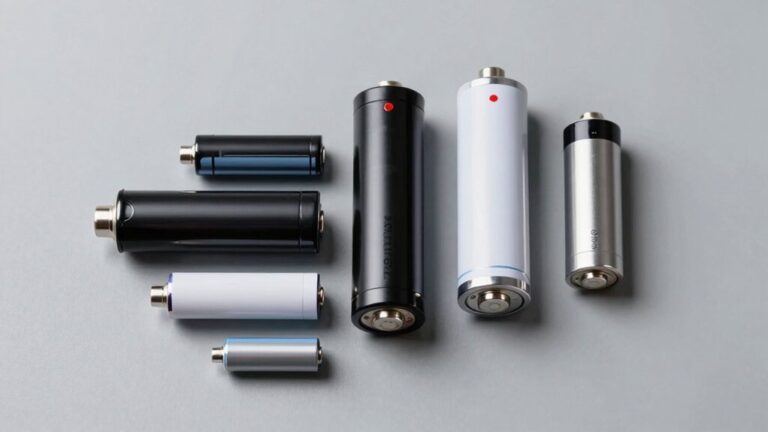
Your drone batteries struggle with short lifespans because lithium-ion cells max out at 100–270 Wh/kg—nowhere near gasoline’s 12,000 Wh/kg energy density. Multirotor physics force continuous high-power discharge at 10–30C rates, generating I²R heat that pushes temperatures from 25°C to 60°C, accelerating degradation. Real-world conditions like temperature extremes (below 5°C or above 50°C) slash capacity by 20–40%, while aggressive flight profiles reduce advertised 300–500 cycle lifespans to just 150–200 cycles. The interplay between electrochemistry, thermal dynamics, and flight mechanics reveals why current battery technology can’t yet break these limitations.
The Energy Density Ceiling of Current Battery Chemistries
Although lithium-ion cells dominate today’s drone market, their commercial energy densities—typically 100–270 Wh/kg at the cell level—remain stubbornly far from the theoretical 400–500 Wh/kg ceiling imposed by Li-ion electrochemistry. You’re facing fundamental material limitations: cathode and anode redox capacities set hard upper bounds, while inactive components—current collectors, separators, binders—add unavoidable mass overhead. Electrolyte stability windows and electrode volume changes (silicon anodes expand considerably) constrain how aggressively you can pack active material without sacrificing cycle life. Safety concerns force conservative designs; organic electrolytes’ flammability prevents you from reaching riskier, higher-energy formulations. The electrochemical redox reactions that move lithium ions between electrodes to create electrical current operate within these physical and chemical constraints, limiting performance gains. Once you account for pack-level hardware, BMS, thermal management, and depth-of-discharge reserves, your effective energy density drops further, leaving incremental gains through high-nickel cathodes or silicon-carbon anodes as the only near-term path forward. Leading manufacturers like DJI and Tattu have optimized their LiPo and LiHV battery variants to maximize performance within these constraints, with DJI’s intelligent systems incorporating real-time battery monitoring across their product line. Beyond chemistry, battery degradation from charge cycles and improper maintenance accelerates the decline in usable capacity over time, a concern that smart battery management systems help mitigate through advanced monitoring and protection. This energy density restriction directly translates to shorter flight times, especially when drones carry heavier payloads, forcing operators to schedule frequent recharging or battery swaps that reduce overall operational efficiency.
How Multirotor Physics Work Against Long Flight Times
Even if lithium-ion chemistries reached their theoretical 400–500 Wh/kg ceiling tomorrow, multirotor drones would still struggle to exceed 90 minutes of flight time. The fundamental issue lies in multi rotor efficiency: your drone’s motors must continuously generate thrust equal to total weight just to hover, consuming roughly 250W for a 5kg UAV. Unlike fixed-wing aircraft that glide, multirotors lack aerodynamic lift, forcing constant propulsion. Safety margins demand motors produce twice the aircraft’s weight in thrust, further degrading power management. Wind resistance compounds these losses, pushing motors harder while payload weight directly reduces endurance. A typical multirotor carrying a LiDAR sensor experiences significantly reduced flight duration compared to missions with lighter camera payloads. Advanced mapping solutions like Pix4D and Agisoft Metashape help optimize flight planning to maximize efficiency on each battery charge. Environmental factors such as temperature extremes can accelerate battery drain and degrade performance during flight missions. Proper storage of batteries at moderate temperatures with partial charge can help extend their overall lifespan across multiple flight missions. Premium models like the DJI Air 3S achieve superior endurance through optimized battery capacity and aerodynamic design. Satellite-based command and control systems enable beyond visual line of sight operations, allowing drones to maintain connectivity and operational effectiveness across extended missions where traditional ground networks are unavailable. Even optimized configurations—100KV motors paired with 28″ propellers—can’t overcome physics. Where fixed-wing drones achieve 90–480 minutes through gliding, multirotors remain constrained to 15–60 minutes regardless of battery advances.
Battery Degradation and the Reality of Cycle Life
Why do drone operators face battery replacement every six months despite manufacturers claiming 300–500 cycle lifespans? The answer lies in the gap between laboratory specifications and real-world battery wear. Manufacturer cycle counts assume controlled 1C discharge rates, 25°C temperatures, and 80% depth-of-discharge limits. Your aggressive flights impose 10–30C bursts, thermal spikes exceeding 50°C, and repeated 100% discharges—conditions that accelerate SEI layer growth and lithium plating. Each high-power maneuver compounds electrode degradation mechanisms that lab tests never encounter. Calendar aging further erodes capacity during storage at full charge, while cell imbalance forces premature pack retirement when the weakest cell fails. Real-world lifespan expectations collapse to 150–200 effective cycles under typical commercial use, explaining why batteries degrade far faster than datasheets suggest. DJI drones primarily use Lithium-Polymer and Lithium-Ion batteries, which are favored for their high energy density but require careful handling to maintain longevity. Models like the DJI Mini 3 showcase how battery performance remains central to drone selection, with extended flight times requiring rigorous battery management. Additionally, exceeding the drone’s power and safety specifications with incompatible batteries can further accelerate degradation and compromise performance. Using manufacturer-approved chargers and following proper charging protocols can significantly extend battery longevity compared to third-party alternatives, particularly since smart chargers with automatic cell balancing prevent uneven charging that compounds degradation. Proper storage practices, such as maintaining batteries at 40–60% state of charge, can help mitigate some of this accelerated degradation between flight operations.
High Discharge Rates and Thermal Management Challenges
When your drone executes high-power maneuvers, the LiPo cells discharge at rates reaching 10–30C—ten to thirty times their nominal capacity per hour—generating heat through I²R losses as electrons force through increased internal resistance. These high discharge rates elevate cell temperatures from 25°C to 60°C within minutes, approaching the 50°C operational threshold where degradation accelerates. Without thermal management, you risk thermal runaway—an exothermic chain reaction where heat generation exceeds dissipation capacity. Passive cooling solutions using thermal interface materials and heat-conducting chassis mounts prove more effective than active fans, which add weight and parasitic power draw. Advanced BMS implementations with embedded temperature sensors enable real-time throttling, while thermal gap fillers and phase-change materials maintain cells within the 5–50°C safety window during sustained operations. Regular inspection of battery connections for corrosion can prevent voltage delivery issues that compound thermal stress during high-discharge operations. LiPo batteries typically endure 300-400 charge cycles before significant capacity loss occurs, making cycle management essential for extending battery lifespan, while popular models like the Vivitar VTI Phoenix demonstrate that proper thermal management can achieve flight times exceeding 30 minutes. For applications requiring greater durability, LiFePO4 batteries can exceed 2000 cycles, offering substantially longer operational lifespans compared to standard LiPo chemistries. Storing batteries charged between 40% and 65% in cool, dry places and cycling them every few months can help extend battery longevity beyond standard expectations. The transition from passive to active cooling technologies represents an evolving approach as drone operations increase in complexity and thermal regulation demands become more critical.
Environmental Conditions That Drain Battery Performance
Operating a drone outside the narrow 5–50°C envelope introduces electrochemical constraints that reduce delivered capacity by 20–40% at the extremes. Cold temperatures elevate internal resistance, lowering C-rate capability and accelerating voltage sag. Thermal extremes—both freezing and heat—shift side-reaction kinetics, increasing self-discharge and irreversible capacity fade. High altitudes compound power demands; reduced air density requires elevated thrust, simultaneously decreasing convective cooling and raising cell temperature. Wind influences drain batteries through continuous stabilization corrections, with headwinds extending time-on-task and gusts triggering load transients. Humidity effects manifest as parasitic leakage currents and connector corrosion, forcing protective shutdowns. Drone operators should also be aware of local regulations and privacy restrictions that may affect flight planning and operational decisions. Before operating a drone, ensure you comply with FAA registration requirements for devices over 0.55 lbs and obtain necessary permits for controlled airspace. Using UV filters can help protect drone electronics from UV exposure during extended outdoor operations. Most modern drones rely on lithium batteries that power multiple charge cycles, though extreme environmental conditions can significantly reduce their effectiveness. Matching battery specifications like C-rating and voltage to your specific flight conditions ensures better performance under demanding environmental scenarios. Weather impacts—turbulence, moisture intrusion, and barometric shifts—combine to degrade both instantaneous discharge efficiency and long-term cycle life, shortening operational endurance beyond laboratory predictions. Direct sunlight exposure accelerates battery chemical processes, causing thermal buildup that further depletes available power during flight operations.
Economic and Technical Trade-Offs in Drone Battery Design
Although lithium-ion chemistries dominate commercial UAV applications, their theoretical energy density ceiling of 250–300 Wh/kg creates a fundamental performance bottleneck that forces designers into harsh trade-offs between endurance, payload capacity, and structural mass. You’re constrained by a zero-sum equation: increasing battery capacity proportionally escalates weight, degrading your power-to-weight ratio and mandating larger airframes. Chemical innovations targeting 400 Wh/kg by 2030 promise relief, but current material advancements like LiFePO4 sacrifice energy density for thermal stability, cutting flight time 15–20%. Solid-state architectures offer double the energy density with suppressed thermal runaway risks, while graphene-enhanced electrodes accelerate charge rates without compromising cycle life beyond 1,000 iterations. To maintain battery longevity during storage intervals, maintain 40-60% charge levels and keep batteries in cool, dry environments away from direct heat sources. Hydrogen fuel cells enable several hours of continuous operation for large-scale cargo UAVs while producing only water vapor as exhaust. Autonomous systems with artificial intelligence and sensors can optimize power consumption by dynamically adjusting flight paths and operational parameters in real time. Extended flight endurance from advanced battery chemistries directly supports precision agricultural applications like targeted pesticide application and real-time crop monitoring across large fields. Premium consumer drones like the DJI Air 3S demonstrate how advanced battery integration achieves 45+ minute flight times through optimized power management and lightweight airframe design. Proper thermal management and high-quality charging equipment prevent battery degradation and extend operational lifespan across multiple flight cycles. Structural battery integration—embedding cells within carbon-fiber frames—eliminates parasitic mass, though manufacturing complexity inflates unit costs substantially.