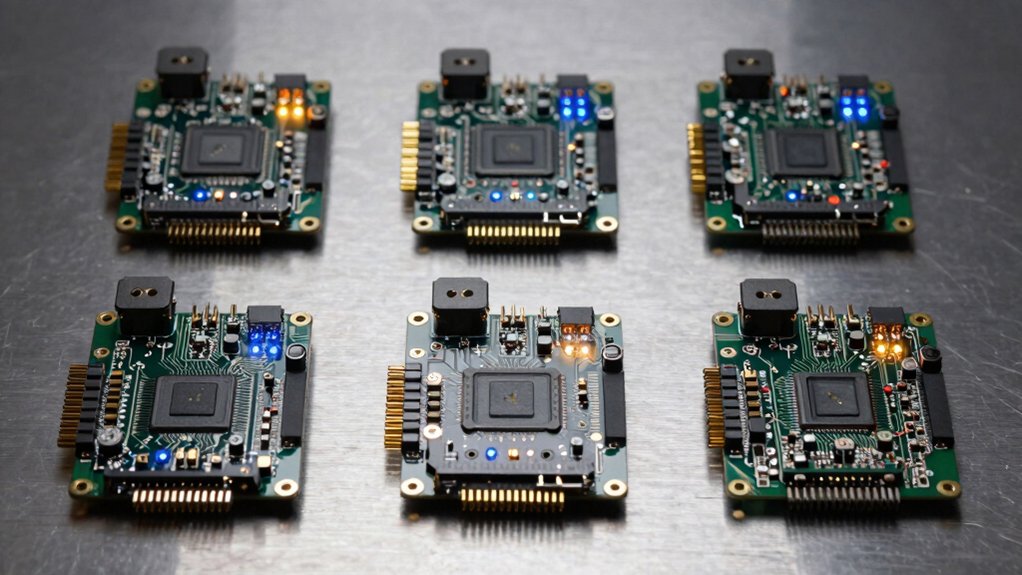
You’d think there’s a million flight controllers out there, but you’re really choosing between just a few that matter. If you’ve ever wondered why some drone pilots swear by specific models while others struggle with inconsistent performance, it comes down to one thing. The right controller can transform your entire flying experience—and we’re about to show you which ones actually deliver.
Quick Overview
- Advanced gyroscope and high-speed processors enable precise control during demanding aerial maneuvers and racing scenarios.
- 16MB black box recording captures comprehensive flight data for performance analysis and continuous handling refinement.
- Multiple UART ports and PWM outputs provide versatile connectivity for telemetry, GPS, and camera integration.
- Support for 2-6S LiPo batteries with dual BEC outputs ensures reliable power distribution and system stability.
- Modular solderless design and compact form factor reduce assembly complexity while optimizing payload capacity and responsiveness.
| HGLRC SPECTER F722 Pro Flight Controller for FPV Drone |

| Most Advanced Features | Main Processor: STM32F722 (216 MHz) | ESC Capacity: Flight controller only (no ESC) | Weight: Not specified | VIEW LATEST PRICE | Read Our Analysis |
| AERO SELFIE F405 45A Flight Controller Stack |

| Best Performance Combo | Main Processor: STM32F405 (168 MHz) | ESC Capacity: 45A continuous, 55A peak per channel | Weight: 21.5g total (9g FC, 12.5g ESC) | VIEW LATEST PRICE | Read Our Analysis |
| AERO SELFIE F405 Drone Flight Controller |

| Professional Grade | Main Processor: STM32F405 (168 MHz) | ESC Capacity: Flight controller only (no ESC) | Weight: 9g | VIEW LATEST PRICE | Read Our Analysis |
| HGLRC SPECTER F722 Lite Flight Controller ELRS 2.4G |
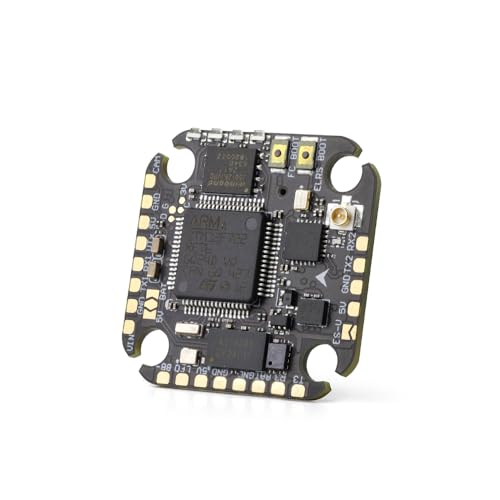
| Best for Racing | Main Processor: F722 with ELRS 2.4G receiver | ESC Capacity: Flight controller only (no ESC) | Weight: 4g ultrafeatherweight | VIEW LATEST PRICE | Read Our Analysis |
| BETAFPV Matrix 1S G4 Brushless Flight Controller |

| Best for Whoops | Main Processor: STM32G473 (55% faster processing) | ESC Capacity: 12A continuous, 18A peak | Weight: 3.6g ultralight | VIEW LATEST PRICE | Read Our Analysis |
| SoloGood F722 Flight Controller 60A ESC FPV Racing Drone |

| Best Value | Main Processor: F722 with onboard OSD | ESC Capacity: 60A 4-in-1 ESC | Weight: Not specified | VIEW LATEST PRICE | Read Our Analysis |
| SoloGood F722 FPV Flight Controller Stack 60A ESC |

| Best for Beginners | Main Processor: ICM42688P F722 | ESC Capacity: 60A 4-in-1 ESC | Weight: Not specified | VIEW LATEST PRICE | Read Our Analysis |
More Details on Our Top Picks
HGLRC SPECTER F722 Pro Flight Controller for FPV Drone
If you’re serious about FPV drone racing, the HGLRC SPECTER F722 Pro delivers the stability and responsiveness you need. Its advanced MPU6000 gyroscope guarantees precise control during demanding maneuvers, while the STM32F722 processor runs at 216 MHz for lightning-fast responsiveness. You’ll appreciate the 16MB black box that captures extensive flight data, letting you analyze performance and make informed adjustments. The dual camera outputs enable seamless switching via Betaflight settings, and the modular design eliminates soldering—you simply plug modules directly into the controller. This combination of performance and user-friendly installation makes it an excellent choice for competitive pilots.
- Main Processor:STM32F722 (216 MHz)
- ESC Capacity:Flight controller only (no ESC)
- Weight:Not specified
- BEC Output:Not specified
- Data Recording:16MB black box
- Battery Compatibility:Not specified
- Additional Feature:Dual camera signal outputs
- Additional Feature:16MB black box recording
- Additional Feature:Modular plug-in design
AERO SELFIE F405 45A Flight Controller Stack
The AERO SELFIE F405 45A Flight Controller Stack delivers the high-performance combo you’ll need when you’re building a drone that demands both reliability and power. You’re getting the STM32F405 flight controller paired with a capable 4-in-1 ESC that supports 2S-6S LiPo batteries with 45A continuous output. The Bosch BMI088 IMU guarantees exceptional stability and vibration resistance, giving you precise flight dynamics. With 6 UART ports, 10 PWM outputs, and dual BEC options, you’ve got versatile connectivity for GPS, cameras, and telemetry. At just 21.5g total, this lightweight stack won’t bog down your build while delivering the performance you’re after.
- Main Processor:STM32F405 (168 MHz)
- ESC Capacity:45A continuous, 55A peak per channel
- Weight:21.5g total (9g FC, 12.5g ESC)
- BEC Output:Dual BEC (5V 3A, 9V 3A)
- Data Recording:MicroSD slot for data logging
- Battery Compatibility:2S-6S LiPo (6V-28V input)
- Additional Feature:Bosch BMI088 IMU sensor
- Additional Feature:6 UART ports connectivity
- Additional Feature:21.5g lightweight combo
AERO SELFIE F405 Drone Flight Controller
Built around the Bosch BMI088 6-axis IMU, the AERO SELFIE F405 excels for drone pilots who demand stability and vibration resistance in compact platforms. You’ll appreciate the STM32F405 processor running at 168MHz with 1MB flash memory, which handles complex flight dynamics effortlessly. The controller features six UART ports and ten PWM outputs, giving you flexibility with peripheral integration. Its dual DC-DC BEC outputs—5V 3A and 9V 3A—power your equipment reliably. At just 36mm x 36mm x 8mm and weighing 9g, you get a lightweight solution that doesn’t compromise performance. The operating temperature range of -40°C to 80°C guarantees you’ll fly confidently in diverse environments.
- Main Processor:STM32F405 (168 MHz)
- ESC Capacity:Flight controller only (no ESC)
- Weight:9g
- BEC Output:Dual BEC (5V 3A, 9V 3A)
- Data Recording:Not specified
- Battery Compatibility:Not specified
- Additional Feature:Bosch BMI088 vibration resistance
- Additional Feature:36x36x8mm compact dimensions
- Additional Feature:-40°C to 80°C rated
HGLRC SPECTER F722 Lite Flight Controller ELRS 2.4G
HGLRC’s SPECTER F722 Lite Flight Controller stands out for FPV racers and freestyle pilots who demand ultra-responsive performance in a compact package. You’ll appreciate the F722 processor’s 40% faster response speed compared to F4 series controllers, delivering millisecond-level delay processing that’s essential for violent freestyle maneuvers. The integrated ELRS 2.4G receiver eliminates external modules, keeping your drone lightweight at just 4g. You’re getting an ICM42688 gyro with high-frequency PID refresh rates perfect for extreme racing. Its 8.4V-25.2V power supply compatibility supports everything from 3-inch whoops to 7-inch long-range drones, while 5VBAT output handles most camera systems. HGLRC backs this controller with responsive 24-hour customer support.
- Main Processor:F722 with ELRS 2.4G receiver
- ESC Capacity:Flight controller only (no ESC)
- Weight:4g ultrafeatherweight
- BEC Output:5VBAT output
- Data Recording:Not specified
- Battery Compatibility:2-6S (8.4V-25.2V)
- Additional Feature:Integrated ELRS 2.4G receiver
- Additional Feature:40% increased response speed
- Additional Feature:5VBAT image transmission support
BETAFPV Matrix 1S G4 Brushless Flight Controller
If you’re flying 1S whoops and demand both speed and precision, BETAFPV’s Matrix 1S G4 delivers with its STM32G473 MCU—55% faster processing than previous generations. You’ll appreciate the integrated 4-in-1 design with 12A continuous and 18A peak ESC capacity, weighing just 3.6g. The onboard serial ELRS receiver keeps your build streamlined, while the built-in OSD and 16MB Blackbox give you real-time flight data and recording capabilities. You’ve got flexibility too—two full serial ports let you add external receivers, GPS, or HD VTX. The independent 3.3V LDO supply for the IMU eliminates interference, ensuring rock-solid stability in demanding flight conditions.
- Main Processor:STM32G473 (55% faster processing)
- ESC Capacity:12A continuous, 18A peak
- Weight:3.6g ultralight
- BEC Output:5V 3A single BEC
- Data Recording:16MB blackbox
- Battery Compatibility:1S whoop
- Additional Feature:Built-in OSD display
- Additional Feature:Serial ELRS RX onboard
- Additional Feature:Independent IMU power supply
SoloGood F722 Flight Controller 60A ESC FPV Racing Drone
The SoloGood F722 Flight Controller 60A ESC is an excellent choice for FPV racing enthusiasts who need integrated power management and advanced flight capabilities. You’ll appreciate the compact 30.5×30.5MM stack that houses the F722 chip, onboard OSD, barometer, and black box functionality. The integrated 4-in-1 60A ESC with dual BEC (5V/10V) simplifies your build considerably. You can power your VTX directly from the 10V output and remotely disable it when needed. The controller supports up to eight motor outputs, making it versatile for various drone configurations. It features Toshiba MOS transistors, Bluejay firmware compatibility, bidirectional DSHOT, and RPM filtering for ideal performance. Four LED indicators keep you informed of system status throughout your flights.
- Main Processor:F722 with onboard OSD
- ESC Capacity:60A 4-in-1 ESC
- Weight:Not specified
- BEC Output:5V/10V dual BEC
- Data Recording:Onboard black box chip
- Battery Compatibility:2-6S
- Additional Feature:Remote VTX power control
- Additional Feature:4 LED status indicators
- Additional Feature:Supports X8 drone builds
SoloGood F722 FPV Flight Controller Stack 60A ESC
For FPV freestyle pilots who value both performance and accessibility, SoloGood’s F722 controller delivers an impressive combination of features. You’ll appreciate the dual 5V/10V BEC system that keeps your drone stable across different power demands. The integrated 60A ESC handles four motors efficiently on 2-6S batteries, while the 30x30mm form factor fits seamlessly into compact builds. You’re getting an onboard OSD chip, barometer, and black box recorder for flight analysis. The four LED indicators let you monitor system status instantly. Large solder pads make installation straightforward, even if you’re new to drone building. With support for up to eight motor outputs, you can expand to X8 configurations when you’re ready.
- Main Processor:ICM42688P F722
- ESC Capacity:60A 4-in-1 ESC
- Weight:Not specified
- BEC Output:5V/10V dual BEC
- Data Recording:Onboard black box chip
- Battery Compatibility:2-6S
- Additional Feature:ICM42688P gyro integration
- Additional Feature:Large beginner-friendly pads
- Additional Feature:Supports X8 motor outputs
Factors to Consider When Choosing a Flight Controller for a Drone
You’ll want to evaluate processing power and speed to guarantee smooth flight performance, alongside sensor quality that keeps your drone stable during operation. Memory capacity and data recording capabilities matter too, as they determine how much flight telemetry you can capture and analyze. Don’t overlook connectivity options and power supply compatibility, since these factors dictate how easily you’ll integrate your controller with other components and peripherals.
Processing Power and Speed
Every millisecond matters when you’re piloting a drone, and that’s where your flight controller’s processing power comes in. You’ll want a processor that can handle rapid sensor data processing and make split-second adjustments to your flight dynamics. The STM32F7 series, for example, delivers up to 216 MHz of computing power, giving you improved control and stability when you need it most. The processor architecture matters too—a 32-bit ARM Cortex-M7 processor handles complex flight algorithms and sensor fusion far better than slower alternatives. Sufficient processing resources are essential if you’re interested in advanced features like high-frequency PID tuning and real-time telemetry. Don’t skimp on processor speed; it’s fundamental to responsive, precise drone control.
Sensor Quality and Stability
Stable, responsive flight relies heavily on your flight controller’s sensor quality. You’ll want advanced gyroscopes and accelerometers like the MPU6000 or BMI088, which provide enhanced stability and vibration resistance for precise flight dynamics.
High-end flight controllers feature dual-precision floating point acceleration and millisecond-level delay processing, enabling faster response times and smoother control. Onboard barometers and inertial measurement units maintain stable altitude and orientation throughout your flight.
Look for sensors with high sampling rates and low latency—they’ll deliver more responsive and agile performance when you need it most. Rigorous vibration testing and damping solutions guarantee your sensor data stays accurate and reliable, keeping your drone stable in challenging conditions.
Memory and Data Recording
Data recording capabilities can make or break your ability to optimize drone performance. You’ll want a flight controller with substantial memory—like a 16MB black box—to capture extensive flight data. This lets you review acceleration, gyroscope readings, and flight events afterward, helping you understand your drone’s behavior in detail.
When you analyze recorded flight information, you can identify stability issues and make informed adjustments to improve handling. The insights gained from detailed data logging prove invaluable for troubleshooting problems and fine-tuning your flight controller settings.
If you’re serious about in-depth flight analysis, prioritize controllers offering robust on-board data storage and recording features. This capability transforms raw performance data into actionable intelligence, enabling you to continuously refine your drone’s operations and achieve better results.
Connectivity Options Available
Beyond capturing flight data, you’ll need a flight controller that connects reliably to all your drone’s components. Multiple UART ports give you flexibility to integrate telemetry modules, GPS units, and HD video transmitters simultaneously. PWM outputs let you directly control motors, servos, and other drone elements without additional adapters. Built-in receivers supporting SBUS or D-Shot protocols streamline communication between your flight controller and radio control system, eliminating compatibility headaches. Some advanced models feature integrated OSD chips, allowing you to display critical flight information directly on your video feed. When evaluating connectivity options, prioritize controllers offering diverse port configurations that match your specific hardware setup and future expansion plans.
Power Supply Compatibility
Your flight controller’s power supply compatibility is critical to ensuring reliable operation and longevity. You’ll want to match your flight controller with your drone’s battery configuration, typically ranging from 2-6S LiPo batteries. Verify that it can handle the maximum current and voltage your motors and components demand.
Look for controllers featuring dual or multiple BEC outputs so you can power accessories like cameras and telemetry modules without additional power solutions. Power efficiency matters too—a well-designed controller minimizes consumption and extends your flight time.
Pay special attention to the power supply design. Independent LDO regulators for the IMU deliver clean, stable power to sensitive components, preventing interference and ensuring accurate sensor readings. This investment in proper power management directly impacts your drone’s performance and reliability.
Weight and Size
Since every gram matters in drone design, selecting a lightweight flight controller directly impacts your payload capacity and flight duration. You’ll want to prioritize compact dimensions that enable efficient packaging and optimize your drone’s overall configuration.
Smaller flight controllers are particularly valuable for micro and nano drones, where space constraints demand careful component selection. The controller’s weight and size fundamentally influence your drone’s center of gravity and stability characteristics, affecting how responsively your aircraft handles during flight.
ESC Integration Features
Three key advantages emerge when you choose a flight controller with integrated ESC capabilities. You’ll enjoy a compact, streamlined design that simplifies your drone’s construction and reduces wiring complexity. The embedded ESC synchronizes motor control with your flight controller, enhancing responsiveness and flight performance tremendously.
You should validate that the ESC’s continuous and peak current ratings match your motors’ power requirements. This guarantees reliable operation and prevents system failures during demanding flights.
Additionally, dual BEC outputs provide separate power distribution for your flight controller and other components, substantially improving overall system stability. Built-in telemetry and diagnostics give you valuable performance data, allowing you to monitor and optimize your drone’s operation efficiently.
Firmware and Software Support
Firmware and software support can make or break your flight controller experience. You’ll want a controller that supports the features you need and receives regular updates for bug fixes and performance improvements. Popular firmware options give you access to active communities where you can troubleshoot issues and uncover user-created profiles tailored to your flying style.
Consider how easily you can flash new firmware and configure settings. Intuitive software tools let you fine-tune flight characteristics, calibrate sensors, and adjust advanced parameters without frustration. Robust developer support guarantees you’re not stuck when problems arise.
Ultimately, choosing a flight controller with sturdy firmware backing and accessible configuration tools streamlines your setup process and maximizes your drone’s potential long-term.