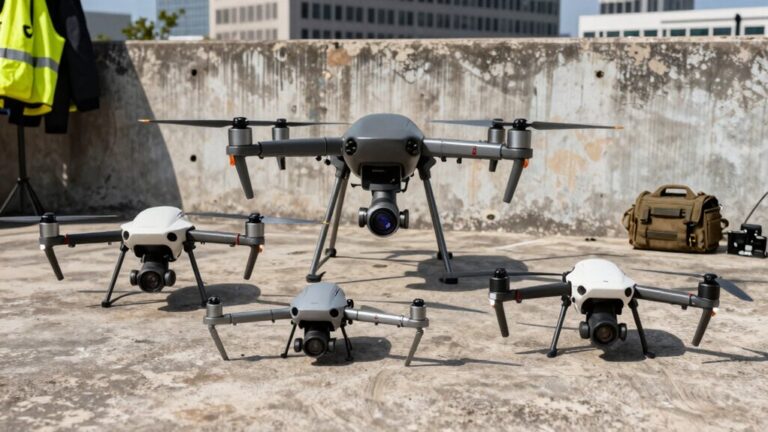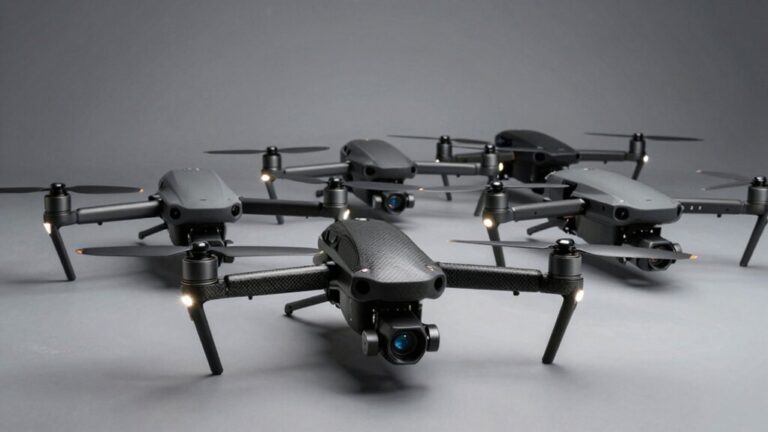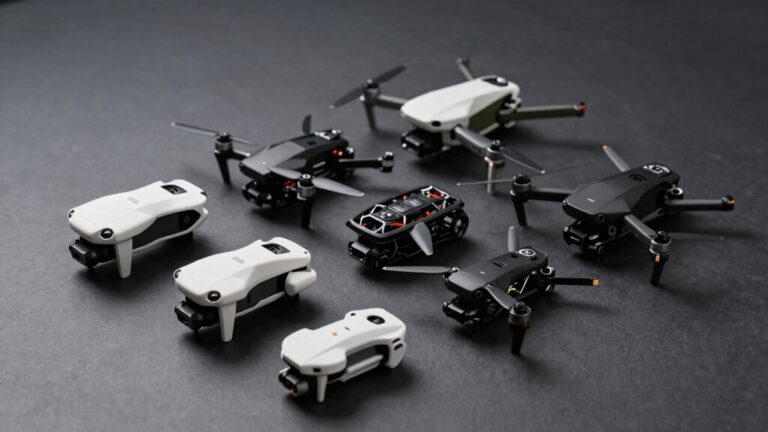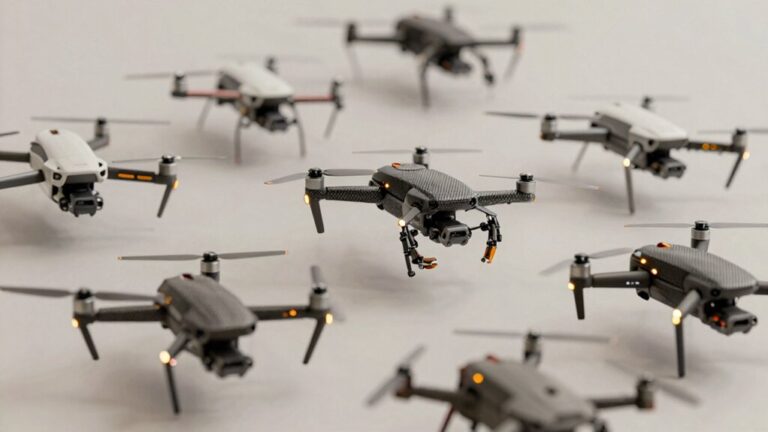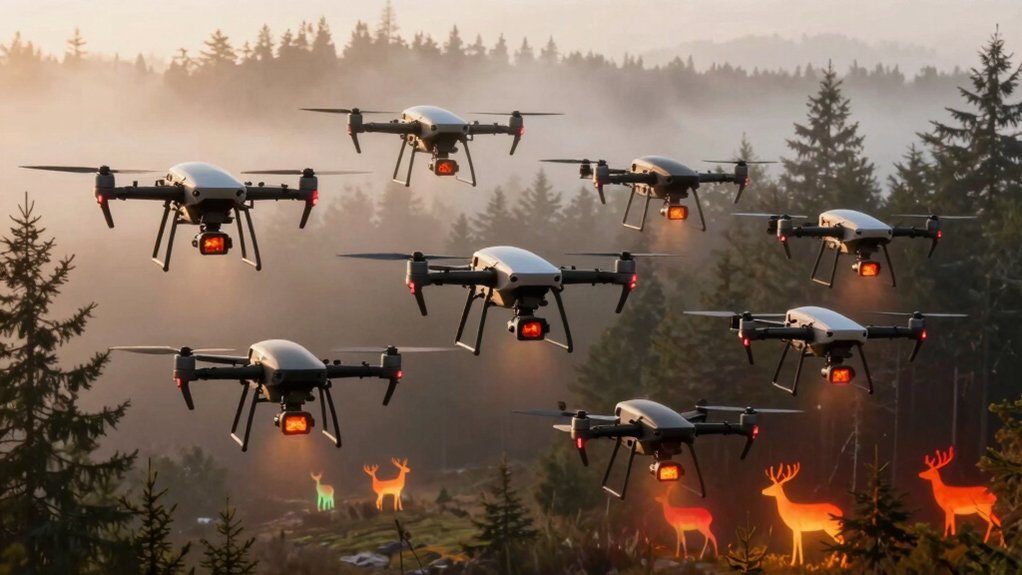
You’ve likely faced the frustration of searching for an injured deer without the right tools. Traditional methods waste precious time and energy. Thermal drones change that equation entirely, giving you the ability to locate animals quickly in dense vegetation and low-light conditions. But not all thermal drones perform equally. Here’s what sets the top performers apart.
Quick Overview
- Thermal sensor resolution of 640×512 pixels or higher enables detailed heat signature detection for locating deer in various terrain conditions.
- Flight time minimum of 25 minutes with hot-swap battery systems allows extended search operations without frequent equipment changes.
- Video transmission distance of at least 15 km ensures safe operator distance during active deer recovery missions.
- 720° obstacle avoidance systems with laser rangefinders protect equipment and improve search efficiency in challenging landscapes.
- Autel EVO MAX 4T V2 combines 640×512 thermal imaging, 42-minute flight time, and 20km transmission for professional deer recovery operations.
| Autel Robotics EVO II Dual 640T Thermal Imaging Drone |

| Professional Grade | Thermal Camera Resolution: 640×512@30fps | Maximum Flight Time: 38 minutes | Video Transmission Range: 15km | VIEW LATEST PRICE | Read Our Analysis |
| Autel Robotics EVO MAX 4T V2 Thermal Drone |
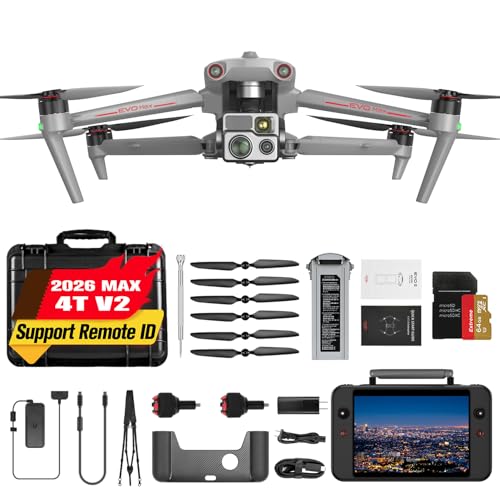
| Best Overall | Thermal Camera Resolution: 640×512 resolution | Maximum Flight Time: 42 minutes | Video Transmission Range: 20km | VIEW LATEST PRICE | Read Our Analysis |
| Autel Robotics EVO Lite 640T Enterprise Thermal Drone |

| Best For Enterprise | Thermal Camera Resolution: 640×512@30fps | Maximum Flight Time: 40 minutes | Video Transmission Range: 12km | VIEW LATEST PRICE | Read Our Analysis |
| DJI Mini 3 Lightweight Drone with 4K Camera |

| Budget-Friendly Pick | Thermal Camera Resolution: None (standard camera only) | Maximum Flight Time: 51 minutes | Video Transmission Range: 10km | VIEW LATEST PRICE | Read Our Analysis |
| Bwine F7GB2 Pro Drone with 4K Camera & GPS |

| Best Value | Thermal Camera Resolution: None (standard camera only) | Maximum Flight Time: 75 minutes (with 3 batteries) | Video Transmission Range: 3000m control range | VIEW LATEST PRICE | Read Our Analysis |
| Autel Robotics EVO MAX 4N V2 Thermal Drone |

| Advanced Professional Grade | Thermal Camera Resolution: 640×512 resolution | Maximum Flight Time: Not specified | Video Transmission Range: 20km | VIEW LATEST PRICE | Read Our Analysis |
| GPS Drone with 4K Camera & Auto Return |
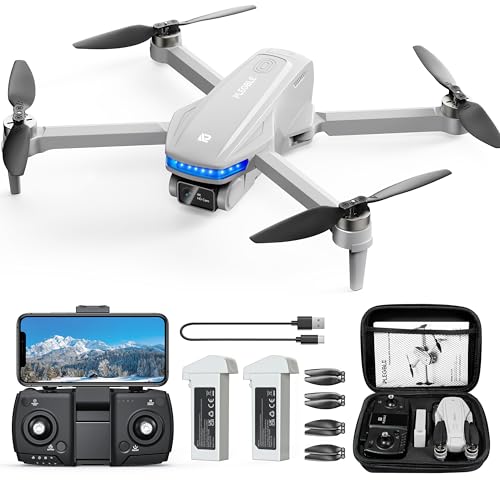
| Best For Beginners | Thermal Camera Resolution: None (standard camera only) | Maximum Flight Time: 46 minutes | Video Transmission Range: 1,968 feet | VIEW LATEST PRICE | Read Our Analysis |
More Details on Our Top Picks
Autel Robotics EVO II Dual 640T Thermal Imaging Drone
If you’re searching for wounded or lost deer across vast terrain, the Autel Robotics EVO II Dual 640T delivers the thermal detection capability you need. Its 640×512 thermal sensor identifies heat signatures from 100 meters away, while the 50MP visible camera provides context. You’ll cover more ground with 38-minute flight times and 15km video transmission range. The drone’s 10+ temperature measurement modes let you distinguish between different heat sources, vital when tracking animals through forests or fields. Advanced sensor integration with 3D mapping guarantees systematic search patterns. You’ll appreciate the no-fly zone function for safety-critical operations and the thermal analysis tool for reviewing footage later.
- Thermal Camera Resolution:640×512@30fps
- Maximum Flight Time:38 minutes
- Video Transmission Range:15km
- Maximum Takeoff Altitude:Not specified
- Visible Light Camera Resolution:50MP
- Wind Resistance Capability:Not specified
- Additional Feature:10+ Temperature Measurement Modes
- Additional Feature:3D Mapping and Path Planning
- Additional Feature:15km SkyLink 2.0 Transmission
Autel Robotics EVO MAX 4T V2 Thermal Drone
The Autel Robotics EVO MAX 4T V2 stands out as the ideal choice for serious deer recovery operations, thanks to its extensive thermal imaging capabilities paired with advanced obstacle aversion technology. You’ll appreciate the 640×512 thermal resolution combined with 48MP wide-angle and 8K zoom cameras, giving you exceptional detail for locating wounded deer across varied terrain. The 720° obstacle aversion with binocular vision and millimeter-wave radar guarantees safe flight through dense forests. You can transmit live 1080p footage up to 20km away with minimal latency, while AES-256 encryption protects your data. With a 42-minute flight time and 4000m takeoff altitude capability, you’re equipped for challenging recovery missions in demanding conditions.
- Thermal Camera Resolution:640×512 resolution
- Maximum Flight Time:42 minutes
- Video Transmission Range:20km
- Maximum Takeoff Altitude:4000m
- Visible Light Camera Resolution:48MP
- Wind Resistance Capability:27mph max wind resistance
- Additional Feature:A-Mesh 1.0 Drone Networking
- Additional Feature:720° Obstacle Avoidance System
- Additional Feature:AES-256 Data Encryption
Autel Robotics EVO Lite 640T Enterprise Thermal Drone
When you’re searching vast terrain for injured or lost deer, you’ll need a thermal drone that combines extended flight time with superior imaging clarity. The EVO Lite 640T delivers exactly that. Its 640×512 thermal resolution outperforms competitors in its class, while the 48-megapixel visible light camera captures pivotal detail. You’ll appreciate the 40-minute flight time—significantly longer than many alternatives—paired with the 12km SkyLink 2.0 transmission range. The AI target recognition streamlines your search process, automatically identifying heat signatures. At just 866 grams, this compact drone handles challenging conditions with 12m/s wind resistance, making it reliable for demanding recovery operations.
- Thermal Camera Resolution:640×512@30fps
- Maximum Flight Time:40 minutes
- Video Transmission Range:12km
- Maximum Takeoff Altitude:4000m
- Visible Light Camera Resolution:48MP
- Wind Resistance Capability:12m/s wind resistance
- Additional Feature:AI Target Recognition Technology
- Additional Feature:Customizable Autel Enterprise App
- Additional Feature:6-inch Smart Controller SE
DJI Mini 3 Lightweight Drone with 4K Camera
For wildlife recovery operations that don’t require thermal imaging, you’ll find the DJI Mini 3 offers an exceptional balance of capability and accessibility. Its sub-249g weight eliminates registration hassles, while the 4K camera with Dual Native ISO Fusion captures impressive detail in varied lighting conditions. You’ll appreciate the extended 51-minute battery life and 38 kph wind resistance for reliable field performance. The 3-axis gimbal guarantees stable footage, and GPS Return to Home provides safety during extended searches. With 10km HD video transmission and auto takeoff/landing features, you’ll operate efficiently across diverse terrain. The built-in 5.5-inch display on the DJI RC controller keeps you informed throughout missions.
- Thermal Camera Resolution:None (standard camera only)
- Maximum Flight Time:51 minutes
- Video Transmission Range:10km
- Maximum Takeoff Altitude:4000m
- Visible Light Camera Resolution:4K UHD
- Wind Resistance Capability:38 kph wind resistance
- Additional Feature:No Registration Required
- Additional Feature:Dual Native ISO Fusion
- Additional Feature:True Vertical Shooting Mode
Bwine F7GB2 Pro Drone with 4K Camera & GPS
If you’re searching for a versatile drone that balances professional imaging capabilities with extended flight time, the Bwine F7GB2 Pro won’t disappoint. You’ll appreciate the 4K camera with its 120° field of view and impressive 5x digital zoom, paired with a stabilizing 3-axis gimbal for smooth footage. The standout feature is its 75-minute total flight time across three batteries—substantially longer than competitors. You’re also getting FAA certification, 3000m control range, and autonomous modes including follow, waypoint, and orbit capabilities. With 2000m altitude capability and L6 wind resistance, you’ll handle challenging conditions confidently. The 30-day money-back guarantee lets you test it risk-free.
- Thermal Camera Resolution:None (standard camera only)
- Maximum Flight Time:75 minutes (with 3 batteries)
- Video Transmission Range:3000m control range
- Maximum Takeoff Altitude:2000m
- Visible Light Camera Resolution:4K video
- Wind Resistance Capability:L6 wind resistance
- Additional Feature:75-Minute Total Flight Time
- Additional Feature:Automatic Low Battery Return
- Additional Feature:Follow/Waypoint/Orbit Flight Modes
Autel Robotics EVO MAX 4N V2 Thermal Drone
The Autel Robotics EVO MAX 4N V2 stands out as an exceptional choice for deer recovery operations because it combines thermal imaging with advanced autonomy features that’ll help you locate injured or lost deer across varied terrain. You’ll appreciate its 640×512 thermal camera capturing temperature differentials in complete darkness, paired with a 50MP wide camera for detailed visual confirmation. The laser rangefinder provides precise distance measurements up to 1,200 meters, while 720° obstacle avoidance guarantees safe navigation through dense forests. Its 12.4-mile transmission range and A-Mesh networking enable extended search operations without losing control, and the Starlight camera excels in low-light conditions where most searches occur.
- Thermal Camera Resolution:640×512 resolution
- Maximum Flight Time:Not specified
- Video Transmission Range:20km
- Maximum Takeoff Altitude:Not specified
- Visible Light Camera Resolution:50MP
- Wind Resistance Capability:Not specified
- Additional Feature:Starlight Camera Low-Light Imaging
- Additional Feature:Hot-Swappable ABX41-D Battery
- Additional Feature:3D Path Planning Technology
GPS Drone with 4K Camera & Auto Return
You’ll find exceptional value in this GPS-enabled drone‘s intelligent safety features, particularly its automatic return-to-home function that activates when you lose signal or battery runs low. Beyond safety, you’re getting serious capability: a 4K camera with 120° wide-angle lens captures detailed aerial footage, while 5GHz FPV transmission streams video in real-time. The 46-minute flight time across two batteries keeps you operational longer. You’ll appreciate the sub-250g weight, eliminating registration hassles. Though this drone lacks thermal imaging for serious deer recovery work, its GPS waypoint and follow-me functions offer versatility for general surveying tasks.
- Thermal Camera Resolution:None (standard camera only)
- Maximum Flight Time:46 minutes
- Video Transmission Range:1,968 feet
- Maximum Takeoff Altitude:Not specified
- Visible Light Camera Resolution:4K camera
- Wind Resistance Capability:Not specified
- Additional Feature:Ultra-Lightweight Under 250g
- Additional Feature:Beginner Mode Flight Restriction
- Additional Feature:Foldable Design with Case
Factors to Consider When Choosing a Thermal Drone for Deer Recovery
When you’re selecting a thermal drone for deer recovery, you’ll need to evaluate thermal sensor resolution to detect animals clearly from distance. You should also consider flight time duration, temperature detection range, video transmission distance, and obstacle avoidance capabilities, as these factors directly impact your ability to locate and track injured or lost deer effectively in various terrain and weather conditions.
Thermal Sensor Resolution
Selecting the right thermal sensor resolution can make the difference between successfully locating a deer and missing it entirely. You’ll want to prioritize thermal sensors with 640×512 pixels or higher to capture the detailed heat signatures necessary for reliable identification and tracking from distance. Lower resolutions like 320×240 simply won’t provide enough detail for effective recovery operations.
Beyond pixel count, you should consider pixel pitch—the distance between individual pixels. This measurement directly impacts your sensor’s sensitivity and effective range, influencing how well you’ll detect distant heat sources.
For advanced operations, you might explore sensors featuring temperature measurement capabilities and multi-spectral imaging. These enhanced features greatly boost your drone’s performance during deer recovery missions, giving you critical advantages in the field.
Flight Time Duration
While thermal sensor specifications determine what you can see, flight time duration determines how long you’ll have to search for and recover injured deer. You’ll want a drone that stays airborne long enough to cover substantial ground without requiring frequent battery swaps.
Most thermal drones offer flight times between 20 to 40 minutes under ideal conditions. Wind, temperature, and payload weight reduce these estimates considerably. You’re looking for at least 25 minutes of actual flight time to conduct meaningful searches across typical recovery areas.
Consider drones with hot-swap battery systems. They’ll let you extend your operational window quickly without returning to base. Longer flight times mean fewer interruptions and more efficient searches when you’re racing against time to locate wounded deer.
Temperature Detection Range
Beyond flight duration, the thermal sensor’s temperature detection range determines whether you’ll spot a deer in varying environmental conditions. You’ll want a drone that captures temperatures from approximately -4°F to 1,022°F, guaranteeing you flexibility across seasons and landscapes.
A wider detection range matters because deer body heat varies depending on environmental factors. In frigid winter conditions, you’ll need sensitivity to lower temperatures. During warmer months or in direct sunlight, a higher range prevents sensor saturation that could obscure your target.
Consider your specific hunting region’s climate when selecting your thermal drone. If you primarily hunt in extreme cold, prioritize lower-temperature sensitivity. For diverse terrain and seasonal variations, choose a drone with the broadest range available. This safeguards reliable deer detection regardless of conditions.
Video Transmission Distance
Video transmission distance directly impacts your ability to monitor and control the drone during deer recovery operations. You’ll want a thermal drone with at least 15 km transmission range to maintain visual contact from a safe distance. Look for systems using multiple frequency bands and advanced encoding, which deliver stable, low-latency video feeds over extended ranges. Anti-jamming capabilities protect against interference in challenging environments, while encryption secures your footage and maintains drone control. However, remember that line-of-sight restrictions and terrain greatly limit effective range. Plan your flight paths carefully and position antennas strategically to overcome these obstacles. Prioritizing robust video transmission guarantees you can effectively locate and recover deer in various conditions.
Obstacle Avoidance System
Because you’re traversing dense forests and complex terrain during deer recovery operations, you’ll need a thermal drone equipped with advanced obstacle circumvention technology. Look for systems offering 360-degree coverage that detect both small and large obstacles like trees and power lines. Binocular vision, millimeter-wave radar, and infrared cameras work together to guarantee safe navigation through difficult environments. Autonomous flight modes that integrate obstacle data with GPS and inertial sensors enable your drone to plan collision-free paths automatically. Additionally, robust anti-interference and anti-jamming capabilities maintain reliable connectivity and obstacle detection in electromagnetically active areas. Finally, choose a drone with obstacle avoidance features designed to handle windy conditions while maintaining stable positioning for accurate thermal identification of downed deer.
Operating Temperature Limits
Operating temperature limits can make or break your thermal drone’s effectiveness in deer recovery operations. You’ll need to verify that your drone’s thermal camera can detect heat signatures within the temperature ranges you’ll encounter during missions.
Different components—motors, electronics, and batteries—each have specific temperature thresholds that affect performance and lifespan. Cold temperatures reduce battery capacity and slow motor response, while extreme heat degrades electronic components and thermal sensor accuracy.
Before selecting a thermal drone, compare its operating specifications against your local environmental conditions. If you’re operating in harsh winter or summer climates, choose equipment rated for those extremes. Mismatched temperature ratings will compromise your ability to locate wounded deer efficiently.
Zoom and Magnification
While temperature specifications guarantee your thermal drone can function reliably in the field, what you’ll actually see through the camera matters just as much. You’ll need at least 10x optical zoom and 16x or greater digital zoom for effective long-range deer detection and identification. Higher resolution thermal cameras, such as 640×512, deliver more detailed imagery that distinguishes deer from dense vegetation and low-light environments better than lower resolutions. Digital zoom capability is particularly essential—you must maintain image quality when magnifying targets to accurately locate and assess downed deer conditions. Advanced image processing algorithms that enhance thermal contrast and edge detection further improve your drone’s tracking ability through challenging terrain. These magnification features collectively transform your thermal drone into a reliable recovery tool.
Portability and Weight
How will you transport your thermal drone to remote deer recovery locations? Portability matters greatly. You’ll want a thermal drone weighing under 249 grams, which eliminates FAA registration requirements and streamlines operations. A compact, foldable design lets you pack your equipment into a backpack or small vehicle, enabling access to hard-to-reach areas where injured deer hide. Consider drones with efficient brushless motors that deliver stable, high-performance flights despite challenging terrain and weather conditions. Battery life and flight time directly impact your success—longer runtimes allow you to cover more ground during critical recovery operations. Ultimately, choosing a lightweight, portable thermal drone with excellent battery performance guarantees you’ll reach distant locations quickly and conduct thorough searches efficiently.